navigation

Industrial manufacturers and distributors ask more of eCommerce than a standard product catalog and checkout. The best platforms for industrial B2B eCommerce need to handle negotiated pricing, complicated customer accounts, technical product data, procurement workflows, and the sales channels customers already use.
This guide compares five B2B eCommerce platforms against those requirements, including ERP integration, assisted sales, dealer commerce, and aftermarket service.
What to Look for in an Industrial B2B eCommerce Platform
The right eCommerce platform should fit the way customers buy and the way your sales and service teams work. For industrial manufacturing, these are the key features to check first.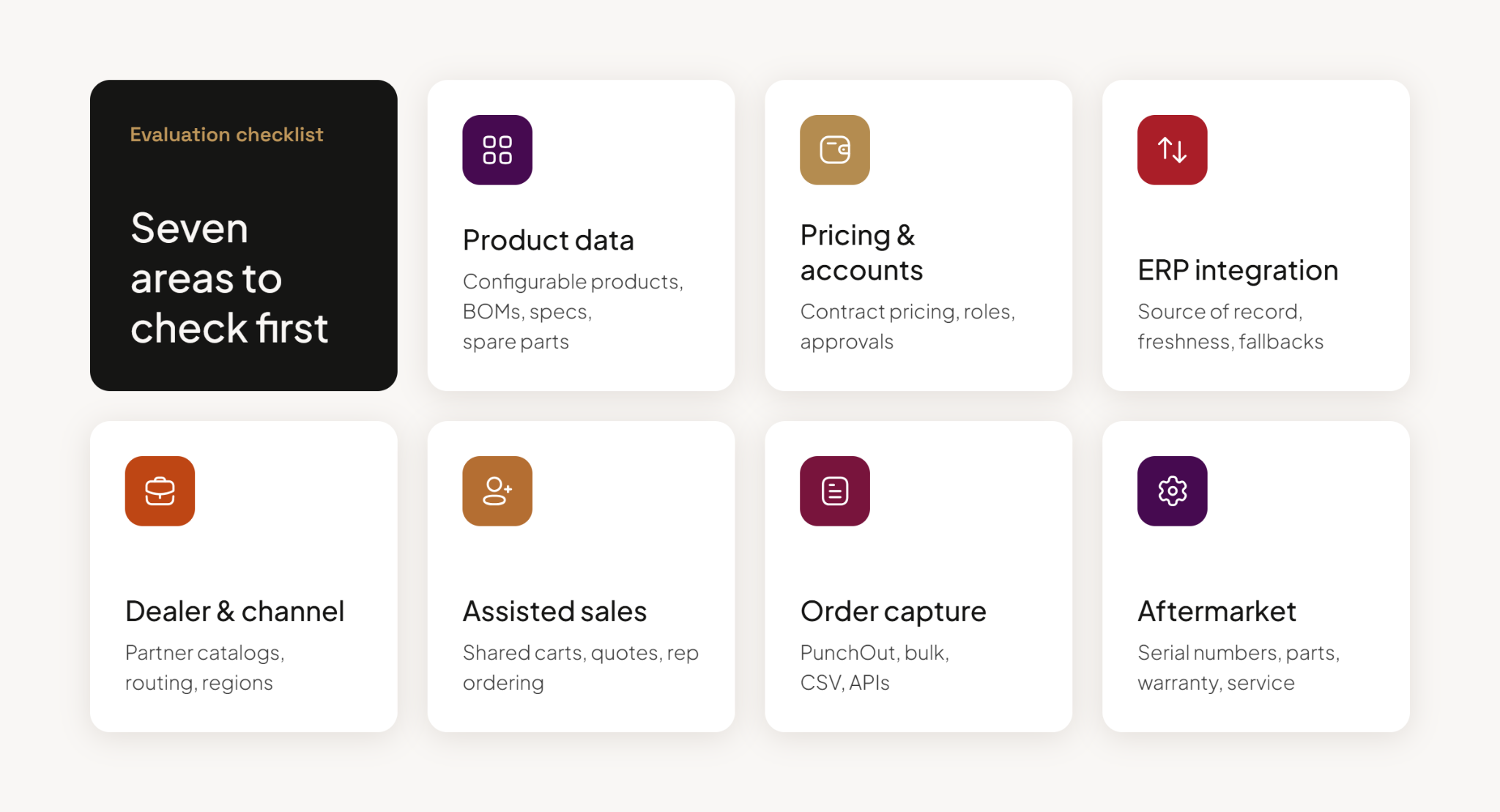
Product Data and Configuration
Industrial catalogs often contain relationships between equipment, assemblies, components, spare parts, and replacements. Your eCommerce platform needs to make that product data useful to both buyers and business users.
Look for these essential features:
- Support for configurable products, kits, bundles, and bills of materials.
- Detailed technical specifications, documentation, drawings, and certifications.
- Replacement, superseded, and compatible parts.
- Multiple units of measure and product-specific ordering rules.
Pricing, Accounts, and Approvals
B2B eCommerce needs to reflect the commercial terms already agreed with each customer rather than show everyone the same price and catalog.
Look for:
- Customer specific pricing, contract pricing, and negotiated pricing.
- Customer specific catalogs and account based pricing.
- Business accounts with multiple buyers, multiple users, and role based account access.
- Purchase approvals, credit terms, order limits, and self service account management.
ERP and Business-System Integration
An ERP integration checkbox tells you very little. Pricing, inventory, credit, customer data, orders, and invoices may live across several ERP systems, CRM systems, or other existing business systems.
For each important data point, ask:
- Which system is the source of record?
- Is the data copied into commerce or requested when it is needed?
- How current does it need to be?
- What happens if the source system is unavailable?
The platform should also provide the integration capabilities needed for accurate pricing, inventory visibility, order management, and customer account data across your existing systems.
Dealer and Channel Commerce
Manufacturing companies may sell directly in one market and through dealers, distributors, or other partners in another. The platform has to reflect who owns the customer relationship and who controls the transaction.
Look for:
- Dealer- or distributor-specific customer accounts, catalogs, and pricing.
- Rules for routing leads, quotes, or orders to the right partner.
- Different inventory, markup, and visibility rules by organization.
- Support for multiple sales channels, regions, and partner business models.
Assisted Sales
Customer self service doesn’t remove the sales team from industrial buying. Buyers may start online and involve sales reps when they need advice, a quote, a pricing change, or help completing an order.
Look for:
- Shared visibility into customer accounts, carts, quotes, contracts, and order history.
- Sales representatives placing or editing orders on behalf of customers.
- Quotes moving between buyer and seller as part of the same sales process.
- Customer activity and account context available to sales reps when they step in.
Procurement and Order Capture
Wholesale customers may order through a customer portal, procurement systems, uploaded files, APIs, or direct contact with a sales representative. A B2B eCommerce platform should support these existing buying habits instead of forcing every order through the online store.
Look for:
- PunchOut and connections to procurement systems.
- Bulk ordering, quick order, CSV upload, and repeat ordering.
- Purchase-order and approval workflows.
- APIs or other digital channels for order capture.
- Self service tools for checking orders, invoices, and account information.
Aftermarket and Service Commerce
For equipment and other long-life products, the ordering process continues after the initial sale. Customers may return later for spare parts, replacement components, maintenance, or service.
Look for:
- Installed equipment or serial-number identification.
- Compatible spare parts and replacement products.
- Warranty and service information in the customer portal.
- Access for service teams to relevant account, product, and order data.
Best eCommerce Platforms for Industrial Companies at a Glance
| Platform | Best Suited To | Platform Approach | B2B Functionality | G2 Rating | Pricing Approach |
| OroCommerce | Manufacturers and distributors with complicated customer accounts, negotiated sales processes, or multiple brands and channel models | B2B-native modular platform | Broad native B2B functionality, including custom pricing, account hierarchies, RFQ, workflows, and multi-organization management in a single platform | 4.3/5 (37) | Quote-based; pricing considers GMV band, admin users, and deployment |
| Sana Commerce Cloud | Manufacturers and distributors using SAP or Microsoft Dynamics that want commerce closely connected to ERP data | ERP-first SaaS | ERP-driven pricing, inventory management, customer accounts, ordering, and self service portals | 4.4/5 (124) | Tiered plans; quote-based |
| BigCommerce B2B Edition | Mid-market and enterprise companies looking for SaaS with packaged B2B capabilities | Open SaaS | Company accounts, customer groups, custom pricing, approvals, quoting, and buyer self-service | 4.2/5 (579) | Enterprise and B2B plans priced by quote |
| Intershop | Large manufacturers and wholesalers building customer portals, spare-parts commerce, or aftermarket services | Modular enterprise commerce | B2B portals, account management, product and service commerce, and real time inventory visibility through connected systems | 4.4/5 (43) | Quote-based |
| commercetools | Engineering-led enterprises that want to build a tailored commerce architecture | API-first composable commerce | Flexible B2B APIs for custom buying journeys, product structures, pricing, and extensive customization | 4.6/5 (16) | Order-based; quote-based |
5 Best Industrial B2B eCommerce Platforms
The platforms below can all support core B2B requirements such as account-based pricing, quotes, buyer permissions, and ERP integration. The bigger differences are where that logic lives, how much comes with the platform, and which industrial sales models each vendor has built around.
OroCommerce
OroCommerce was built specifically for B2B and has a strong manufacturing and distribution customer base. Its clearest strength is managing complicated commercial relationships and sales processes inside the commerce platform, including situations where buyers, sales reps, dealers, and different business units all participate in the transaction.
Best fit
Manufacturers and distributors that need to support complicated customer accounts, negotiated pricing, sales-assisted buying, or multiple business units and channels.
Key capabilities for industrial commerce
- Workflow-heavy B2B sales. Quotes, pricing overrides, internal approvals, buyer approvals, and other sales processes can be configured as workflows rather than treated as separate custom applications.
- Multi-organization commerce. A company can run different brands, regions, websites, catalogs, and partner models from the same platform while controlling what each organization can see and do.
- Sales-assisted commerce. Sales reps can work with the same customer accounts, carts, RFQs, quotes, and order history buyers use online. Oro also extends order capture beyond the storefront with AI SmartOrder for purchase orders arriving through channels such as email.
Pricing
OroCommerce uses quote-based pricing based on factors such as GMV, internal users, and deployment. Core B2B functionality, CRM, multiple websites, and AI capabilities are included under the same commercial model rather than priced as separate storefront products.
Sana Commerce Cloud
Sana Commerce Cloud takes an ERP-first approach. It is designed around SAP and Microsoft Dynamics, making it especially relevant when pricing, inventory, customer data, and order logic already live in the ERP and the goal is to bring that information directly into eCommerce.
Best fit
Manufacturers and distributors that want eCommerce closely connected to SAP or Microsoft Dynamics and prefer to keep core business rules in the ERP.
Key capabilities for industrial commerce
- ERP-first commerce. Contract prices, stock, customer terms, and order data come directly from supported ERP systems. This reduces the need to duplicate commercial rules across ecommerce and ERP.
- Equipment and parts selling. Sana supports ERP-based bills of materials, product substitutions, technical catalogs, and spare-parts scenarios, making it particularly relevant to machinery and equipment manufacturers.
- ERP-backed self-service. Buyers can see live stock, previous orders, invoices, shipment information, account balances, and other records already held in the ERP.
Pricing
Sana offers Essential, Pro, and Advanced plans, with pricing provided by quote. The level of ERP support, sales-agent functionality, PunchOut, and other B2B features varies by plan, so buyers need to check which capabilities are included.
Learn more about Sana Commerce alternatives and how they compare on cost and flexibility.
BigCommerce B2B Edition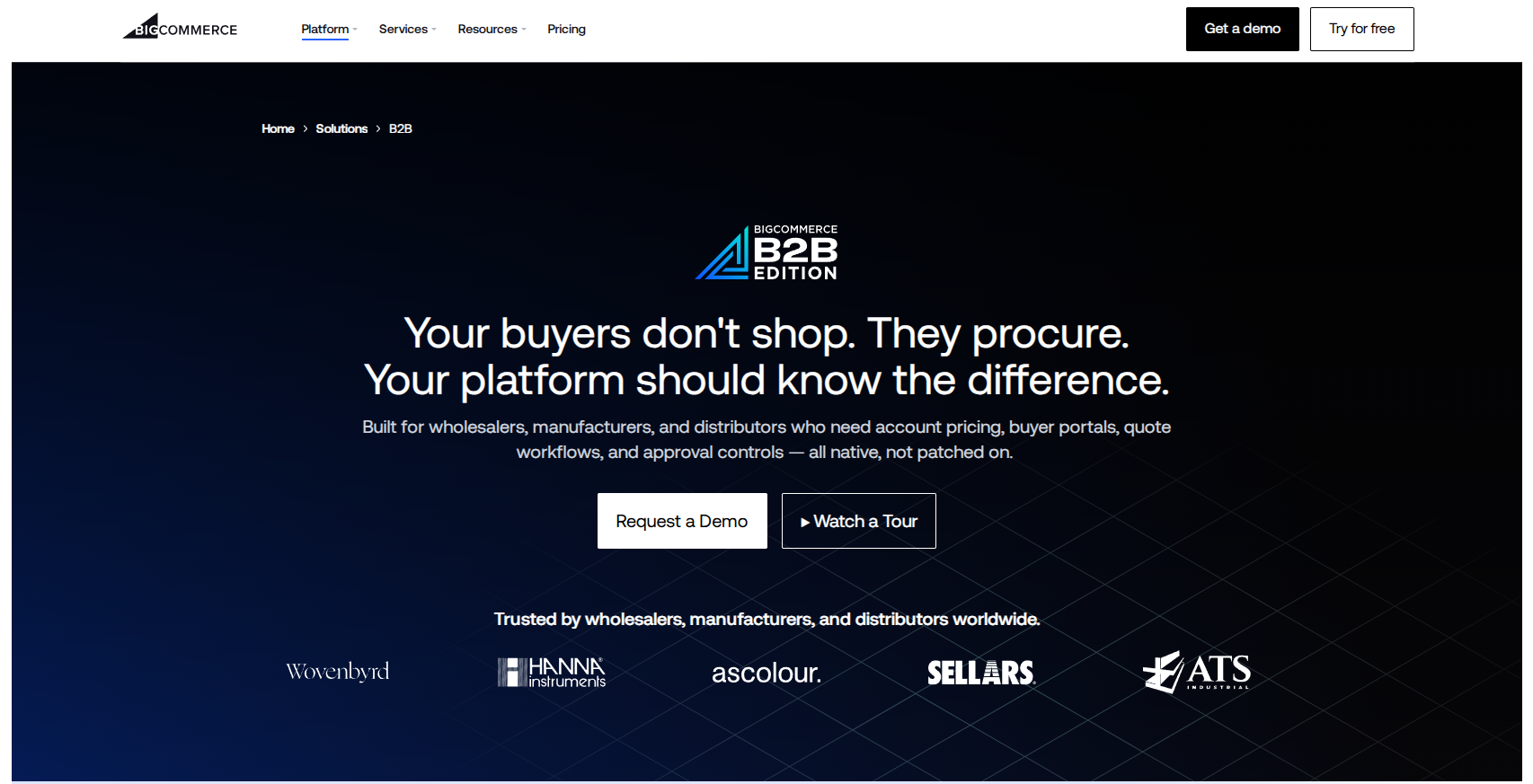
BigCommerce B2B Edition brings B2B account management and purchasing workflows to a SaaS commerce platform. It is a good option for companies that want packaged B2B capabilities while keeping access to BigCommerce’s broader app ecosystem, storefront options, and marketing tools.
Best fit
Mid-market and enterprise manufacturers or distributors that want a SaaS platform with strong account, quoting, and self-service functionality.
Key capabilities for industrial commerce
- Packaged B2B buyer experience. B2B Edition brings company hierarchies, buyer roles, approvals, quotes, invoices, net terms, and account management into its Buyer Portal.
- Structured buying organizations. Companies can model several layers of business accounts and give different buyers their own roles, permissions, pricing, and purchasing responsibilities.
- Sales-rep ordering. Sales teams can access customer accounts, prepare carts, and place orders for buyers, making it useful where digital ordering and sales-assisted purchasing need to coexist.
Pricing
Enterprise and B2B pricing is provided by quote. Buyers should confirm which B2B Edition capabilities and add-ons are included in the proposed package rather than comparing the standard BigCommerce subscription price alone.
Further reading on BigCommerce B2B Edition:
- 5 Best BigCommerce Alternatives For Enterprise B2B In 2026
- BigCommerce vs Salesforce Commerce Cloud
- BigCommerce vs Shopify Plus: Which Platform Serves B2B Businesses Better?
Intershop
Intershop has a long-standing focus on enterprise B2B and is particularly relevant for industrial manufacturers that want ecommerce to extend into customer portals, spare-parts sales, and aftermarket service. It also works well for larger organizations operating across several brands, markets, or business units.
Best fit
Large manufacturers and wholesalers that need customer portals, aftermarket commerce, or a shared platform across multiple organizations.
Key capabilities for industrial commerce
- Installed-base and aftermarket commerce. Customer portals can connect registered equipment with compatible spare parts, maintenance information, service contracts, and service requests.
- Customer and service portals. Intershop treats the portal as more than an ordering interface, bringing product information, transactions, service data, and customer information together for buyers and service teams.
- Advanced order operations. Its Professional tier adds multichannel order capture, enterprise inventory visibility, fulfillment routing, returns, and other order-management capabilities. That gives Intershop a broader operational footprint than platforms focused primarily on storefront commerce.
Pricing
Intershop offers Essential, Advanced, and Professional subscription levels with pricing by quote. More advanced B2B and order-management capabilities sit in the higher tiers.
commercetools
commercetools takes the most composable approach of the five. Instead of prescribing how the full commerce experience should work, it provides APIs and B2B services that companies can combine with their ERP, PIM, CRM, and other systems.
Best fit
Larger manufacturers and distributors with strong technical teams that want extensive customization and control over their commerce architecture.
Key capabilities for industrial commerce
- Technical product modeling. commercetools explicitly supports bills of materials, large numbers of product permutations, configurable products, and spare-parts catalogs.
- Dealer and partner experiences. Manufacturers can build different assortments, buying flows, and portals for dealers or distributors while connecting them to the same underlying commerce services.
- Architectural freedom. ERP, PIM, CRM, OMS, and commerce services can be combined around the manufacturer’s existing architecture rather than following one prescribed application structure. That makes commercetools attractive when extensive customization is a requirement, but it also puts more responsibility on the implementation team.
Pricing
commercetools uses custom, order-based pricing rather than pricing tied directly to GMV. Some advanced B2B capabilities are offered separately, so the full commercial scope depends on which services a company needs.
Other leading platforms may also make sense depending on the wider technology stack and your eCommerce strategy. Adobe Commerce is often considered by companies that want broad commerce flexibility and already have the technical resources to support it, while SAP Commerce Cloud is more likely to enter the conversation when SAP already plays a central role in business operations.
Download a side-by-side comparison table featuring in-depth analysis of the top solutions across all critical capabilities.
How to Evaluate Industrial eCommerce Platforms Before You Buy
Once you know a platform can support your core requirements, the harder comparison begins. Two vendors may both say they support contract pricing, ERP integration, or dealer commerce, but the cost and effort behind that answer can be very different.
Check What Comes With the Platform
A vendor saying a requirement is “supported” doesn’t tell you how much work sits behind it. Ask them to classify your important requirements as native, configurable, third-party, or custom.
Then look at the pattern. If several must-have requirements depend on custom development or separate products, that will affect implementation cost, upgrades, and who you depend on after launch. This is also where an RFP template helps: use the same response categories for every vendor so you’re comparing the same thing.
Calculate the Cost of the Platform You Will Actually Run
License price is only one part of total cost of ownership. Start with the architecture you expect to operate three or five years after launch.
Ask what happens to your costs when you:
- Add another website, region, or need to manage multiple brands.
- Increase order volume, GMV, users, or API traffic.
- Add a payment gateway or another commercial service.
- Connect another ERP, PIM, procurement platform, or supply chain solution.
- Build custom functionality and carry it through future upgrades.
Also look at how vendors are trying to reduce implementation and maintenance effort over time. For example, OroCommerce’s OroMomentum program results show up to half the implementation time, up to half the time to add a custom feature, and upgrades up to twice as fast as a manual process.
The broader point is to ask every vendor what they are doing to reduce the ongoing cost of changing their platform, not only what it costs to buy today.
Understand What Customization Means Five Years Later
Ask the vendor or implementation partner to walk you through a recent major upgrade for a customized customer. Find out:
- Which customizations carried forward with little or no change?
- Which had to be rewritten or retested?
- Was the custom code built through supported extension points, APIs, and events, or by changing core platform code?
- Who handled the upgrade work, and how much of it required the original implementation partner?
A healthier extension model keeps custom business logic separate from the core product and gives teams supported ways to extend it. Be more cautious when routine upgrades require significant rewrites, depend heavily on one partner, or force you to retest large parts of the application each time.
Look at the Implementation Ecosystem
A strong platform can still be a poor choice if finding people who know how to implement it is difficult.
Look at the partner ecosystem in the context of your own stack. If you run Microsoft Dynamics, SAP, a specialist PIM, procurement software, or several ERP systems, find out whether implementation partners have worked with those systems before.
The same applies geographically. A manufacturer rolling out across several countries may need local tax, payments, fulfillment, and ERP knowledge that a general ecommerce agency does not have.
And ask who owns the relationship after launch. You should know whether you can change implementation partners, bring more work in-house, or use another specialist later.
Make Sure the Commercial Model Can Follow the Business
Your eCommerce strategy may look different in three years.
You might acquire another company, launch a dealer portal, add a direct sales channel, introduce another brand, or move a new region online. Before choosing a platform, understand whether those changes fit the existing license and architecture or trigger another implementation project.
This is particularly important for industrial companies where business operations rarely fit into one storefront serving one type of buyer.
Look at Where the Vendor Is Investing
Today’s feature comparison tells you what the software can do now. The roadmap tells you which customers the vendor expects to serve tomorrow.
For industrial B2B, look at whether investment is going into account management, quoting, procurement, order automation, technical product data, sales assistance, aftermarket service, and the integrations that connect those workflows.
AI is another useful test. Ask what the vendor’s AI work is designed to improve. Automating purchase-order entry or helping sales teams work with account data addresses a different B2B problem from generating product descriptions for an online store.
Tie the Decision Back to Measurable Business Outcomes
A platform project should have a clearer target than “improve customer satisfaction” or “increase operational efficiency.” Decide what those outcomes mean for your business before you compare vendors.
For example, you might measure fewer manually entered orders, faster quote turnaround, higher customer self-service adoption, fewer order errors, or reduced cost per order. Commercial metrics such as digital revenue and average order value can matter too, but they should be tied to the buying journeys the platform is expected to change.
Those measures give you a better basis for choosing between platforms and, later, for judging whether the implementation delivered what the business expected.
Why OroCommerce Is the Best Choice for Complex Industrial B2B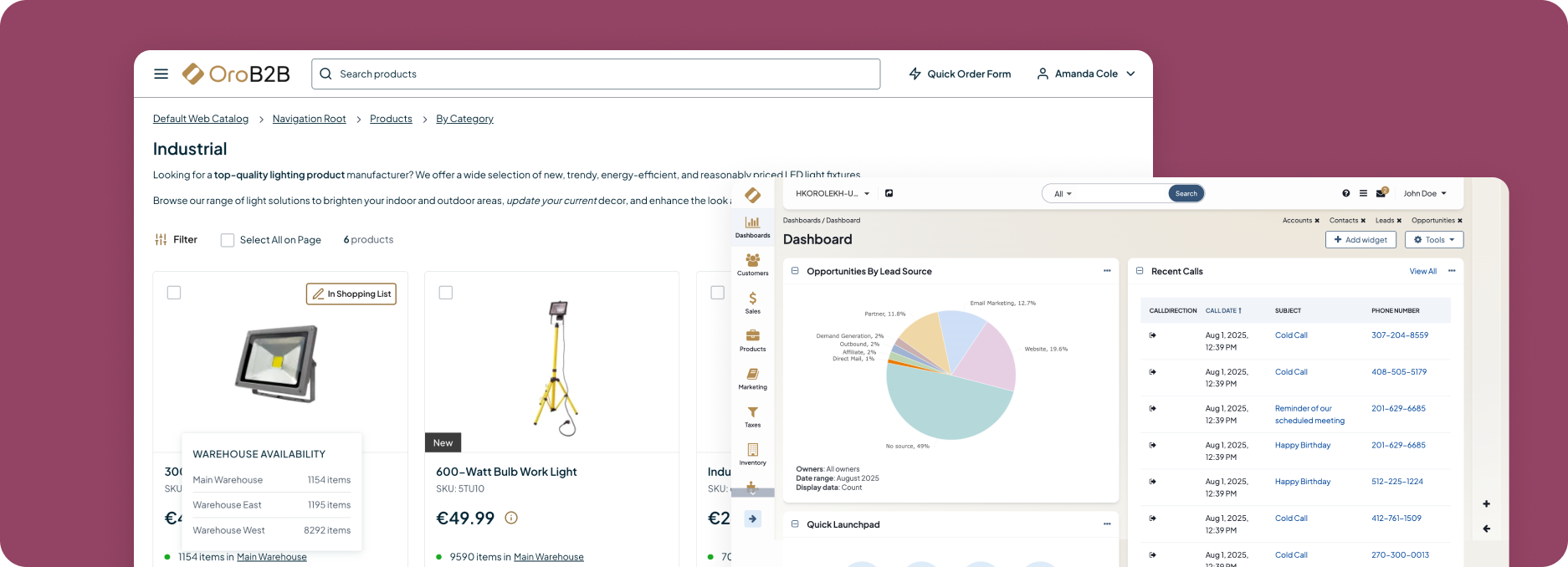
Industrial commerce gets harder when one platform has to support different countries, ERPs, pricing models, sales channels, and order types at the same time. OroCommerce has strong customer proof in exactly those situations.
- ICL runs more than 20 country portals connected to four ERPs, giving different markets room to operate while keeping commerce on a common platform.
- Azelis supports 150 customer portals across more than 200 markets and 65,000 customers, with product availability and commercial rules changing by market.
- DiversiTech operates across 12 ERP environments and three sites as it grows through acquisitions. It has also added AI-assisted order intake to help its customer service team process more orders.
- EECO manages 1.5 million SKUs from 3,000 vendors, with account- and territory-specific catalog rules and procurement integrations.
- HKL Baumaschinen handles both equipment rental and product sales across 200 locations.
That breadth is a strong reason to include OroCommerce on an industrial B2B shortlist. It has been used for global rollouts, acquisition-heavy distribution, large catalogs, equipment rental, procurement, and high-volume order automation, rather than one narrow industrial sales model.
Want to see how OroCommerce would fit your sales model, systems, and customer structure?
Conclusion About Best Platforms for Industrial B2B eCommerce
The best industrial B2B eCommerce platform is the one that matches how your business already sells and how much of that model you want the commerce platform to own.
If most commercial logic already sits in SAP or Microsoft Dynamics, an ERP-first option like Sana may be the better fit. If you want a SaaS platform with packaged B2B functionality, BigCommerce is easier to evaluate on those terms.
Intershop becomes more interesting when aftermarket and service are central. commercetools makes more sense when your team wants more control over the architecture. OroCommerce is strongest when the harder part is the B2B sales model itself and the platform needs to handle more of that logic natively.
Before you decide, take your hardest buying journey and map it across each platform. Then compare what is native, what has to be added, and what that means for implementation and ownership over time.
That will tell you more than any feature matrix.
If you’re ready to compare vendors, use our free B2B eCommerce RFP template to structure the evaluation and score vendor responses.
FAQ
What platforms are best for B2B e-commerce?
OroCommerce, Sana Commerce Cloud, BigCommerce B2B Edition, Intershop, and commercetools are strong options. The best fit depends on your sales model, ERP setup, and B2B requirements.
Which B2B platform is best?
For industrial B2B, OroCommerce is the strongest choice for companies with complex accounts, negotiated, personalized pricing, sales-assisted buying, and multiple sales channels. It was built specifically for B2B rather than adapted from a B2C platform.
What are the top 5 e-commerce platforms?
For industrial B2B: OroCommerce, Sana Commerce Cloud, BigCommerce B2B Edition, Intershop, and commercetools.
What are the 4 types of B2B?
The four common types are producers, resellers, governments, and institutions. Digital commerce can support each by enabling businesses to streamline operations and manage purchasing online.