
navigation

The five platforms in this guide can all support B2B eCommerce. They differ much more in how they support it.
Some come with account structures, quoting, approvals, and customer specific catalogs already built in. Others give you the architecture to create those experiences yourself. That difference affects implementation, ongoing development, and how much of your B2B process can live in the commerce platform instead of being pushed back into your ERP and CRM systems.
This guide compares OroCommerce, Kibo, commercetools, Shopify Plus, and Adobe Commerce with that in mind, focusing on where each platform fits and what suppliers may have to add around it.
Selection Criteria for a B2B eCommerce Platform for Suppliers
Rather than compare long feature lists, we looked at the decisions that tend to separate one platform from another for suppliers.
- How much B2B functionality is already in the platform? We looked at company customer accounts, negotiated pricing, customer specific catalogs, quotes, approvals, and other purchasing workflows that can otherwise require extensions or custom development.
- How does it fit around your business systems? For many manufacturing companies, the ERP still controls pricing, inventory, and orders. We looked at how each platform connects with ERP, PIM, and CRM systems, and how much integration work that approach is likely to require.
- How far can buyers get on their own? There is a big difference between a storefront that accepts orders and self service portals where customers can manage repeat purchases, quotes, order history, and account activity.
- How much do you need to build and maintain? A packaged B2B platform and a composable platform can both produce a strong buyer experience, but they ask very different things of your internal team and implementation partner. That has a direct effect on time to launch, ongoing development, and potential cost savings.
These same questions are useful if SAP Commerce Cloud or another modern eCommerce platform is on your broader shortlist.
Best B2B Ecommerce Platforms for Suppliers at a Glance
Here’s how the five leading platforms for suppliers stack up before we go deeper on each one.
| Platform | G2 Rating | Best For | Top Supplier Feature | Starting Price |
|---|---|---|---|---|
| OroCommerce | 4.3/5 | Manufacturers and suppliers with involved B2B sales processes, multiple organizations, or dealer/distributor channels | Configurable B2B workflows for RFQs, approvals, account structures, and different selling models | Custom pricing, all-in-one |
| Kibo | 4.1/5 | Suppliers that need B2B commerce closely connected with order management | Integrated order management alongside account-specific pricing and B2B commerce capabilities | Custom pricing |
| commercetools | 4.5/5 | Engineering-led suppliers with massive SKU counts | API-first B2B capabilities including Business Units and configurable approval workflows | Custom pricing |
| Shopify Plus | 4.4/5 | Suppliers with relatively straightforward B2B requirements or combined B2B and DTC sales | Company-specific catalogs, volume pricing, and quantity rules in the Shopify ecosystem | From ~$2,300/month |
| Adobe Commerce | 4.0/5 | Content-heavy supplier portals with dev resources | Shared catalogs, negotiable quotes, company accounts, and PO approval workflows | Custom pricing |
5 Best B2B eCommerce Platforms for Suppliers in 2026
Each of these five platforms takes a different approach to supplier commerce, from purpose-built B2B architecture to composable, developer-first stacks.
OroCommerce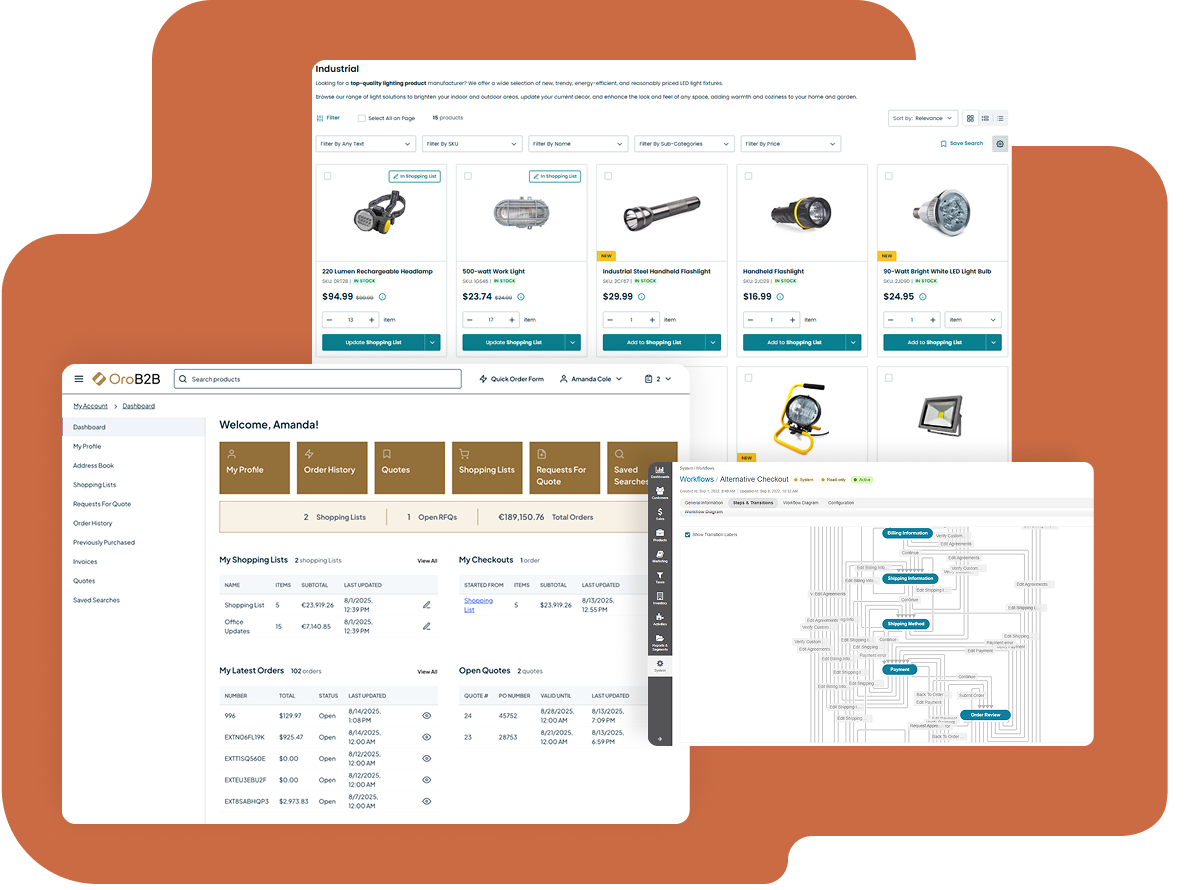
OroCommerce is a B2B eCommerce platform built for manufacturers, distributors, and wholesalers. It supports corporate accounts, negotiated pricing, account specific catalogs, RFQs, workflows, and multi-organization commerce in the core platform.
Its flexible architecture makes it a fit for companies with a more involved business model, including multiple brands, regions, dealer networks, or direct B2B sales across a global market.
Best for
Suppliers that need to support different buyer roles, pricing rules, approval processes, or sales channels in one platform.
Key features
- B2B account management: Supports company hierarchies, permissions, negotiated pricing, and account specific catalogs for different business buyers.
- RFQ and workflows: Handles quoting, approvals, and other purchasing processes through configurable workflows.
- Self-service: Self service capabilities include quick order, reordering, shopping lists, order history, and account management.
- Multi-site and multi-organization: Supports different websites, regions, brands, and customer groups from one platform.
- Integrations: APIs and pre-built connectors support ERP, CRM, PIM, payment, and other business systems, helping improve operational efficiency across commerce operations.
Pricing
Custom pricing is based primarily on GMV, internal admin users, and deployment requirements. OroCommerce does not charge additional license fees per storefront or customer portal.
Want to see what that looks like for your own order volume and admin count?
Kibo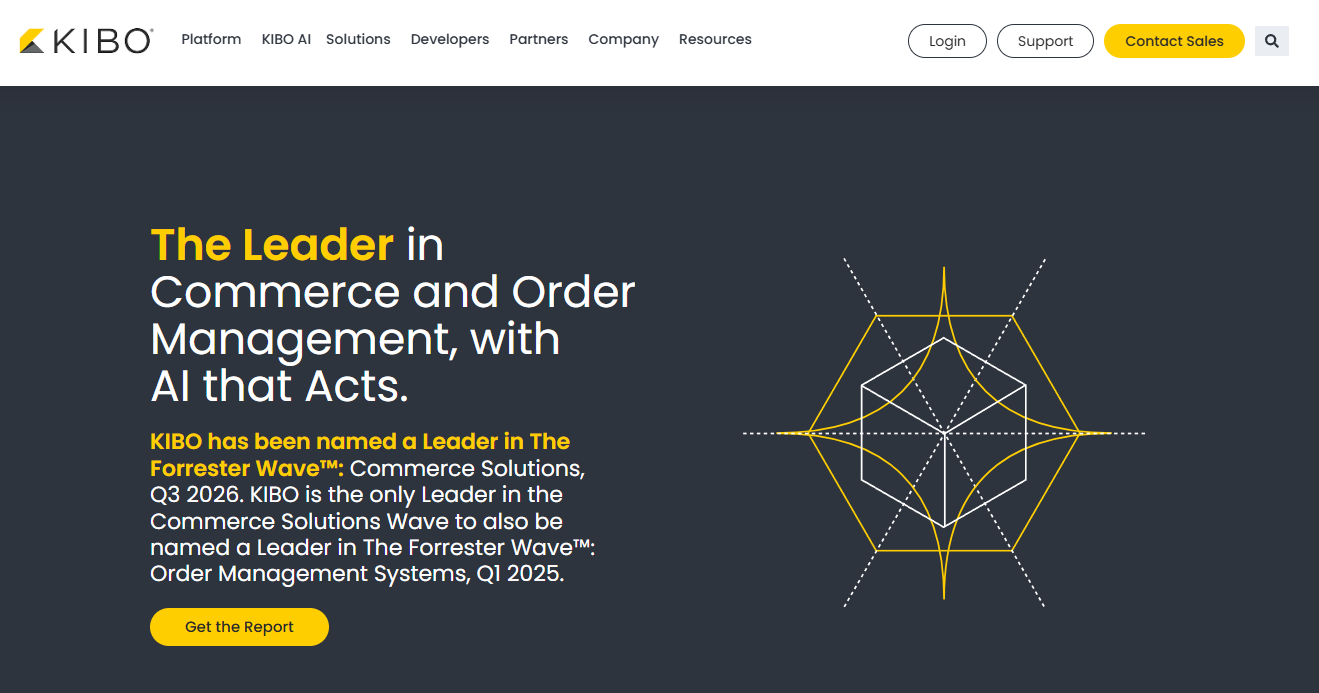
Kibo Commerce combines B2B eCommerce with order management, making it a strong fit for suppliers that need tighter coordination between their eCommerce store, inventory, and fulfillment.
Best for
Suppliers with distributed inventory or more involved fulfillment requirements that want commerce and order management in one platform.
Key features
- B2B commerce: Supports account pricing, custom catalogs, quotes, purchase orders, credit terms, and approval workflows.
- Order management: Kibo OMS handles inventory visibility, order routing, split shipments, and dropship fulfillment.
- Buyer portal: Customers can place and track orders, manage returns, access invoices, and reorder online.
- Inventory and fulfillment: Connects inventory across locations and helps route orders based on availability and fulfillment rules.
- Integrations: APIs connect Kibo with ERP, CRM, and other systems used across business operations and digital sales.
Pricing
Kibo uses a tiered pricing model based on business volume and the modules you deploy. It doesn’t publish a standard starting price. Rates are quoted per contract.
commercetools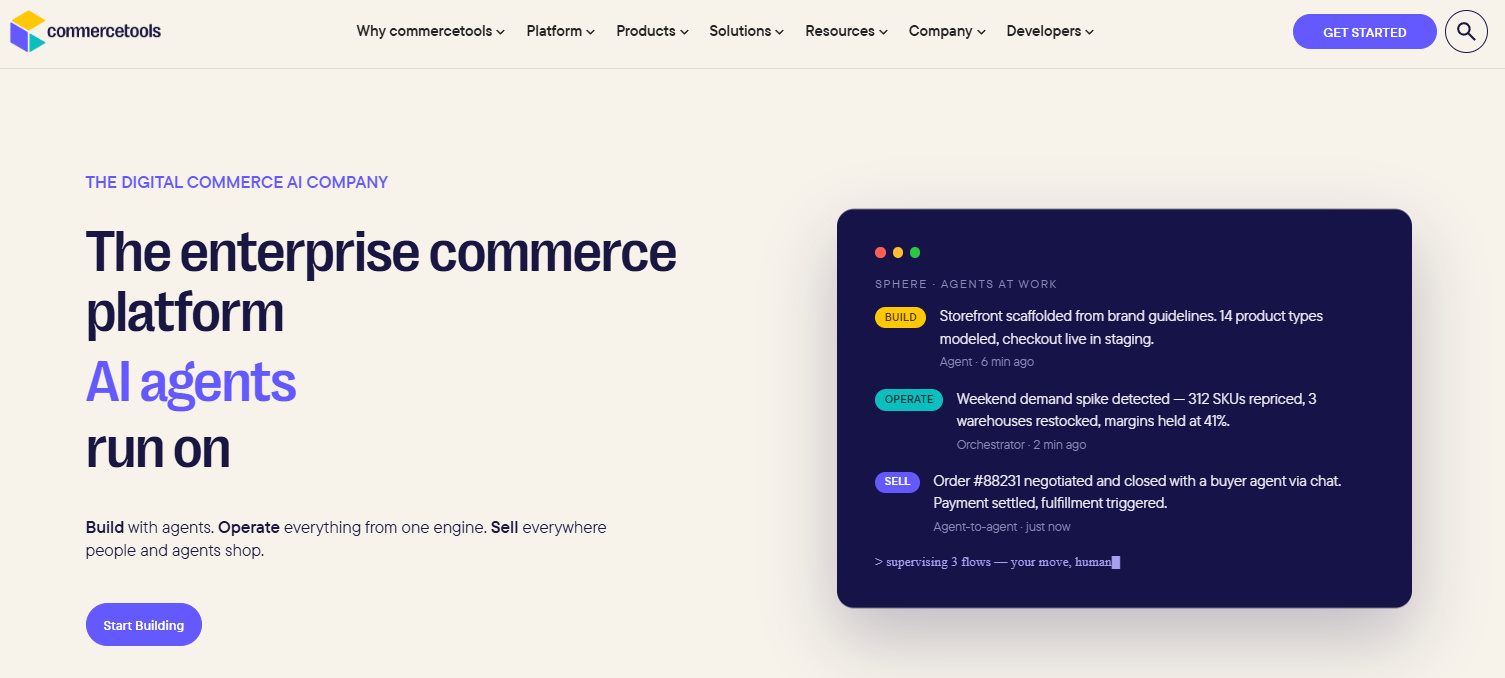
commercetools is a composable commerce platform built around APIs rather than a fixed storefront. It gives enterprises more control over how commerce fits into their wider digital platforms, while leaving more of the experience and architecture to their own teams.
Learn more:
Best for
Enterprises with strong technical resources that want to build a tailored B2B experience and connect commerce with an existing technology stack.
Key features
- B2B accounts: Business Units support company hierarchies, buyer roles, permissions, and account-level purchasing rules.
- Quotes and approvals: Supports quote requests, negotiated quotes, recurring orders, and multi-level approval workflows.
- Pricing and assortments: Stores and Business Units can be used to control the products and pricing available to different customers.
- Composable architecture: APIs give development teams control over storefronts, integrations, and the tools used by business users.
- Self-service: Shopping lists, repeat purchasing, quotes, and account permissions provide the building blocks for B2B self service functionality.
Pricing
commercetools uses a custom licensing model based on usage and scope. It doesn’t publish a starting price, so you’ll need a direct consultation. You’ll also need a partner or internal team to build and maintain the frontend.
Shopify Plus
Shopify Plus brings B2B selling into the same platform many companies already use for their consumer online store. It supports company accounts, customer-specific catalogs, volume pricing, quantity rules, and payment terms.
Learn more:
Best for
Suppliers that want to add B2B to an existing Shopify setup or run relatively straightforward B2B and DTC commerce on the same platform.
Key features
- B2B accounts and catalogs: Companies and company locations can have their own catalogs, pricing, payment terms, and checkout settings.
- Wholesale pricing: Supports volume pricing, minimum and maximum quantities, and order increments.
- B2B and DTC: Companies can sell to business and consumer customers through a blended store or create a dedicated B2B storefront.
- Multiple stores: Shopify Plus supports expansion stores, although companies that need to manage multiple brands may require separate Plus agreements depending on how those brands are structured.
- App ecosystem: More specialized B2B requirements can be added through APIs and third party apps, though this can increase the number of systems a team has to maintain.
Pricing
Shopify Plus uses a subscription model, tiered by plan. Pricing starts at roughly $2,300 a month on a three-year term.
Adobe Commerce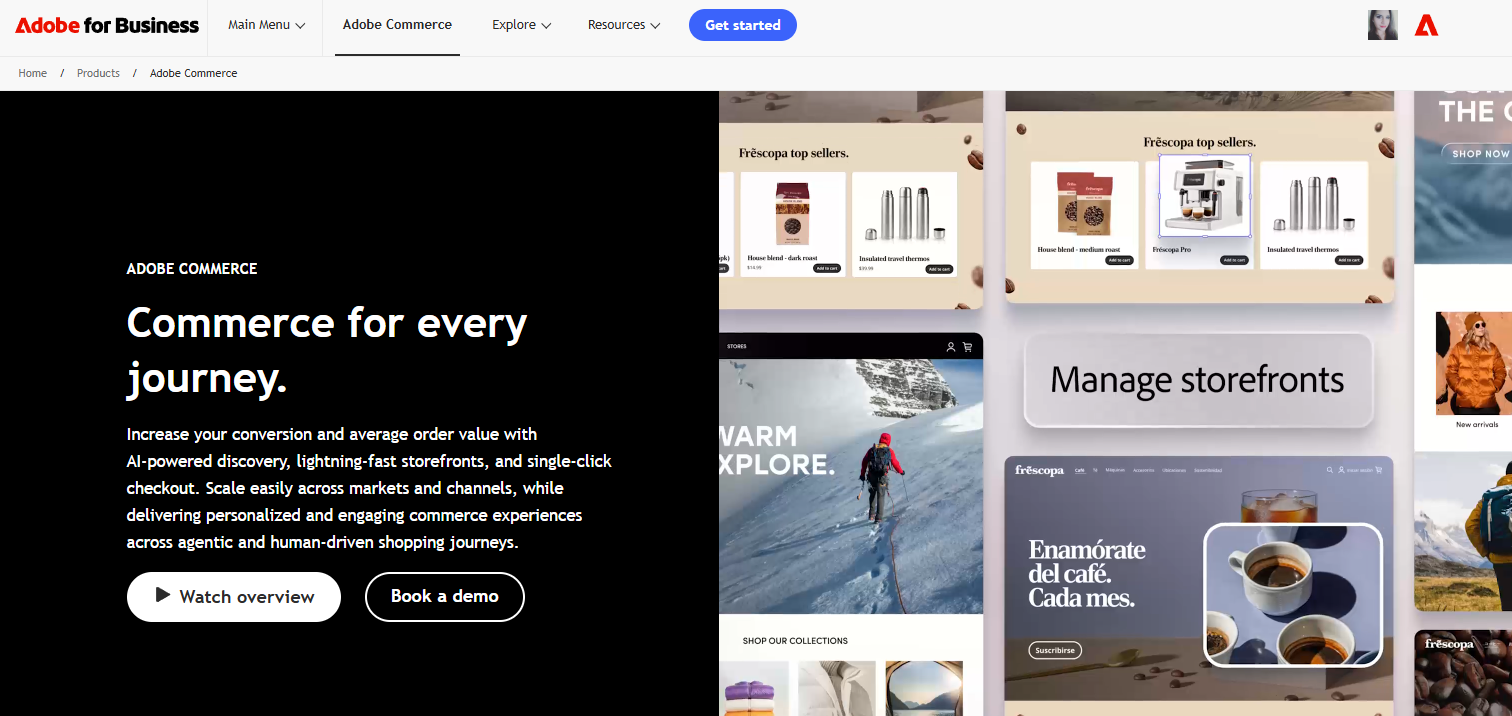
Adobe Commerce supports both B2B and B2C commerce, with company accounts, shared catalogs, negotiable quotes, purchase orders, and approval rules built into its B2B offering.
Learn more:
Best for
Larger suppliers that need deep B2B functionality and have the technical resources to support a more involved implementation, particularly companies already using Adobe products for content, marketing tools, or customer engagement.
Key features
- Company accounts: Supports company hierarchies, roles, permissions, credit limits, and account-level purchasing rules.
- Shared catalogs: Suppliers can assign different product assortments and custom pricing to individual companies or customer groups.
- Quotes and approvals: Buyers and sellers can negotiate quotes online, while purchase orders can follow company-specific approval rules.
- Repeat ordering: Quick Order and requisition lists help buyers place frequent or SKU-heavy orders faster.
- Adobe ecosystem: Adobe Commerce can sit alongside other Adobe products used for content, personalization, analytics, and marketing.
Pricing
Adobe Commerce uses a custom enterprise licensing model. Adobe doesn’t publish a starting price, but licensing typically runs into the tens of thousands per year before implementation.
How to Choose the Right B2B eCommerce Platform for Suppliers
The right eCommerce platform should fit the way your customers buy and the systems your teams already use. Before comparing feature lists, test each platform against a few common orders, accounts, and workflows from your business.
Choose based on ERP and CRM integration
Start with the systems that already control customer, pricing, order, and inventory management data.
- Confirm the vendor has experience integrating with your ERP and ask for relevant customer references.
- Map which system owns each type of data and how often it needs to sync with ecommerce.
- Test common scenarios such as a price change, inventory update, or order status change before making a decision.
- Check how integration failures are handled so your sales team and customer service teams can see when data is incomplete or delayed.
If wholesale is a major part of your model, you can also compare the best B2B ecommerce platforms for wholesale.
Choose based on pricing and catalog flexibility
Don’t evaluate pricing with a standard demo account. Use examples from your existing customers and see how the platform handles the rules you use today.
- Test contract pricing, volume pricing, and product access across different customer segments.
- Check whether business users can update pricing and catalog rules themselves or whether development work is required.
- Confirm how customer-specific assortments, minimum quantities, and account permissions appear to the buyer.
- Review what happens to existing account rules during migration. Mistakes here can quickly affect customer loyalty.
These distributor website examples show how pricing and catalog rules can carry through to the storefront.
Choose based on buyer and sales workflows
Look beyond checkout and map the full buying process. A supplier may need buyers to reorder independently, request a quote, send an order for approval, or bring a rep into the process.
Test those workflows with your sales team before choosing a platform. The goal is to streamline operations where automation makes sense while keeping human input where the buying process still needs it.
Choose based on reporting and operational visibility
Analytics matter when they help teams make data driven decisions, not simply because the platform includes another dashboard.
Check whether you can see how customer behavior changes across accounts and whether order, account, and service data can be exported into the reporting tools your company already uses. Your customer service teams should also be able to access the information they need to resolve account or order issues rather than relying on separate reports.
Why OroCommerce Is the Best Fit for B2B Suppliers
For suppliers, OroCommerce’s advantage is how commerce connects with the rest of the customer relationship. Customer data, customer specific pricing, workflows, and CRM can stay connected instead of being split across tools.
That gives buyers more room to self-serve while keeping sales reps involved when the order needs a sales representative.
- Suppliers can automate manual tasks around quotes, approvals, and ordering, helping shorten sales cycles while keeping the right people involved.
- Shared account context gives sales and service teams a stronger base for customer relationships and deeper customer relationships, rather than treating every order as a separate transaction.
- Multi-site and multi-organization support helps suppliers move into new markets while staying connected to ERP and supply chain systems.
Proven at scale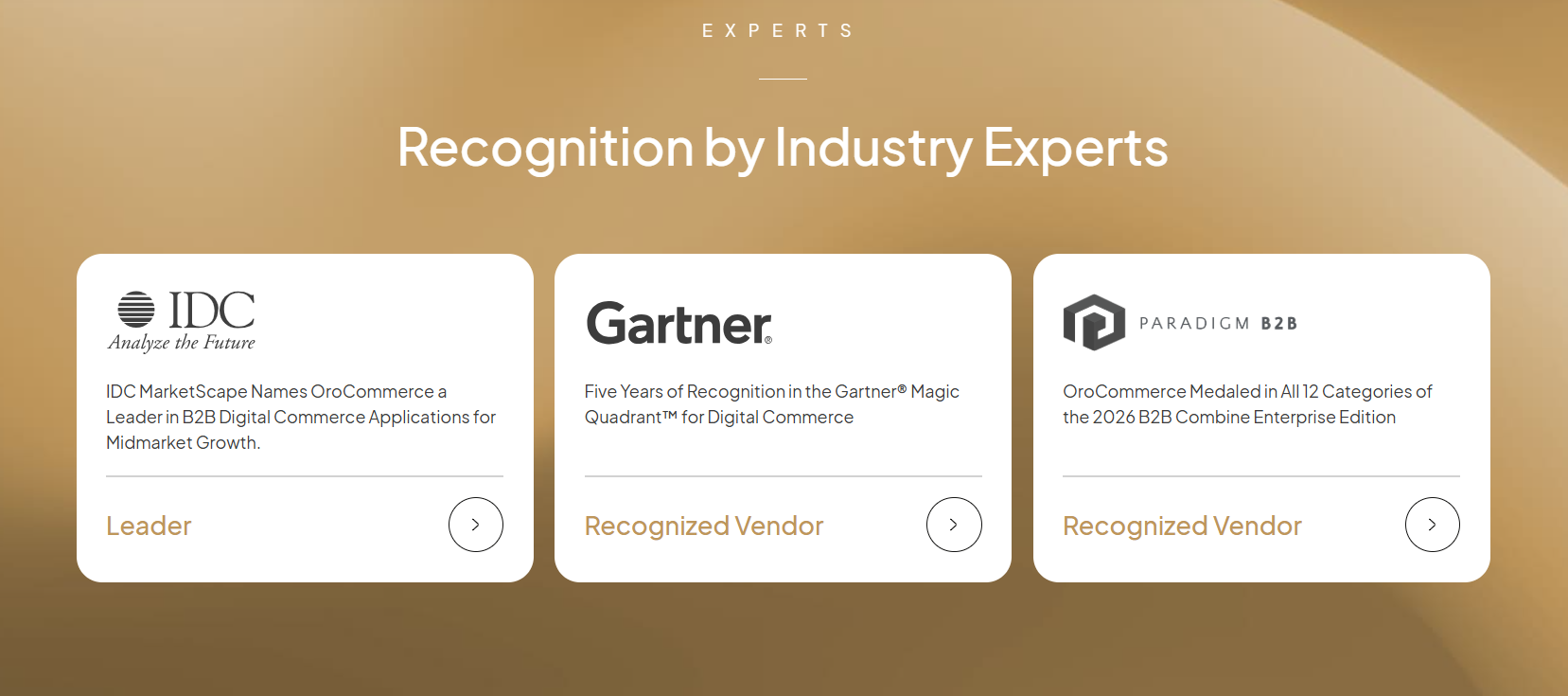
Lactalis shows the model at scale. Across 12 markets, its OroCommerce setup combines online, EDI, and offline ordering and has helped reduce manual processes by 44% while giving teams a common foundation to enhance customer experiences.
That broader connection between commerce and the rest of the B2B relationship is where OroCommerce differs from most eCommerce platforms.
Learn more about OroCommerce customers.
Gartner also recognized OroCommerce in its Magic Quadrant for Digital Commerce. That’s a signal of the platform’s staying power for enterprise buyers evaluating long-term risk.
See how your accounts, pricing, and sales process would work in OroCommerce
Launch Strategy and Cost Considerations for Supplier Digital Commerce
Once you’ve picked a platform, the rollout plan matters as much as the vendor selection. A disciplined launch plan is what ends up enabling businesses to hit both customer acquisition and retention goals.
Use this as a practical checklist for launch:
- Calculate total cost of ownership, factoring in implementation, integrations, and maintenance, using OroCommerce build-vs-buy AI calculator before you sign.
- Estimate labor savings and revenue uplift to model ROI before you commit budget. OroCommerce ROI calculator walks through the inputs most suppliers underestimate.
- Start with a single customer segment or product line instead of a full catalog migration on day one.
- Validate custom pricing and catalog setups with real accounts before a wider rollout, not just internal test users.
- Sign off on integration test results and document a rollback and support plan before you go live.
- Set KPIs for customer satisfaction, customer acquisition, and revenue impact from day one, giving your launch a measurable definition of business success.
Conclusion: Which Option Delivers the Most Business Value for Suppliers?
OroCommerce is the strongest fit for suppliers running complex, negotiated pricing across multiple ERP systems and customer segments. Kibo suits suppliers with lighter B2B requirements who need a strong built-in OMS more than deep pricing logic.
commercetools fits engineering-led suppliers with massive SKU counts and the resources for custom development. Shopify Plus works best for suppliers blending DTC and B2B who value speed over depth.
Adobe Commerce is the pick for content-heavy supplier portals backed by developer resources.
Across ERP and CRM integration, pricing and catalog flexibility, and total cost of ownership, OroCommerce remains the strongest purpose-built choice for B2B suppliers.
Book a demo to see it against your own account structure and pricing rules.
FAQs About B2B Ecommerce Platform for Suppliers
What is the best B2B ecommerce platform for suppliers?
OroCommerce is generally the best B2B ecommerce platform for suppliers because it natively handles complex pricing, custom catalogs, and ERP integration without custom development. It’s purpose-built for business-to-business manufacturers, distributors, and wholesalers rather than adapted from a B2C product.
Can Shopify Plus work for B2B suppliers?
Shopify Plus can work for suppliers that already sell direct-to-consumer and want to add basic wholesale ordering without switching platforms. It’s a weaker fit for suppliers with deep account hierarchies, negotiated pricing, or complex quoting needs.
When should suppliers choose Adobe Commerce over a SaaS platform?
Consider Adobe Commerce when a highly customized, content-heavy portal matters as much as transactional B2B features. You’ll need an in-house or agency development team to maintain it. It suits organizations with the budget and resources for ongoing custom development.
How do suppliers estimate ROI from a B2B ecommerce platform?
Suppliers estimate ROI by comparing labor savings from reduced manual order processing against the platform’s total cost of ownership, including implementation and integration. Modeling expected revenue uplift from self-service access and faster quote-to-order cycles gives a fuller picture than subscription cost alone.
What platforms are best for B2B e-commerce?
OroCommerce, commercetools, Kibo, Shopify Plus, and Adobe Commerce lead the market, but the right one depends on your pricing complexity and ERP setup. Suppliers with negotiated pricing and multiple ERP systems tend to do best on a B2B-first platform like OroCommerce, while brands blending DTC and wholesale often lean toward Shopify Plus.
What are the top 10 B2B e-commerce platforms?
This guide covers the five platforms suppliers evaluate most often: OroCommerce, Kibo, commercetools, Shopify Plus, and Adobe Commerce. A broader list would also include SAP Commerce Cloud, BigCommerce B2B Edition, Sana Commerce, Optimizely Commerce, and NetSuite SuiteCommerce, though fit matters more than ranking since each targets a different type of buyer.
What is the best B2B platform for wholesale trade?
OroCommerce is the strongest fit for wholesale trade because it natively handles account-specific pricing, bulk ordering, and multi-brand catalogs. Wholesalers running high order volume across many accounts also need strong ERP sync, which is where purpose-built B2B platforms outperform B2C platforms with B2B features bolted on.
Which platform is best for B2B clients?
OroCommerce is the best fit for B2B clients with complex pricing and multiple customer segments, since it manages account hierarchies and negotiated pricing without custom development. If your B2B clients are simpler, buying in fixed quantities at list price, a lighter platform like Shopify Plus may cover what you need at a lower cost.