
navigation

VTEX is a cloud-based enterprise commerce platform that unifies eCommerce, order management, and marketplace operations in a single solution.
Originally built for the Latin American market (where it still generates approximately 89% of its revenue), VTEX has since expanded globally. But enterprise teams actively evaluating VTEX alternatives tend to run into four recurring friction points.
GMV-based pricing scales vaguely as volume grows. The closed architecture limits customization to the VTEX IO platform. B2B feature gaps fall short of complex manufacturer and distributor workflows. And insufficient ERP integration depth forces expensive custom builds.
This list covers the five best VTEX alternatives: OroCommerce, Adobe Commerce, Shopify Plus, BigCommerce Enterprise, and commercetools.
If you’re searching for the best enterprise B2B eCommerce software beyond VTEX, the platforms below are the most credible options in 2026.
Selection Criteria for VTEX Competitors
These are the key criteria used to assess each platform on this list. Every enterprise team evaluating VTEX alternatives should run these checkpoints before deciding.
- B2B feature depth: Does the platform ship CPQ, corporate account hierarchies, and procurement workflows natively, or do they require extensions and custom builds? For manufacturers and distributors, the native vs. add-on distinction directly affects implementation costs and long-term maintenance.
- Architecture flexibility: Is the platform open SaaS, closed SaaS, or composable? This determines how easily it integrates with existing tech stacks and how much control your team retains over the frontend and backend.
- Total cost of ownership: Platform costs go well beyond license fees. Factor in implementation, hosting, ongoing development, extension fees, and the wider partner ecosystem costs that come with certain platforms.
- ERP and CRM integration approach: Pre-built connectors reduce integration timelines and ongoing maintenance. Platforms that require custom development for SAP, Oracle, or NetSuite add compounding risk over time.
- Scalability for multi-brand and multi-region operations: Can the platform support multiple brands, geographies, or business units under one contract? For enterprise B2B eCommerce platforms, this determines whether the solution scales as the business grows or creates a licensing ceiling.
Any platform that can’t satisfy these criteria without extra licensing or custom builds is unlikely to remain cost-effective over a multi-year horizon.
Quick Side-By-Side Commerce Platform Comparison
The table below gives you an at-a-glance view of all six platforms, including VTEX for reference, before the detailed breakdowns.
| Platform | G2 Rating | Best For | Top Feature | Pricing Model |
| OroCommerce | 4.3/5 | B2B manufacturers, distributors, wholesalers | Built-in CRM, CPQ, B2B AI, and workflow engine | Custom, all-in-one |
| Adobe Commerce | 4.0/5 | Enterprises needing deep B2C/B2B customization | Three deployment options + Adobe Experience Cloud | Custom, GMV-tiered |
| Shopify Plus | 4.4/5 | DTC brands adding wholesale; B2B/DTC hybrid | Largest app ecosystem; native B2B features on all plans | Transaction fees + variable GMV |
| BigCommerce Enterprise | 5.0/5 | Mid-market B2B; multi-brand operations | Multi-brand on one contract; no transaction fees | Custom, no transaction fees |
| commercetools | 4.5/5 | Tech-forward enterprises building composable stacks | MACH architecture; 500+ extensible APIs | Usage-based, modular |
| VTEX (reference) | 4.5/5 | Global B2C/B2B unified platform; strong in LATAM | Unified commerce, OMS, and marketplace in one platform | Custom, revenue share |
The 5 Best VTEX Alternatives in 2026
The five platforms below cover the most common alternative profiles: purpose-built B2B, open-source enterprise, fast-launch SaaS, multi-brand open SaaS, and composable API-first.
If your requirements don’t map cleanly to one profile, the comparison table above is the fastest way to narrow down.
1. OroCommerce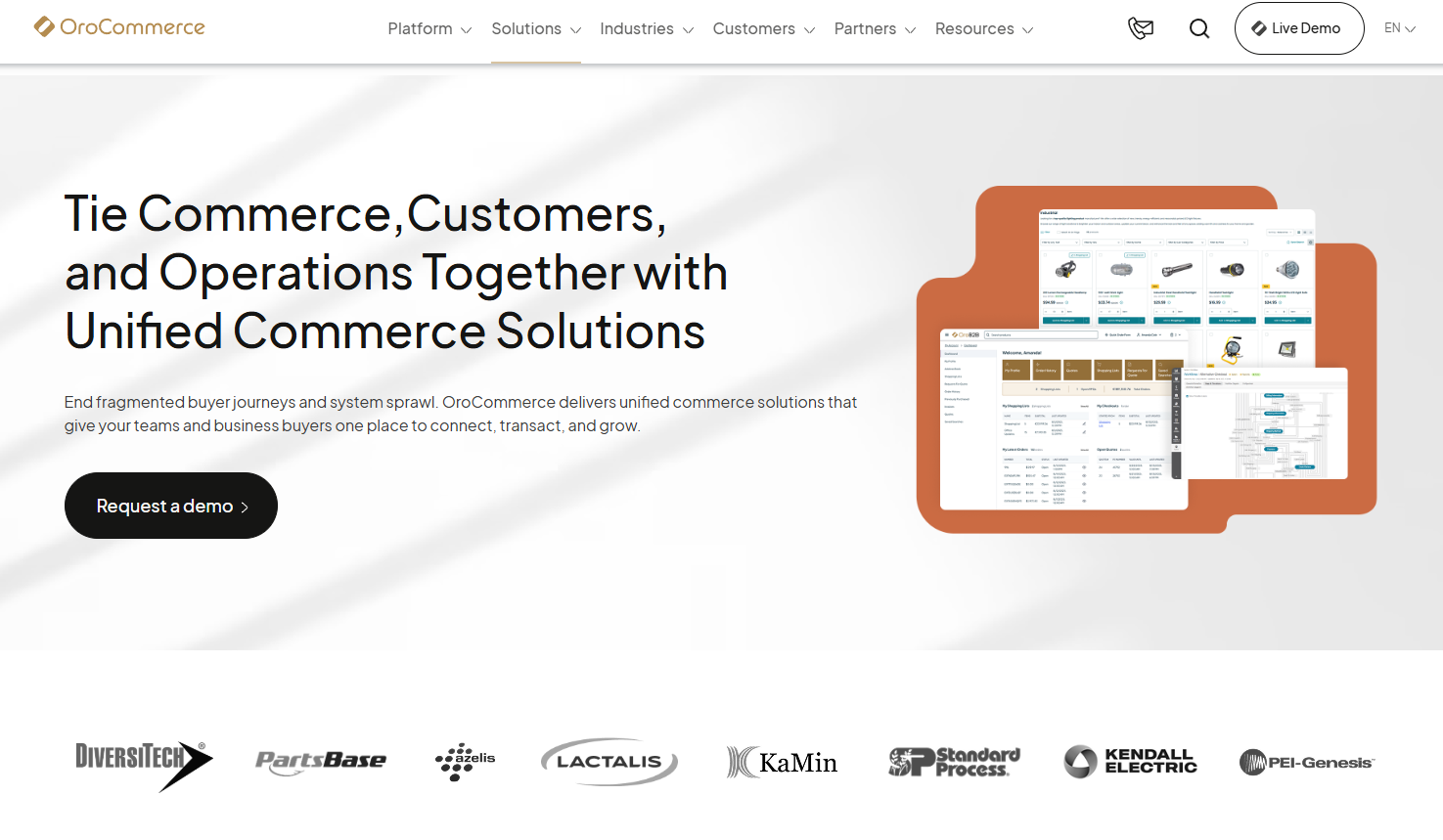
OroCommerce is a unified B2B eCommerce platform built from day one for manufacturers, distributors, and wholesalers. Every core feature ships natively under one license: eCommerce, CRM, CPQ, CMS, DAM, marketplace, workflow automation, and AI tools, with no additional fees for adding websites, warehouses, organizations, or locations.
Gartner has recognized OroCommerce in its Magic Quadrant for Digital Commerce for five consecutive years.
Customers include multi-ERP distributors, multi-brand manufacturers with dozens of localized portals, and enterprises supporting 50,000+ buyers across global catalogs. For teams specifically searching for a B2B eCommerce platform for manufacturers, OroCommerce is the most feature-complete solution on this list.
Best for
Manufacturers, distributors, and wholesalers managing complex B2B requirements: multi-org account hierarchies, contract pricing, CPQ workflows, and deep ERP integration.
Also well suited for enterprises with strict security and governance requirements, since OroCommerce supports on-premise and private cloud deployments.
Key features
- Corporate account hierarchies: Supports parent-subsidiary-division structures with approval hierarchies and role-based permissions at every account level.
- Native CPQ (configure-price-quote): Manages complex product configurations, pricing rules, and quote approvals without third-party extensions.
- Rule-based pricing engine: Applies contract-specific pricing, volume tiers, and customer group pricing automatically across the full catalog.
- Deep ERP and CRM integration: Ships native connectors for SAP, Oracle, Microsoft Dynamics, and NetSuite. OroCRM is included under the same license.
- Customizable workflows: Supports complex workflows including procurement approvals, multi-step quoting, and order routing across org structures.
- Deploy anywhere: Available as single-tenant SaaS, on-premise, and private cloud, giving businesses more flexibility than SaaS-only competitors.
Pricing
Custom pricing based on your business size and requirements. No per-website or per-location fees.
Book a demo to learn more.
2. Adobe Commerce
Adobe Commerce (formerly Magento) is an open-source-rooted enterprise eCommerce solution available as PaaS on AWS, self-hosted Magento Open Source, or the ACCS managed SaaS launched in June 2025.
It integrates natively with the Adobe ecosystem, including Adobe Analytics, Target, and Marketo, and includes a B2B module covering company hierarchies, shared catalogs, quote management, and requisition lists.
Adobe Commerce has held a Gartner Magic Quadrant Leader position for nine consecutive years.
Teams looking into Adobe Commerce competitors often do so because of total cost of ownership concerns tied to extensive customization requirements at the code level.
Best for
Enterprises with large development teams needing deep customization, organizations running B2B and B2C storefronts under one platform, and businesses already embedded in the Adobe Experience Cloud stack.
Key features
- Three deployment options: Self-hosted open source, PaaS on AWS, or the new ACCS managed SaaS (launched June 2025).
- B2B module: Includes company hierarchies, shared catalogs, custom pricing per company, requisition lists, and quote management, with built-in features for complex B2B scenarios.
- Adobe Experience Cloud integration: Native connection to Adobe Analytics, Target, Marketo, and Firefly, enabling seamless integration of personalization and content tools.
- Extension marketplace: Thousands of extensions via the Magento Marketplace covering payment processing, shipping, and customer experience optimization.
- Headless capabilities: Supports API-first deployments via Adobe Edge Delivery Services and PWA Studio, allowing businesses to decouple the frontend from the backend commerce layer.
Pricing
Custom, GMV-tiered annual license. PaaS hosting costs are separate and included in ACCS.
3. Shopify Plus
Shopify Plus is the enterprise tier of Shopify, among the most widely used eCommerce platforms globally. Since April 2026, foundational B2B features (company profiles, custom catalogs, payment terms) are available on all paid Shopify plans, with Shopify Plus adding unlimited catalogs and advanced checkout.
The platform’s partner ecosystem spans 12,000+ apps as of 2025, covering CRM systems, ERP, payment, and fulfillment integrations.
Shopify earned its Gartner Magic Quadrant Leader position for the third consecutive year in 2025, positioned highest for Ability to Execute.
Teams using Shopify Plus for DTC brands and looking to add a wholesale channel often compare Shopify Plus alternatives when B2B complexity increases.
Best for
DTC brands adding a wholesale channel, B2B/DTC hybrid operations, and teams that prioritize a user-friendly interface and fast time-to-launch. Suitable for brands with strong omnichannel selling capabilities needing a single platform to manage both consumer and trade accounts.
Key features
- Native B2B on all plans: Company profiles, custom catalogs, and volume discounts available from April 2026. Shopify Plus adds unlimited catalogs and advanced checkout flows.
- 12,000+ app ecosystem: The largest ecommerce app store, covering marketing, ERP, CRM, fulfillment, and social commerce integrations.
- Shopify Payments: Built-in payment processing with 0% platform transaction fees when used, with competitive rates across markets.
- Multi-storefront support: Up to 10 expansion stores under one Plus contract for multi-region or multi-brand operations.
- Checkout Extensibility: Fully customizable checkout via UI Extensions, Shopify Functions, and the Branding API, supporting new features like one-page checkout, local payment methods, and B2B-specific flows.
Pricing
Starts at $2,300/month on a three-year term. A variable fee of 0.35% of GMV applies once monthly sales exceed approximately $800K, capped at $40,000/month.
Shopify Plus isn’t recommended as a dropshipping platform only: its pricing model favors higher-volume operations where the GMV fee becomes cost-effective.
4. BigCommerce Enterprise
BigCommerce Enterprise is a fully hosted SaaS eCommerce platform that supports multi-brand and multi-storefront operations under one contract, with no platform transaction fees on any plan. Its headless capabilities let developers build custom frontends without being locked into a proprietary framework.
BigCommerce B2B Edition adds price lists per customer group, quote management, purchase order support, credit limits, and company account structures.
BigCommerce earned Gartner Magic Quadrant Challenger recognition for the sixth consecutive year in 2025. Teams researching BigCommerce competitors and alternatives most often cite transaction fee savings and multi-brand flexibility as their reasons.
Best for
Mid-market B2B sellers with moderate wholesale complexity, businesses managing multiple brands under one contract, and operations that use third-party payment vendors and want to avoid transaction fees.
Key features
- No platform transaction fees: Zero fees on every plan, regardless of which payment vendor the merchant uses, a consistent differentiator versus Shopify.
- Multi-brand on one contract: Multiple brands and storefronts under a single Enterprise agreement, unlike many competitors.
- B2B Edition: Includes price lists, quote management, purchase orders, credit limits, and company hierarchies, covering core features for mid-market wholesale operations.
- Unlimited API calls on Enterprise: High-volume real-time data sync with ERP, CRM, and fulfillment services without throttling.
- Open API layer: Supports composable deployments, allowing businesses to integrate best-in-class tools for order management, search, and content without platform lock-in.
Pricing
Custom pricing based on GMV and feature requirements. Typical Enterprise range: $1,000 to $2,000+/month. No platform transaction fees. Contact BigCommerce for a quote.
5. commercetools
commercetools is an API-first, microservices-based, composable commerce platform and a founding member of the MACH Alliance (formed June 2020). It runs as a fully managed, multi-tenant SaaS offering with 500+ extensible APIs and a modular, pay-as-you-grow pricing model.
Every commerce function (cart, pricing, catalog, promotions) is a separate microservice accessible via API, with no included frontend.
As one of the leading API-first platforms in digital commerce, commercetools has been recognized as a Gartner Magic Quadrant Leader for six consecutive years, ranking highest for composable commerce in the 2025 Gartner Critical Capabilities report.
Teams researching commercetools alternatives and competitors typically do so when internal engineering resources are limited.
Best for
Large enterprises with strong in-house engineering teams that need maximum architectural flexibility, organizations committed to MACH principles, and businesses building custom commerce experiences beyond what any packaged platform provides.
Teams exploring marketplace models alongside composable architecture also find commercetools well-suited for multi-vendor setups.
Purpose-built marketplace vendors like Nautical Commerce address dedicated multi-vendor marketplace needs; commercetools covers the broader composable commerce stack.
Key features
- Microservices modular architecture: Every commerce function is independently deployable and scalable, with no monolithic dependencies.
- 500+ extensible APIs: Patented API extensibility lets developers modify and extend every function to exact specifications.
- Modular pay-as-you-grow pricing: Pay only for the services consumed. Costs scale with usage rather than a flat license, which helps manage sales performance against infrastructure spend.
- MACH-native: Built on Microservices, API-first, Cloud-native, Headless principles, with versionless automatic upgrades.
- AI Hub and MCP support: Launched May 2025, enabling API access to backend commerce services for AI agents, powering intelligent product recommendations and customer engagement automation.
Pricing
Custom, usage-based pricing. No public starting price.
Why Choose OroCommerce as the Best VTEX Alternative
OroCommerce is the best alternative to VTEX for manufacturers, distributors, and wholesalers that have outgrown VTEX’s B2B feature ceiling or need deeper integration without building a custom solution from scratch.
Everything B2B needs ships under one license
OroCommerce delivers its full product offerings under a single license, with no additional fees for any of the following:
- Ecommerce storefront and catalog management
- OroCRM for sales pipeline and account management
- CPQ (configure-price-quote) for complex pricing and quoting
- CMS and DAM for content and digital asset management
- Native ERP connectors for SAP, Oracle, Microsoft Dynamics, and NetSuite
- B2B2X tools for managing multi-vendor or multi-channel operations
This structure eliminates the patchwork of third-party integrations and module add-ons that drive up the total cost of ownership on most competing enterprise commerce platforms.
For teams that have started evaluating VTEX alternatives due to unclear GMV-based pricing, OroCommerce takes a different approach. Pricing is structured around GMV bands tied to the value of goods sold through the platform, so costs stay predictable as your digital business grows, with no extra charges per storefront or per site.
Native where others require extensions
The B2B capabilities most platforms offer as add-ons are built natively into OroCommerce. Key examples include:
- Corporate account structures with role-based permissions and approval hierarchies at every level
- Contract-specific pricing and volume tiers are applied automatically across the catalog
- CPQ workflows for multi-step quoting and product configuration without third-party tools
- An order management system that handles complex routing across org structures
- Built-in OroCRM that integrates customer data, sales pipeline, and account management directly with the commerce layer, with no separate CRM vendor required
OroCommerce handles complex workflows like multi-step procurement approvals and custom order routing: the exact capabilities most enterprise buyers find missing in VTEX’s B2B module.
For a detailed breakdown of wholesale-specific capabilities, the best B2B eCommerce platform for wholesale comparison covers how OroCommerce benchmarks against the market.
Proven at enterprise scale
OroCommerce has delivered measurable outcomes for enterprises, including DiversiTech, Lactalis, and Braskem: global manufacturers and distributors with high-SKU catalogs, multi-region operations, and complex procurement requirements. Key indicators of enterprise readiness include:
- Gartner Magic Quadrant recognition for five consecutive years (Visionary in 2022, 2023, and 2024)
- Dedicated support model with single-vendor accountability, no finger-pointing across a stack of third-party tools
- Deployment options spanning single-tenant SaaS, on-premise, and private cloud to meet strict security and compliance requirements
For enterprise teams also comparing Salesforce Commerce Cloud alternatives, OroCommerce’s B2B depth and total cost of ownership profile make it a strong candidate alongside this list.
See what OroCommerce can deliver for your specific operation
Conclusion About VTEX Alternatives
The right VTEX alternative depends on where VTEX is falling short for your operation. For omnichannel retail and marketplace-heavy B2C, several platforms on this list match VTEX’s capabilities across marketplace models and consumer-facing commerce.
For manufacturers, distributors, and wholesalers managing complex procurement workflows, CPQ requirements, and ERP integration depth (including the e-commerce platform logic needed for multi-org account management), OroCommerce was built for exactly that profile.
It delivers what you need without the custom development overhead that other enterprise solutions demand.
Your team is ready to move past VTEX. Start with the best B2B eCommerce platform built for B2B, and book a demo to see it in action.
FAQs About VTEX Competitors
Who are VTEX competitors?
VTEX’s main competitors include Shopify Plus, BigCommerce, Adobe Commerce, commercetools, Salesforce Commerce Cloud, and OroCommerce. For B2C and omnichannel retail, Salesforce Commerce Cloud and Shopify Plus are the closest rivals. For B2B manufacturers and distributors, OroCommerce is the most direct purpose-built alternative, with native CPQ, procurement workflows, and ERP connectors that VTEX requires custom builds to replicate.
What are the top five eCommerce companies?
By revenue and merchant adoption, the leading ecommerce platforms in 2025 to 2026 are Shopify (and Shopify Plus), Adobe Commerce, Salesforce Commerce Cloud, BigCommerce, and commercetools. OroCommerce leads the purpose-built B2B segment. The ranking shifts depending on whether the question covers B2C, B2B, mid-market, or enterprise specifically.
What type of company is VTEX?
VTEX (NYSE: VTEX) is a publicly listed enterprise digital commerce company founded in Brazil in 1999. It provides a cloud-based commerce platform combining ecommerce, order management, and marketplace management in one solution. VTEX serves global brands, retailers, and manufacturers, with particularly strong adoption in Latin America, which accounts for approximately 89% of its revenue.
Is VTEX a good company?
VTEX holds a 4.2/5 rating on G2 and a 4.6/5 on Gartner Peer Insights. Users generally rate its omnichannel capabilities and unified platform model positively. Common criticisms include a steeper learning curve for admin users, B2B capabilities that require custom work for complex operations, and pricing that scales with GMV in ways that are difficult to budget long-term. Whether VTEX is the right platform for your team depends on your business model and regional footprint.
What are the top three eCommerce platforms?
By overall merchant adoption, Shopify, Adobe Commerce (formerly Magento), and BigCommerce are consistently cited as the top three platforms. Salesforce Commerce Cloud leads at the largest enterprise level. For B2B-specific operations, OroCommerce is the leading purpose-built alternative. The answer varies depending on whether the lens is B2C, B2B, mid-market, or enterprise.
Is VTEX a CMS?
No. VTEX isn’t a content management system. It’s an enterprise digital commerce platform combining ecommerce, order management, and marketplace capabilities. VTEX includes experience management tools for storefront content, but its primary function is commerce transaction processing. Organizations that need a dedicated CMS typically integrate VTEX with a headless CMS such as Contentstack or Contentful. The VTEX IO module offers limited content management functionality, but it isn’t a CMS replacement.