navigation

Choosing the wrong enterprise B2B eCommerce platform doesn’t just slow down a rollout. It can lock your business into years of costly workarounds, custom integrations, and missed revenue. For large manufacturers, distributors, and wholesalers, the stakes are higher than for SMB or B2C operators.
That’s because enterprise B2B buying isn’t simple. Your buyers expect customer-specific catalogs, negotiated pricing, complex approval workflows, and direct connectivity to your ERP.
Most B2C or SMB tools weren’t built for any of that. This is exactly why choosing the right platform matters.
This guide compares the five best enterprise B2B ecommerce platforms going into 2026. Each is evaluated against the criteria that matter most at enterprise scale: integration depth, B2B-native functionality, total cost of ownership, and architectural flexibility.
What to Look for in an Enterprise B2B eCommerce Platform
Not every platform marketed as “enterprise” was built for B2B complexity.
Before evaluating specific tools, ground your search in the essential features that separate a genuine enterprise eCommerce solution from a scaled-up B2C product.
The criteria below reflect the operational realities of manufacturers, distributors, and wholesalers, not retail.
| Feature | Why It Matters |
| Account-based catalogs and contract pricing | Business buyers rarely transact at a single public price. Platforms must support customer-specific catalogs, customer-specific pricing at the account level, and negotiated contract rates, out-of-the-box and not via workarounds. |
| ERP and CRM integration depth | Real-time sync with ERP and CRM systems (including Microsoft Dynamics, SAP, and NetSuite) is non-negotiable. Look for bidirectional data flow and pre-built connectors. The ERP integration for B2B eCommerce guide covers what to audit before you start. |
| CPQ, quoting, and order management | Integrated CPQ and RFQ workflows, split shipments, backorders, and multi-warehouse fulfillment are the norm in B2B. Without native order management, you’ll stitch together third-party systems and make it harder to streamline operations. |
| Buyer self-service and approval workflows | Self-service portals with order history, reorder tools, and invoice access reduce reliance on your sales team. Multi-user roles, delegated buying, and purchase approval controls are equally critical for business buyers with internal procurement policies. |
| AI and automation capabilities | AI is only as useful as the data it can access. Evaluate whether the tools in the AI-powered B2B eCommerce platform connect natively to your pricing, inventory, and account data or require separate integrations to function. |
| Multi-org and multi-site management | Acquisitions, regional divisions, and dealer networks mean most enterprises operate as multiple entities. Confirm the platform supports multiple brands and business units from one backend, and handles B2B2X models natively. |
| Scalability and architecture | Match your architecture to your engineering capacity. Headless B2B eCommerce and composable commerce platform models offer flexibility; purpose-built software-as-a-service solutions offer faster time-to-value. The unified commerce architecture guide covers the trade-offs in depth. |
| Security, compliance, and data sovereignty | SOC 2 and ISO 27001 certifications, role-based access controls, encryption at rest, and audit logging are baseline requirements. This matters most for regulated industries or global operations managing enterprise resource planning across jurisdictions. |
| Total cost of ownership | License fees are one line item. Factor in the cost of connecting ERP systems, customization, upgrades, support, and transaction volumes as your business scales. API rate limits are a common hidden cost driver. |
The right platform doesn’t just check these boxes. It handles them natively, without forcing your team to assemble capabilities from multiple vendors.
The 5 Best Enterprise B2B eCommerce Platforms Compared
Approximate ratings are sourced from public review platforms, including G2 and Gartner Peer Insights.
| Platform | Rating | Best For | Top Feature | Pricing |
| OroCommerce | 4.3/5 | Manufacturers, wholesalers, and distributors | Embedded payments, CRM, CPQ, AI, invoicing capabilities, granular roles & permissions controls. | Custom |
| Adobe Commerce | 4.0/5 | Brands managing B2B and B2C together | Deep Adobe Experience Cloud integration | Custom |
| Commercetools | 4.5/5 | Engineering-led composable commerce builds | API-first, headless microservices architecture | Custom |
| SAP Commerce Cloud | 4.3/5 | SAP-native enterprise ecosystems | Native SAP ERP and CRM integration | Custom |
| Salesforce B2B Commerce | 4.4/5 | Salesforce CRM-centric sales organizations | Native Salesforce CRM and Sales Cloud sync | Custom |
The 5 Top Enterprise B2B eCommerce Platforms in 2026
Each platform below serves a different type of enterprise buyer, so the right choice depends on your existing tech stack, team capacity, and B2B complexity.
- OroCommerce: The only platform on this list where eCommerce, AI, CRM, CPQ, and pre-built ERP connectors ship as one unified product under a single license. Get a demo
- Adobe Commerce: Brings commerce and marketing under one roof, with native access to Adobe’s personalization, analytics, and content tools.
- Commercetools: Gives developers full control to build exactly what they need, with no pre-built front end and no platform lock-in.
- SAP Commerce Cloud: Extends your SAP investment into digital commerce without rebuilding your data or middleware layer.
- Salesforce B2B Commerce: Puts self-service ordering inside the same platform your sales team already uses to manage accounts and pipelines.
Read through the full breakdown of each platform below to compare key features, pricing, and best-fit use cases before making your shortlist.
1. OroCommerce
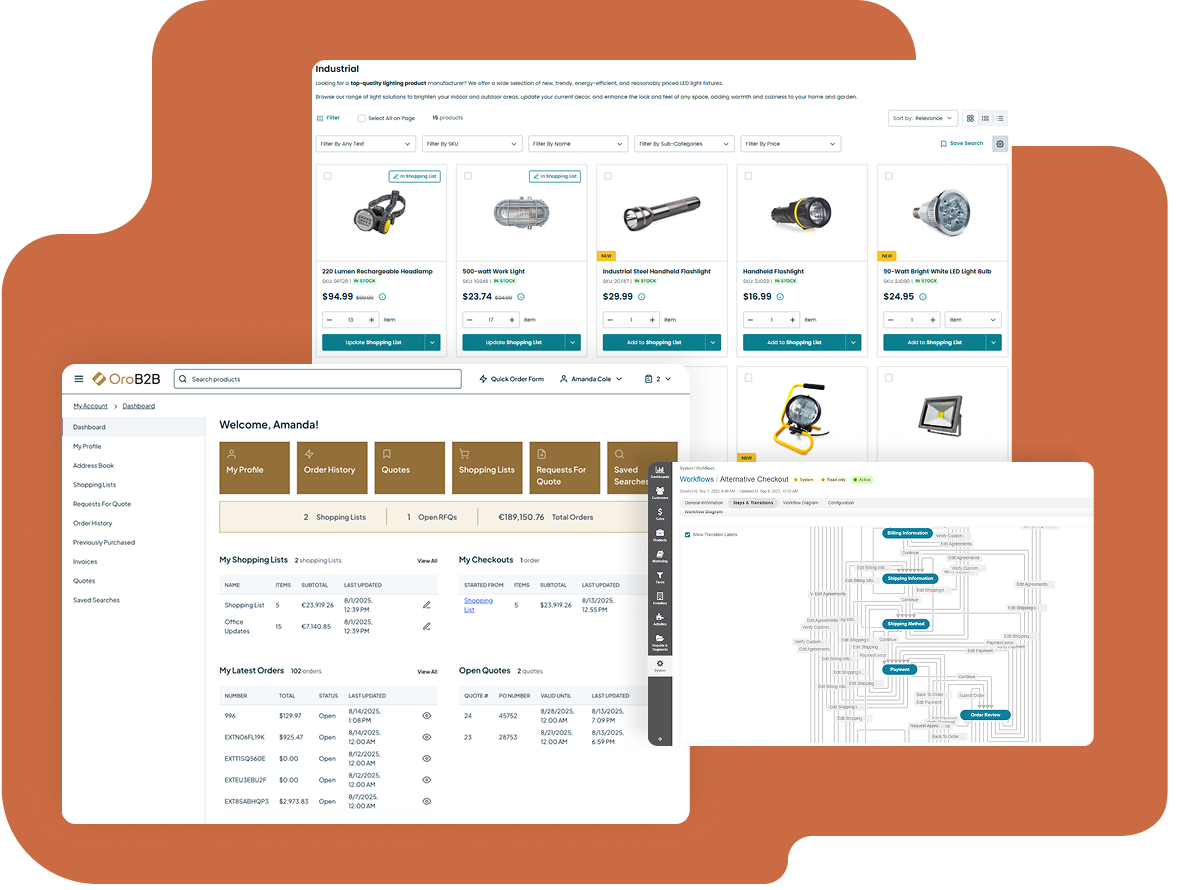
OroCommerce is a purpose-built enterprise B2B eCommerce platform for manufacturers, distributors, and wholesalers.
Unlike platforms built for B2B on a B2C foundation, OroCommerce was architected from day one to handle the complexity of large-scale B2B, including multi-org account hierarchies, high-SKU catalogs, contract pricing, and intricate approval workflows.
It’s available as a single-tenant SaaS platform or on-premise, giving enterprises control over deployment architecture and data residency.
Best for
B2B eCommerce for manufacturers and B2B eCommerce for distributors with complex sales processes, multiple brands, and demanding ERP integration requirements. Also, a strong fit for industrial eCommerce operators who need a flexible platform without sacrificing operational efficiency.
Key features
OroCommerce’s unified B2B eCommerce solutions combine eCommerce, CRM, AI, CPQ, CMS, PIM, DAM, invoicing, and payments under one license with no per-site fees. Its unified sales enablement for B2B tools give sales reps and buyers a shared, real-time view of every account.
- Account hierarchies and customer accounts: Mirror complex buyer org structures with granular roles, permissions, and delegated purchasing across business units and branches.
- Customer-specific catalogs and custom pricing: Segment- and account-level price books, a combined price list engine, and negotiated contract management out of the box.
- Integrated CPQ and RFQ: Quote-to-order workflows, configurable product logic, and multi-round negotiation tools built natively. A low-code workflow engine handles approval routing and order logic without custom development.
- OroIQ (Native AI): OroCommerce’s built-in AI layer covers order automation, buyer self-service, and back-office task execution, with more tools on the roadmap.
- Seamless ERP integration: Pre-built connectors for Microsoft Dynamics, SAP, NetSuite, JD Edwards, and Infor for real-time pricing, inventory management, and order reconciliation.
- Customer self-service: Full buyer portal with order history, reorder tools, invoice access, and payment via OroPay, reducing sales team overhead while enhancing customer satisfaction.
- Built-in CRM and sales force automation: Native customer relationship management covers customer data, leads, and opportunities in one place, with no separate CRM platform required.
- Marketing automation and customer engagement: CRM-driven pipeline management, lead tracking, and marketing tools built into the same platform as the storefront.
- Multi-org and multi-site: Run multiple brands, sales channels, and marketplaces from a single backend instance.
Pricing
Custom enterprise pricing follows a “one platform, one license” model with no per-site fees and no usage-based charges. Request a tailored quote based on your scale and requirements.
2. Adobe Commerce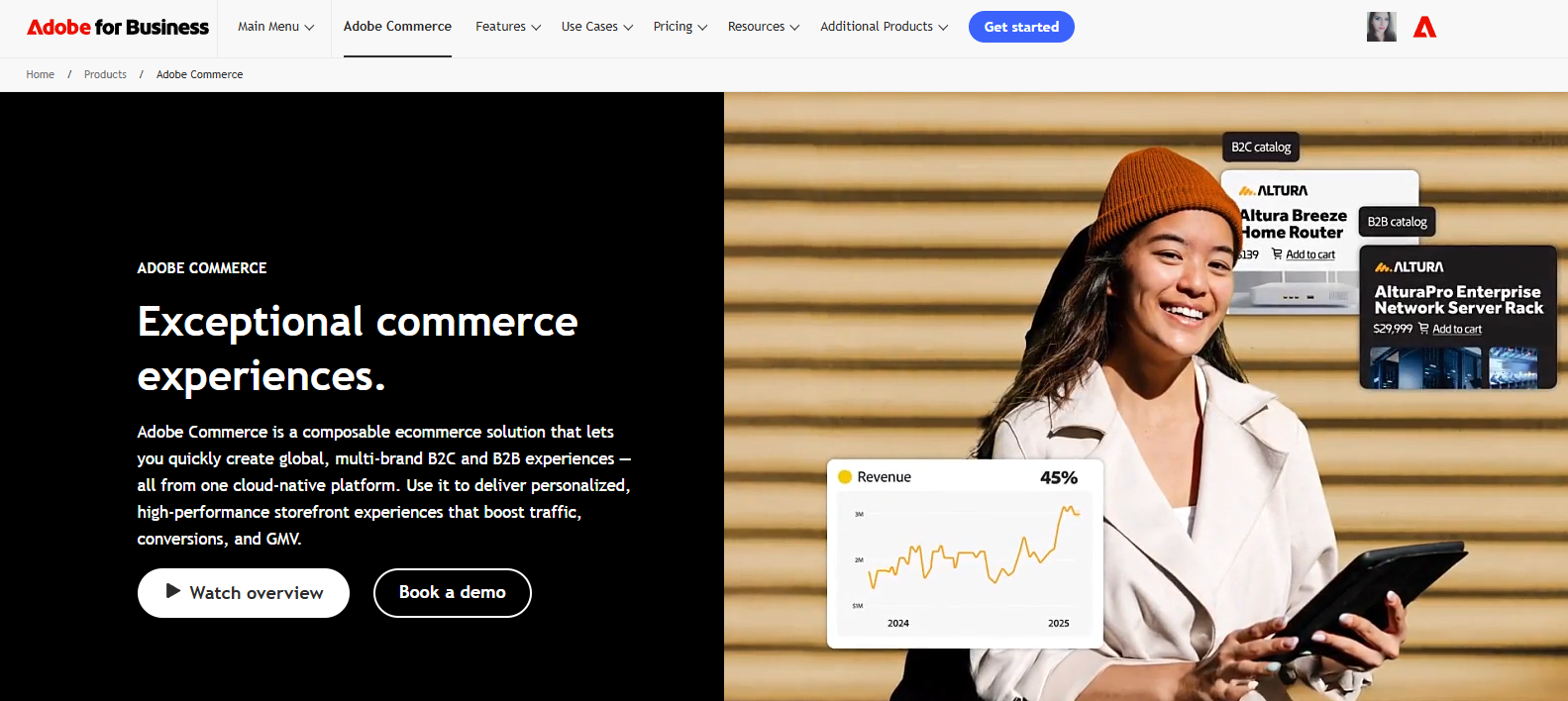
Adobe Commerce is a mature eCommerce platform with broad adoption across B2C and B2B enterprise segments.
Built on the open-source Magento foundation, it offers extensive customization and a large extension network via the Commerce Marketplace.
It’s deeply integrated with the Adobe Experience Cloud, making it a natural home for digital commerce within the broader Adobe stack.
Best for
Adobe Commerce suits enterprise businesses with significant B2C volume alongside their B2B operations. It’s particularly strong for teams already using Adobe Experience Manager, Marketo Engage, or Adobe Analytics who want to enhance customer experiences across both channels.
Key features
- B2B account management: Company account structures, customer accounts, requisition lists, purchase order workflows, and credit limits included out of the box.
- Customer-specific pricing: Multiple price books, customer group pricing, and flexible payment options configurable at the account level.
- Composable commerce platform: API-first architecture lets engineering teams extend or replace storefront components without overhauling the full stack.
- Marketing tools and personalization: Native connection to Marketo Engage for marketing automation, Adobe Analytics for customer data, and Real-Time CDP for customer engagement and personalization across online stores.
- Inventory management systems: Support for multiple warehouse sources, shipping rules, and backorder handling within the native OMS.
- Robust integration capabilities: A large extension network and third-party connectors cover ERP, CRM, and logistics, though deep integrations often require custom development.
- Multi-brand and multi-site: Manage multiple brands, languages, and storefronts from a single installation, valuable for enterprise businesses managing a portfolio of business units.
Pricing
Custom pricing scales with transaction volume and feature set. Adobe Commerce on Cloud reduces infrastructure management overhead for teams without deep DevOps capacity.
3. Commercetools
Commercetools is the leading API-first, headless B2B ecommerce platform built on a microservices architecture. It pioneered the MACH (Microservices, API-first, Cloud-native, Headless) approach and remains the reference for engineering-heavy teams that want maximum control over their existing tech stack.
Best for
Enterprise businesses with strong engineering teams that need a flexible platform to build truly custom customer experiences at scale. Organizations that require a composable, modular architecture to support unique business processes or complex multi-market rollouts will benefit most.
Key features
- Composable commerce platform: Commercetools exposes every capability (catalog, pricing, cart, checkout, order management, and customer data) as independent APIs for full composability.
- API-first architecture: Over 300 REST and GraphQL APIs give developers granular control over every function, connecting to virtually any existing tech stack or third-party tools.
- B2B Commerce module: Account hierarchies, customer-specific pricing, approval workflows, quote management, and self-service account management available natively.
- Software as a service on cloud infrastructure: Hosted on Google Cloud and AWS, eliminating infrastructure management overhead.
- Robust integration capabilities: Connect to any ERP, CRM, PIM, or marketing platform via open APIs, enabling businesses operating across diverse regions and sales channels.
- Multi-site and multi-market: Run multiple brands, regions, and business models from a single backend, enabling businesses to expand into new markets without rebuilding.
- Flexible platform for unique build requirements: Composable microservices let teams swap components without vendor lock-in, at the cost of significant development investment.
Pricing
Custom enterprise pricing is based on transaction volumes and modules selected. A free trial is available for development and evaluation.
4. SAP Commerce Cloud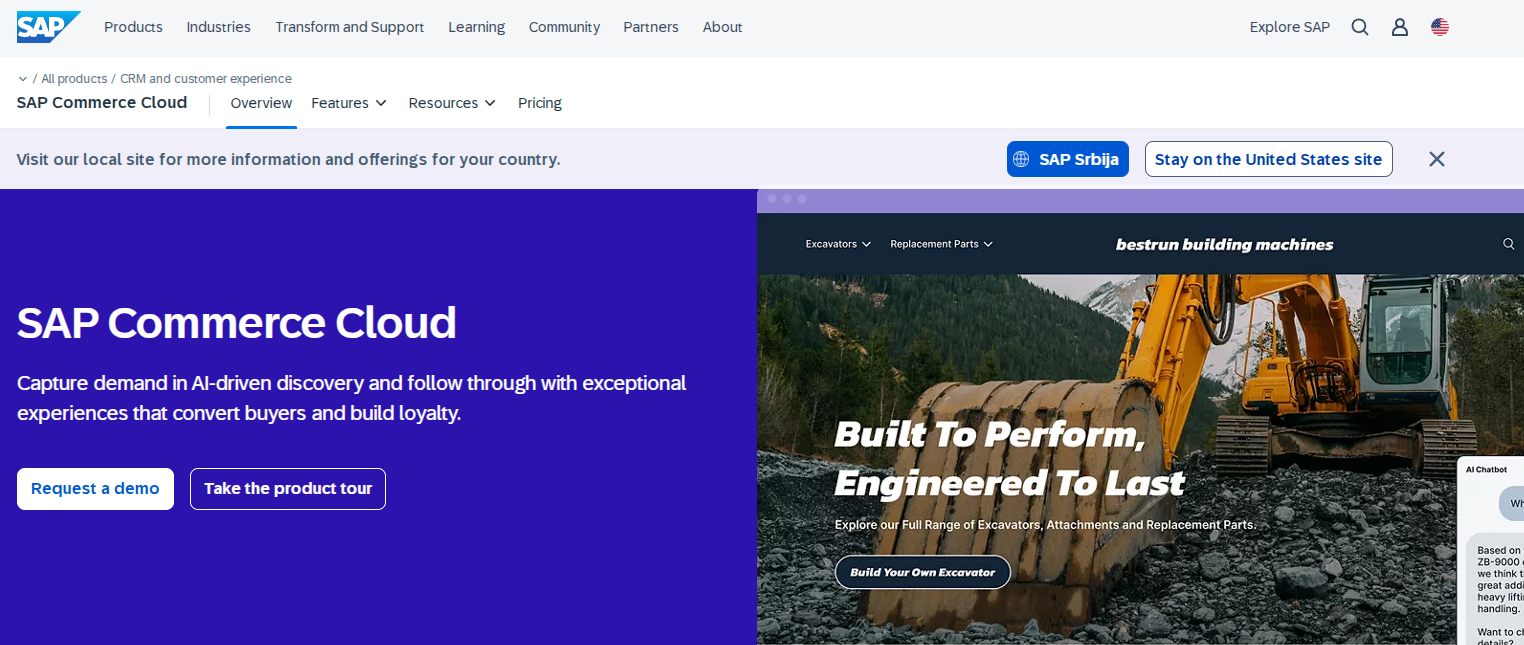
SAP Commerce Cloud (formerly SAP Hybris) is the enterprise commerce solution within the SAP environment. Designed primarily for large organizations already running SAP ERP or SAP S/4HANA, it extends enterprise resource planning capabilities into digital commerce for both B2B and B2C scenarios.
Best for
Organizations with SAP at the center of their business operations. If your ERP, inventory management, and customer data all live in SAP, you’re already ahead. Seamless integration with pricing, inventory, and order data removes many of the middleware challenges that complicate ERP integration on other enterprise platforms.
Key features
- Deep SAP ecosystem integration: Native connectors to SAP S/4HANA and SAP ERP for real-time data sync across pricing, inventory management, and orders, with no custom middleware required.
- Complex catalog management: Customer-specific pricing, custom pricing rules, and configurable products covering high-SKU B2B scenarios.
- B2B account and self-service: Account hierarchies, managing corporate accounts, self-service capabilities for buyers, approval workflows, and quote management are all supported natively.
- Omnichannel commerce: Consistent experience across web, mobile, and in-store sales channels with strong omnichannel order management.
- SAP Ariba integration: Direct connection to SAP’s procurement systems enables punchout and buyer-side eProcurement workflows.
- SAP CX for customer engagement: Marketing automation, personalization, and customer data management through the integrated SAP CX suite.
- Microservices extensibility: Extend the platform for unique business processes via microservices, though it adds significant configuration complexity.
Pricing
Custom enterprise pricing through SAP licensing. Total cost of ownership is typically high and requires experienced SAP implementation partners.
5. Salesforce B2B Commerce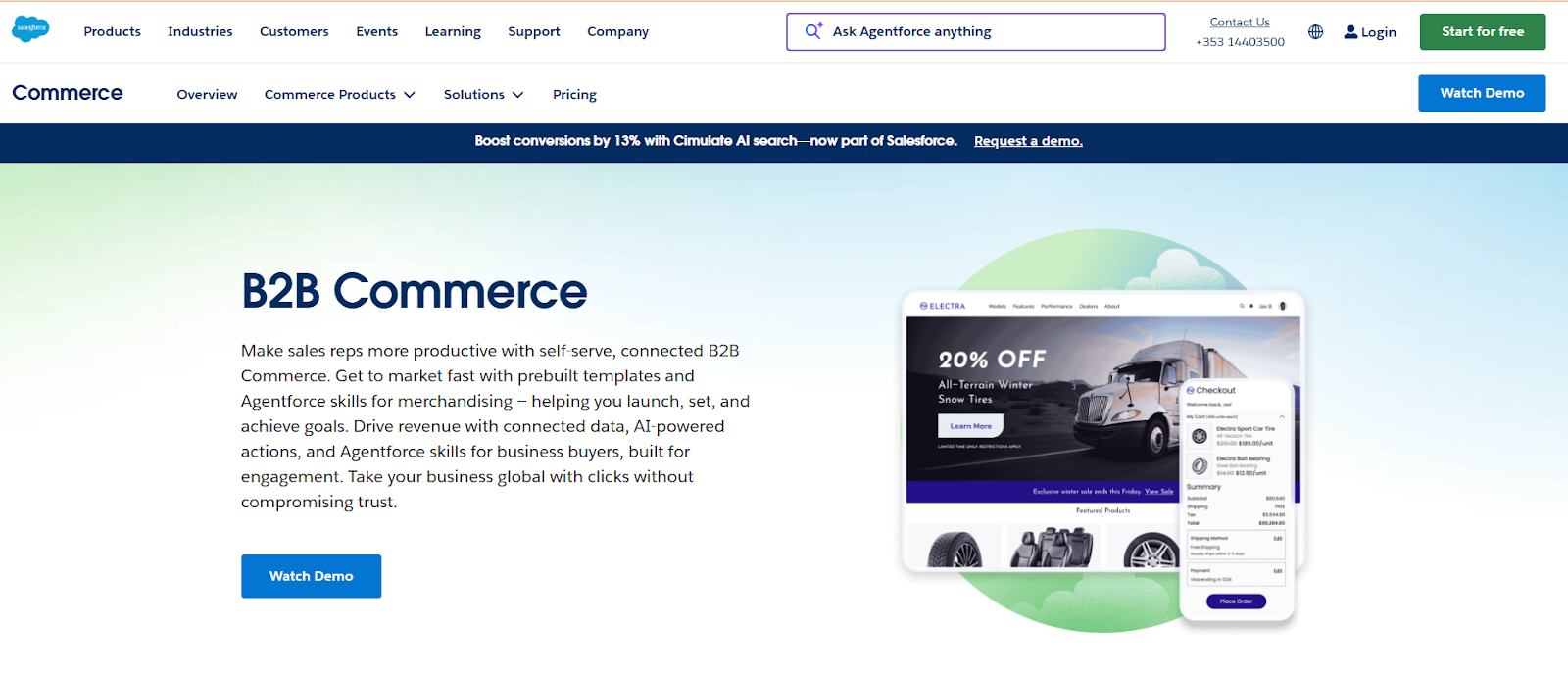
Salesforce B2B Commerce (part of Salesforce Commerce Cloud) is built natively on the Salesforce platform, letting businesses run digital commerce directly within the Salesforce environment. For organizations where the sales team and customer relationship management drive revenue, it offers integrated CRM capabilities.
Salesforce B2B Commerce has narrower native B2B capabilities than purpose-built platforms, particularly for complex sales processes involving CPQ, RFQ, or high-SKU catalog management.
Best for
Organizations with significant investment in the Salesforce CRM environment that want to extend into digital self-service commerce without managing a separate ecommerce platform. It’s the best fit when ecommerce capabilities need to be tightly coupled to pipeline and service data.
Key features
- Native Salesforce CRM integration: Shares customer data, customer accounts, and pipeline data with Sales Cloud and Service Cloud, with no synchronization required between commerce and CRM systems.
- Unified view for the sales team: Sales reps see customer behavior, customer preferences, and account status in one place, supporting integrated CRM capabilities and more effective sales force automation.
- Customer self-service features: Buyer portal for reordering, invoice access, and self-service account management, with B2B-specific approval workflows and account hierarchies.
- Flexible payment options: Multiple payment methods, credit management, and purchase order support are configurable per account.
- Marketing automation via Marketing Cloud: Extends customer engagement across email, web, and digital channels from within the Salesforce environment.
- Salesforce AppExchange: Thousands of third-party integrations extend ecommerce capabilities across analytics, POS, and more.
- SaaS platform scalability: Cloud-native architecture scales reliably as transaction volumes grow, though ERP integration typically requires third-party connectors rather than native ones.
Pricing
Custom enterprise pricing is based on the Salesforce products included and transaction volume.
Why OroCommerce Is the Best Enterprise B2B eCommerce Platform
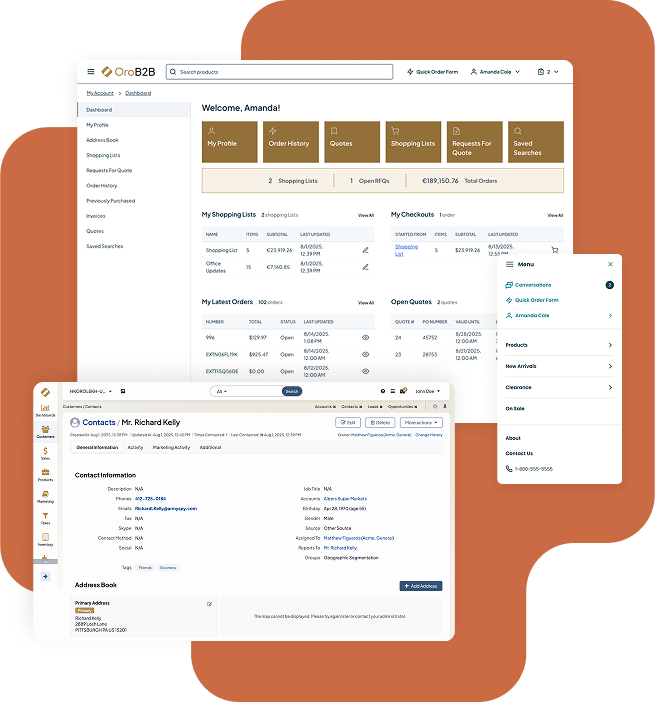
Most B2B commerce platforms started in retail and were adapted for wholesale. OroCommerce was built the other way around, for manufacturers, distributors, and wholesalers from day one, with all core B2B capabilities working out of the box. That structural difference matters more than it sounds.
When customer data sits in your CRM, pricing rules live in the ERP, and inventory management runs separately, your teams answer buyer questions by checking three systems. Orders stall because nothing verifies credit limits, contract terms, or availability in one place.
New-market launches are slow because every region must rebuild business operations and customer experience logic from scratch. OroCommerce fixes this by running all core functions (eCommerce, CRM, CPQ, invoicing, payments, and order management) on a single shared platform with a single consistent data layer.
Here’s what that delivers for your business:
- Your sales team and buyers work from the same data. Quotes, orders, invoicing, and payments flow through one process with no middleware. Sales reps and buyers see identical pricing and account status in real time.
- ERP integration is pre-built, not custom. Native connectors for SAP, NetSuite, Microsoft Dynamics, Infor, and JD Edwards keep your sales data and inventory accurate. No fragile middleware to maintain.
- Run multiple business units from one instance. Multi-org, multi-site, and B2B2X models are built into the core architecture. Azelis runs 150 portals on a single OroCommerce instance.
- AI tools are included, not an add-on. SmartOrder uses AI and OCR to automate order entry from emailed purchase orders. AI-powered search, back-office task execution, and in-portal messaging are included at no additional cost.
- One license covers everything. No per-site fees, no per-user charges, no usage-based pricing that scales against you. Every essential feature (CPQ, CRM, PIM, DAM, marketplace tools, invoicing, and payments) is included.
OroCommerce is recognized in Gartner’s Magic Quadrant for Digital Commerce and was named a Leader in IDC MarketScape for B2B Digital Commerce for Midmarket Growth.
For manufacturers, distributors, and wholesalers with complex requirements that other platforms handle through add-ons, OroCommerce handles them natively.
What would your B2B commerce architecture look like without the workarounds?
How to Choose the Right Enterprise B2B eCommerce Platform
There’s no universal answer. But there’s a structured way to get to yours.
Define your ERP integration requirements first
Start by auditing your existing systems, particularly your ERP. Ask what level of connection your commerce operation requires: real-time inventory availability, live contract pricing, or bidirectional order reconciliation.
Refer to the eCommerce integration guide to map your integration architecture before evaluating any platform.
If you run Microsoft Dynamics, SAP, or NetSuite, prioritize platforms with verified, production-grade connectors over those that offer only general API compatibility. Custom middleware adds cost and long-term risk.
Match architecture to your engineering team
Strong in-house engineers? Lean IT team or priority on speed?
OroCommerce deployment gives you maximum flexibility. A purpose-built B2B SaaS platform delivers more out of the box and reduces integration surface area.
The decision to adopt a unified commerce architecture has long-term consequences. Get engineering leadership in the room before committing.
Evaluate the total cost of ownership, not just license fees
A lower headline license cost can easily become more expensive over three years once integration development, customization, upgrades, and support are accounted for.
Pay attention to API rate limits and transaction-based pricing tiers that scale with your growth.
The B2B eCommerce supply chain management angle belongs in your TCO model, too, since platforms that require separate OMS or supply chain tools add both cost and integration complexity.
Run a narrow pilot before full deployment
Integrate your ERP, CRM, and one buyer segment to validate core workflows before committing to a full rollout. This surfaces integration friction, performance gaps, and UX issues before they affect your customer base.
Use the KPI framework below to establish baselines during the pilot so your rollout roadmap is grounded in real data.
KPIs to Measure After Deploying an Enterprise B2B eCommerce Platform
Deployment is not the finish line. Track these metrics to confirm that your platform delivers commercial, operational, and buyer enablement value.
Revenue per account and average order value measure whether digital commerce is expanding wallet share or simply shifting channels. Flat average order value post-launch typically signals a gap in cross-sell capability or low customer self-service adoption.
Order cycle time and fulfillment accuracy reflect operational efficiency gains from seamless ERP integration and automated order management. Reduction in processing time is often the fastest, most measurable ROI from an enterprise ecommerce deployment.
Days’ sales outstanding should decrease as AR automation replaces manual invoicing. Flexible payment options, automated credit management, and digital invoice access all contribute to faster collections.
Self-service adoption rate and support ticket volume are the clearest signals of buyer enablement. Rising customer self-service adoption and declining ticket volume free your sales team to focus on new markets and high-value account management rather than order entry and status queries.
Conclusion About Enterprise B2B eCommerce Platforms
No single enterprise B2B eCommerce platform is right for every organization. SAP Commerce Cloud makes sense if your entire stack is SAP. Salesforce B2B Commerce is compelling when Salesforce CRM is your system of record.
Commercetools is the right choice for teams with the engineering resources to build a fully composable solution. Adobe Commerce fits brands that need to unify B2B and B2C under a marketing-rich platform.
But for manufacturers, distributors, and wholesalers with complex B2B requirements, OroCommerce is the standout choice.
It’s the only platform here that was purpose-built for enterprise B2B from the ground up. Native CRM, integrated CPQ, pre-built ERP connectors, and a unified architecture come standard, with no need to stitch together separate systems.
Walk through your use case with a commerce specialist.