
navigation

Moving B2B commerce online often exposes how much happens beyond the storefront. Contract pricing, quoting, approval workflows, and ERP integrations all need to work together. The commerce platform you choose affects how much of that functionality comes built in and how much requires additional development or software.
In this digital transformation eCommerce tools comparison, we examine five platforms: OroCommerce, Adobe Commerce, Intershop, Kibo Commerce, and BigCommerce B2B Edition. We compare their B2B capabilities, where each fits best, and what to consider when evaluating pricing and implementation requirements.
What Is Digital Transformation in eCommerce?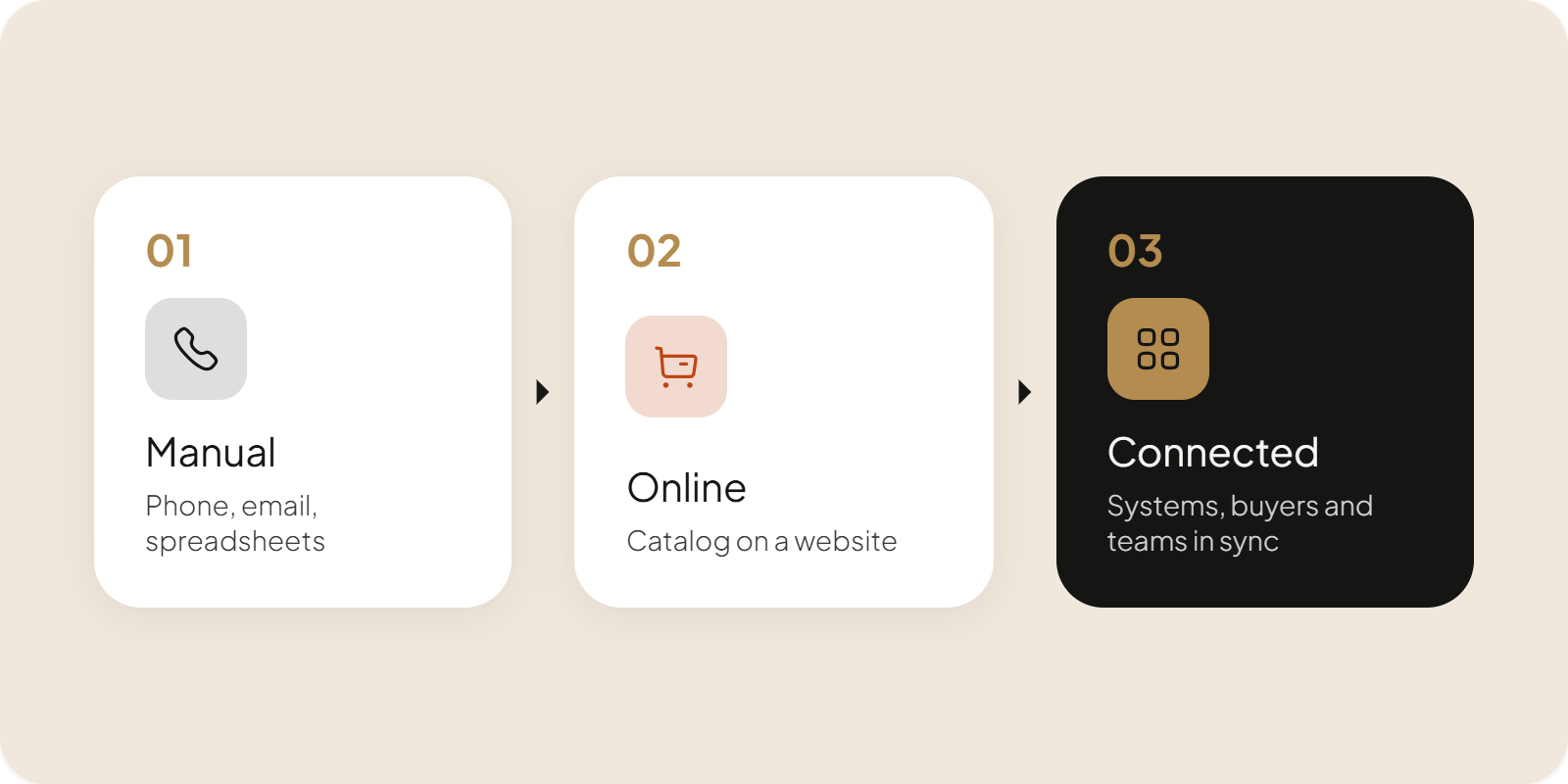
Digital transformation in eCommerce connects the systems and people involved in everyday business operations, from ordering and pricing to quoting and customer support. For ecommerce businesses, that means giving buyers and sales teams access to the same information across digital channels.
In B2B, this takes more than putting a catalog online. Contract pricing, approval workflows, and ERP integrations must reflect how each customer buys, whether you’re selling parts, chemicals, or services online.
Buyers also move between channels. According to McKinsey’s 2026 B2B Pulse Survey, B2B buyers use an average of 10 interaction channels. They expect the convenience of online shopping, but they also want to work with sales reps when needed. A good self-service experience supports both.
Ultimately, the goal is empowering businesses to serve more customers without increasing manual work at the same rate, while making it easier for buyers to do business with them.
Why B2B digital transformation starts with the right platform
Delivering that connected experience depends partly on what your existing platform can support. Before evaluating new tools, consider whether your current setup is keeping up with changing business needs.
Some signs of trouble include:
- New sales channels or business models require extensive custom development.
- Pricing and availability differ across channels because business systems struggle to stay in sync.
- Acquisitions make it increasingly difficult to manage inventory and customer data across multiple ERPs.
- Upgrades become expensive or risky because of accumulated customizations.
These issues don’t automatically call for a new platform. Some can be resolved through better integrations, data management, or process improvements. Others may limit what you can do next, including with AI-powered eCommerce.
Our B2B replatforming guide helps you assess when to improve your current setup and when to consider replacing it.
How to Evaluate eCommerce Tools for Digital Transformation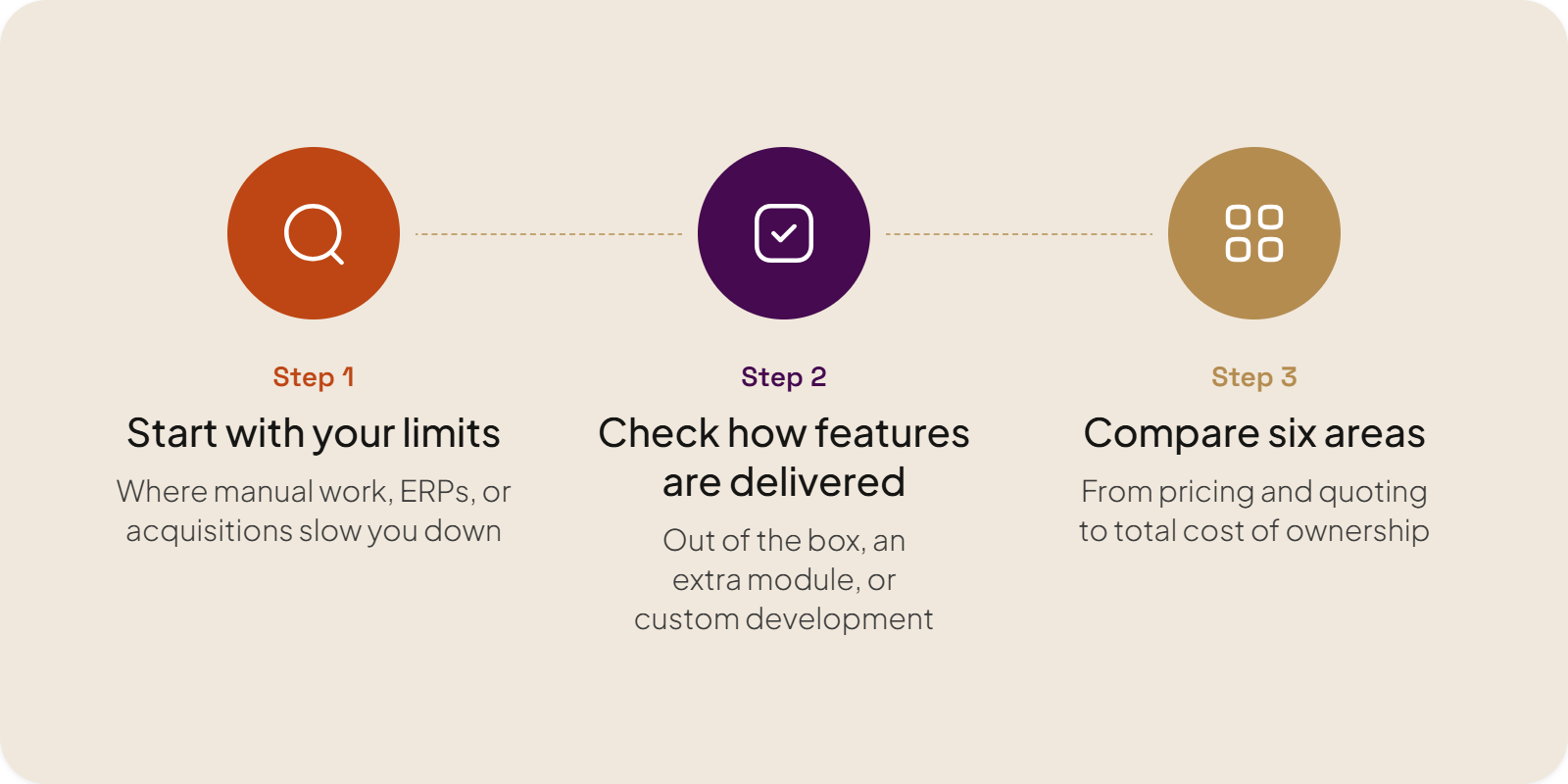
Your current platform’s limitations should help shape how you evaluate alternatives. If quoting involves too much manual work, test the full quote-to-order process. If acquisitions keep adding ERPs, examine how each platform handles those integrations.
Don’t take a vendor’s feature checklist at face value. A capability might be included out of the box, require additional modules, or depend on custom development. That affects both implementation costs and long-term maintenance.
The six areas below cover the essential features and costs worth comparing when shortlisting B2B eCommerce platforms.
Six Areas to Evaluate in a B2B eCommerce Platform
- B2B pricing and quoting: Customer-specific price lists, request for quote (RFQ) for buyer-initiated quotes, and configure, price, quote (CPQ) software for complex products.
- Catalog and content management: Product information management (PIM) for product data and digital asset management (DAM) for images and documents.
- ERP and third-party integrations: APIs and connectors that sync orders, stock, and invoices with the enterprise resource planning (ERP) system.
- Multi-site and multi-currency selling: Separate storefronts, languages, and price books in multiple currencies for each brand or region.
- Automation and AI: Workflow rules, marketing automation, and AI that take repetitive tasks such as order entry off your team.
- Total cost of ownership: License, implementation, extensions, hosting, and internal IT time.
Questions to ask before you shortlist
- Which buying tasks still need a sales rep today?
- How many systems must the new platform connect?
- Does your team have developers to build and maintain extensions?
- Will you add brands, regions, or acquired companies? If so, compare approaches to B2B multi-site management.
Building your B2B eCommerce RFP?
Use our template to document your requirements and assess vendor capabilities.
Digital Transformation eCommerce Tools Comparison at a Glance
The table below compares five eCommerce platforms, their approaches to B2B functionality, and the types of businesses they’re best suited for.
Depending on your requirements, other tools, such as Salesforce Commerce Cloud, may also be worth evaluating.
| Tool | Platform type | Best for | Starting price |
|---|---|---|---|
| OroCommerce | B2B suite (SaaS, private cloud, or on-premises) | Manufacturers, distributors, wholesalers | Custom quote, all-in-one |
| Adobe Commerce (Magento) | Extensible platform (cloud or on-premises) | B2C and B2B businesses needing extensive customization | Custom quote |
| Intershop | B2B suite (SaaS/PaaS on Microsoft Azure) | Procurement-driven manufacturers | Custom quote |
| Kibo Commerce | Composable, API-first | Fulfillment-heavy omnichannel sellers | Custom quote (order lines) |
| BigCommerce B2B Edition | SaaS platform with B2B Edition | Mid-market brands adding wholesale | Custom quote |
Table 1: Quick comparison based on vendor documentation, October 2026.
All five vendors quote B2B pricing individually. The profiles below show how each one charges.
Compare eCommerce Platforms by Use Case with the 2026 Gartner® Critical Capabilities Report
Five eCommerce Tools for Digital Transformation Compared
Each profile covers what the tool does, who it suits, four core capabilities, and pricing.
OroCommerce
OroCommerce is a B2B eCommerce platform that combines commerce, customer relationship management connects customer interactions with quotes, orders, and support cases, giving sales and service teams a shared view of each account.
Its open, API-first architecture supports integrations with existing ERPs and other business applications, with SaaS, private cloud, and on-premises deployment options.
Best for
Manufacturers, distributors, and wholesalers with complex sales processes: negotiated quotes, contract pricing, approval chains, and several ERPs or brands to run from one backend.
Key features
- Native CPQ and RFQ: Buyers request quotes in their portal, and approved quotes convert straight into orders.
- Portals for buyers and reps: Buyers reorder, manage invoices, and message your team online, while reps use a field sales app that works offline.
- Multi-organization backend: Each brand, region, or acquired company runs its own storefronts, catalogs, and price lists on one instance.
- AI and automation: AI SmartOrder automates purchase order processing, while OroIQ provides natural-language access to supported back-office tasks and business data.
Pricing
Custom pricing based on gross merchandise value (GMV), internal admin users, and deployment. Enterprise plans include 25 admin users, with no additional license fees for buyer accounts, storefronts, or SKUs. Account management and core AI capabilities are included. OroPay handles payment processing for cards, ACH, and invoices, with transaction fees but no separate license fee.
See the OroCommerce pricing page for details, or book a demo to get a quote for your setup.
Adobe Commerce (Magento)
Adobe Commerce supports B2C and B2B sales on one customizable platform, enabling companies to serve different customer types through tailored storefronts. Its open architecture and extension marketplace offer flexibility for customizing purchasing workflows and integrations.
Adobe Commerce Intelligence also provides detailed analytics through reporting dashboards and custom reports.
See our list of Adobe Commerce competitors and our Adobe Magento vs. Salesforce comparison for B2B.
Best for
Brands and B2B sellers with in-house or agency developers who want code-level control over the storefront and checkout.
Key features
- Company accounts: Manage business customers with organizational hierarchies, user roles, and purchasing permissions.
- Shared catalogs: Assign customer-specific product assortments and pricing to different companies.
- Negotiable quotes: Buyers and sales reps can negotiate pricing and convert agreed quotes into orders.
- Purchase order approvals: Configure purchasing rules and approval limits for different company users.
Pricing
Adobe Commerce uses custom pricing. Magento Open Source is a separate, free edition backed by community support, but it doesn’t include Adobe Commerce’s B2B functionality. Development, extensions, and hosting may add to the total cost.
Intershop
Intershop is a German B2B commerce vendor. It focuses on manufacturers, wholesalers, and holding companies. Intershop’s platform runs as SaaS/PaaS on Microsoft Azure. It supports multi-brand, multi-region eCommerce operations that sell across multiple channels.
Intershop also appears in our review of SAP Commerce Cloud competitors for enterprise B2B.
Best for
Manufacturers and wholesalers whose buyers order through procurement systems and need budgets, cost centers, and approvals.
Key features
- Buyer self-administration: Buyer admins get management tools for cost centers, budgets, and users, plus multi-step approvals.
- OCI and cXML punchout: Catalogs connect directly to buyers’ ERP and procurement software.
- Integrated PIM: Product management sits inside the commerce core instead of a separate system.
- Copilot for Buyers and Copilot for Merchants: These AI-powered tools identify spare parts from images and run agents for routine merchant work.
Pricing
Custom quote. Intershop sells a base subscription plus optional components, and you buy its AI copilots and agents through credit-based subscriptions.
Kibo Commerce
Kibo Commerce is a composable commerce vendor whose B2C, B2B, order management, and subscription modules run on shared microservices. It follows MACH principles (microservices, API-first, cloud-native, headless), so you can deploy one module first and add others in phases.
Kibo also features in our review of platform options for B2B suppliers.
Best for
Omnichannel sellers whose ecCmmerce operations depend on complex fulfillment across stores, warehouses, and drop-ship partners.
Key features
- Order routing: Real-time inventory management and order promising span every fulfillment location.
- Account hierarchies: Nested business accounts with roles, permissions, and spending limits support customer management at scale.
- Quotes and contract pricing: The full quote lifecycle runs alongside tiered, volume-based, and custom pricing.
- KIBO AI: Natural-language queries deliver advanced analytics, so merchants make data-driven decisions without building reports.
Pricing
Custom quote with a flexible pricing model. Packages range from Starter to Complete, and Kibo prices on order lines ingested rather than GMV.
BigCommerce B2B Edition
BigCommerce is a SaaS provider that lets you launch and run an online store without managing hosting. B2B Edition adds wholesale capabilities, and a WordPress plugin lets content teams run storefronts on WordPress sites.
Its free Feedonomics Surface tool enables businesses to sync product feeds for marketing campaigns on Google, Microsoft, and social media platforms.
Compare BigCommerce alternatives for enterprise B2B, read BigCommerce vs. Salesforce for B2B, or see how it ranks among industrial B2B eCommerce platforms.
Best for
Small and medium-sized businesses and D2C ecommerce brands that want a user-friendly interface and a quick wholesale channel.
Key features
- Company hierarchies: Admins set pricing and catalog access by parent company, subsidiary, department, or individual buyer.
- Built-in CPQ: One quoting engine creates quotes for both B2B and B2C buyers.
- Account payment terms: Admins manage purchase orders, credit cards, net terms, and credit limits for each company.
- Multiple storefronts: Several storefronts run on one back end, with open APIs for ERP, OMS, and CRM integrations.
Pricing
B2B Edition needs the Performance plan, which starts at $1,499/month billed annually. BigCommerce doesn’t publish a separate B2B Edition price, so you’ll need a quote.
Lower plans start at $29/month and cover basic features. Advanced features such as price lists also require Performance.
Head-to-Head: Digital Transformation Capabilities Compared
Native depth is the biggest difference. Some platforms ship B2B capabilities out of the box. Others need extensions, apps, or integrations.
This scorecard rates each platform’s capabilities using vendor documentation reviewed in October 2026. Confirm each rating in a demo before you decide.
Rating definitions:
- Built in: Available within the platform’s B2B offering.
- Add-on: Requires an additional product or license.
- Integration: Uses a separately managed software system.
| Capability | OroCommerce | Adobe Commerce | Intershop | Kibo | BigCommerce B2B Edition |
|---|---|---|---|---|---|
| Customer-specific pricing | Built in | Built in | Built in | Built in | Built in |
| RFQ and negotiated quotes | Built in | Built in | Built in | Built in | Built in |
| Buyer approval workflows | Built in | Built in | Built in | Built in | Built in |
| Sales CRM | Built in | Integration | Integration | Integration | Integration |
| Product information management (PIM) | Built in | Integration | Built in | Integration | Integration |
| Digital asset management (DAM) | Built in | Add-on | Integration | Integration | Integration |
| Multi-site and multi-brand selling | Built in | Built in | Built in | Built in | Built in |
Table 2. Based on vendor documentation reviewed in October 2026. Ratings describe how capabilities are provided, not their functional depth. PIM and DAM refer to dedicated management capabilities beyond basic catalog editing or media storage.
- Native beats bolted-on: Native CRM, quoting, and PIM share one data model, so you skip the sync jobs that app-based or composable setups need.
- Extensions add upkeep: In a multi-vendor ecommerce environment, every app adds a license, an update cycle, and a failure point to monitor.
- Time to launch follows: For most e-commerce businesses, fewer integrations mean a faster go-live. One API-first backend still feeds storefronts, mobile apps, and punchout catalogs.
How to Choose the Right Tool for Your Business
All five platforms are scalable eCommerce solutions. Pick the one whose native capabilities match how your buyers already purchase.
Match the platform to your business model
- OroCommerce: Manufacturers and distributors with complex B2B sales processes, multiple business units, or several ERPs.
- Adobe Commerce: Businesses combining B2C and B2B customer experience that needs extensive customization.
- Intershop: Manufacturers and wholesalers serving customers with structured procurement processes, including punchout and approvals.
- Kibo Commerce: Omnichannel businesses with complex order routing and fulfillment requirements.
- BigCommerce B2B Edition: Growing brands adding wholesale capabilities to their existing B2C operations.
Budget beyond the license
The license is one line in the eCommerce total cost of ownership. Plan for these costs too:
- Implementation: Partner or agency fees for setup, data migration, and integrations.
- Extensions and apps: Monthly fees for search, reviews, email marketing, and other marketing tools.
- Hosting and maintenance: Infrastructure, upgrades, and security patching for self-hosted options.
- Internal IT time: Hours spent maintaining integrations, scripts, and automation tools.
Want more options? See our roundup of eCommerce platforms for B2B self-service. If you sell internationally, compare B2B platforms built for global trade.
Why OroCommerce Is the Best Digital Transformation eCommerce Tool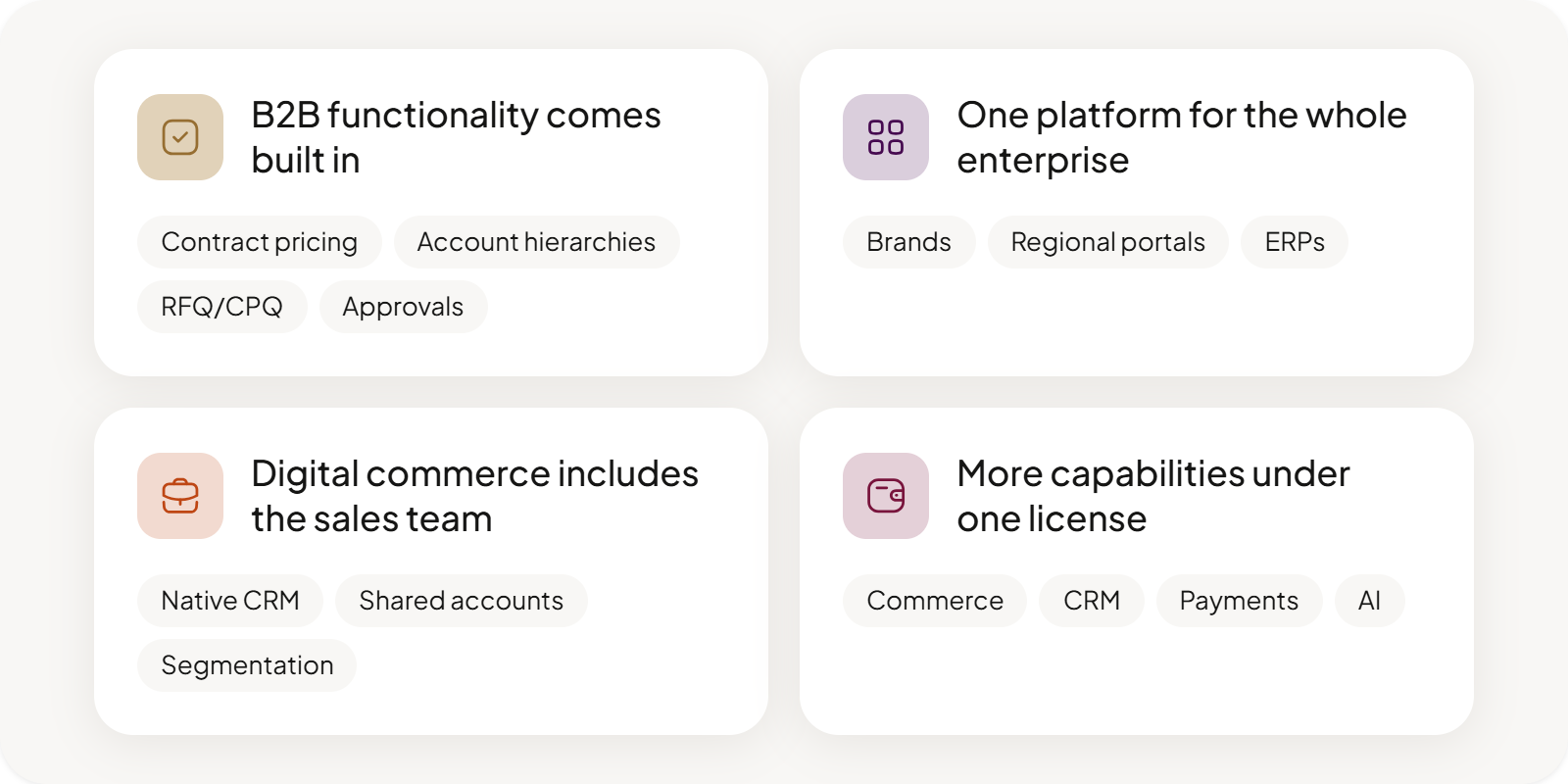
OroCommerce was built for manufacturers and distributors whose operations involve multiple business entities, complex buying rules, and existing enterprise systems. Here’s what makes its approach different:
- B2B functionality comes built in. Contract pricing, account hierarchies, RFQ/CPQ, and approval workflows are configurable out of the box. Businesses can adapt these processes to their needs rather than spend months developing basic B2B functionality.
- One platform can support the whole enterprise. Run multiple brands, regional portals, and ERPs on one instance. Expansion doesn’t require separate commerce licenses, while granular permissions and flexible deployment options support robust security measures.
- Digital commerce includes the sales team. Native CRM connects customer engagement with quoting and ordering. Buyers and reps work with shared account information, while customer segmentation helps tailor catalogs and offers.
- More capabilities come under one license. Commerce, CRM, payments, and AI are included, reducing dependence on separately licensed products. SmartOrder automates purchase order entry, while built-in tools support data analysis of sales trends and let teams create customized reports.
Proof at enterprise scale: Lactalis used OroCommerce to expand across 12 markets, onboarding 15,000 customers while increasing digital orders by 230% and reducing manual business processes by 44%.
OroCommerce has been recognized in the Gartner® Magic Quadrant™ for Digital Commerce for six consecutive years.
See how Gartner evaluated OroCommerce alongside other digital commerce providers, including its strengths and cautions.
A Practical Plan for Your eCommerce Digital Transformation
An eCommerce digital transformation moves through four steps: audit, shortlist, phased integration, and launch with continuous optimization.
Four steps to move from legacy systems to a unified platform
- Audit current systems and problems. Map every tool, ERP, and manual handoff in your order flow.
- Shortlist and run a demo. Test two or three platforms against your real quotes, price lists, and approval flows.
- Integrate ERP and migrate data in phases. Start with one region or brand, then expand once the order flow is stable.
- Launch and optimize with buyer feedback. Use analytics tools to track customer behavior in the portal, then fix the biggest friction points first.
During the audit, record key metrics such as order volume, website performance, and traffic from search engines and social media. Google Analytics and Google Search Console give you that baseline.
A phased rollout keeps risk low. It also gives every later market a tested template.
Final Words About Digital Transformation eCommerce Tools Comparison
All five platforms can modernize an online business. They differ in how much B2B logic ships natively.
Adobe Commerce and Kibo Commerce add B2B through modules, and BigCommerce adds it through B2B Edition. OroCommerce and Intershop build it into the core.
- Mid-market teams that want SaaS simplicity: BigCommerce B2B Edition offers fast setup on a hosted platform.
- Omnichannel sellers with complex fulfillment: Kibo Commerce specializes in composable order routing.
- Complex B2B manufacturers and distributors: OroCommerce delivers quoting, CRM, and multi-organization selling in one system.
Complex B2B transformation favors a unified, B2B-native suite that supports business growth without more tools to maintain. Book a demo to see OroCommerce run your own buying scenarios.
FAQs About Digital Transformation eCommerce Tools Comparison
What are the best eCommerce tools for digital transformation?
The leading options in 2026 are OroCommerce, Adobe Commerce, Intershop, Kibo Commerce, and BigCommerce B2B Edition. ERP-centric teams also weigh Sana Commerce competitors and alternatives.
OroCommerce suits complex B2B sellers, and Adobe Commerce suits teams that want code-level control. Intershop fits procurement-driven manufacturers, Kibo Commerce fits fulfillment-heavy omnichannel sellers, and BigCommerce B2B Edition fits mid-market brands.
Which ecommerce platform is best for B2B digital transformation?
A B2B-native platform with built-in quoting, contract pricing, and CRM is the strongest fit for B2B digital transformation. OroCommerce, the B2B ecommerce suite with built-in CRM, includes CPQ, RFQ, PIM, and a multi-organization backend in one system. That cuts the integrations a manufacturer or distributor must build and maintain.
How much does enterprise ecommerce software cost?
Most enterprise vendors price by custom quote. OroCommerce licenses by GMV band, Kibo Commerce prices by order lines, and Adobe Commerce and Intershop quote each deal individually.
BigCommerce B2B Edition requires the Performance plan, which starts at $1,499 per month billed annually. Implementation, hosting, and extensions add to the total.
Is OroCommerce better than Intershop for B2B?
OroCommerce and Intershop both serve B2B manufacturers and wholesalers. OroCommerce adds a native CRM, CPQ, and a multi-organization backend for running several brands or acquired companies.
Intershop is strong in procurement, with OCI and cXML punchout, cost centers, and budget approvals. OroCommerce fits sellers that want CRM and commerce in one system.
How long does ecommerce digital transformation take?
A phased B2B rollout takes months for the first market and longer for global scale. Lactalis, the French dairy group, onboarded 15,000 customers across 12 markets in about two years on OroCommerce. It started with three pilot markets, and later launches took a few months each.