
navigation

Some B2B orders take a few clicks. Others involve negotiated quotes, multiple approvers, and help from sales reps. And according to the Gartner 2026 survey, 70% of business buyers prefer a completely digital, self-service experience.
Supporting these different ways of buying is what makes choosing a B2B digital commerce platform challenging. It needs to meet customer expectations while handling complex pricing, account-specific rules, and enterprise resource planning (ERP) integrations.
This guide covers the capabilities worth prioritizing, compares leading platforms, and helps you figure out which approach fits your business.
What Is a B2B Digital Commerce Platform?
A B2B digital commerce platform is an online platform that manufacturers, distributors, and wholesalers use to sell to other businesses. It supports B2B purchasing requirements such as customer-specific pricing and catalogs, quote requests, order approvals, and repeat ordering. It can also connect to ERP and CRM systems to keep customer and order information consistent.
The terms B2B e commerce platform and B2B digital commerce platform are often used interchangeably. Whatever the terminology, a capable eCommerce platform should support more than online transactions. It should also improve how businesses interact with suppliers, from requesting quotes to tracking orders and managing their accounts.
B2B digital commerce vs B2C eCommerce
The biggest difference is focus. B2C platforms center on the shopper’s checkout. B2B platforms center on seller efficiency and the account relationship, so they need a different feature set:
1. Order size: bulk ordering by SKU, case, or pallet replaces single-item carts.
2.Pricing: negotiated pricing per account replaces one public price list.
3.Accounts: multi-user accounts include roles, budgets, and spending limits.
4.Approvals: a multi-step purchasing process routes orders to approvers before release.
5.Back office: heavy ERP dependence covers stock, credit, and invoices.
6.Timing: deals run on longer sales cycles compared with the impulse buying common in B2C ecommerce stores.
Common B2B commerce models
- Channel sales (indirect): a manufacturer sells through distributors, who resell to business clients.
- Direct sales: a manufacturer sells straight to the companies that use its products.
- Multi-vendor marketplace: one operator hosts many suppliers in a shared catalog.
- B2B2C: a business sells to partners and also reaches retail customers, often from the same backend.
Benefits of a B2B Digital Commerce Platform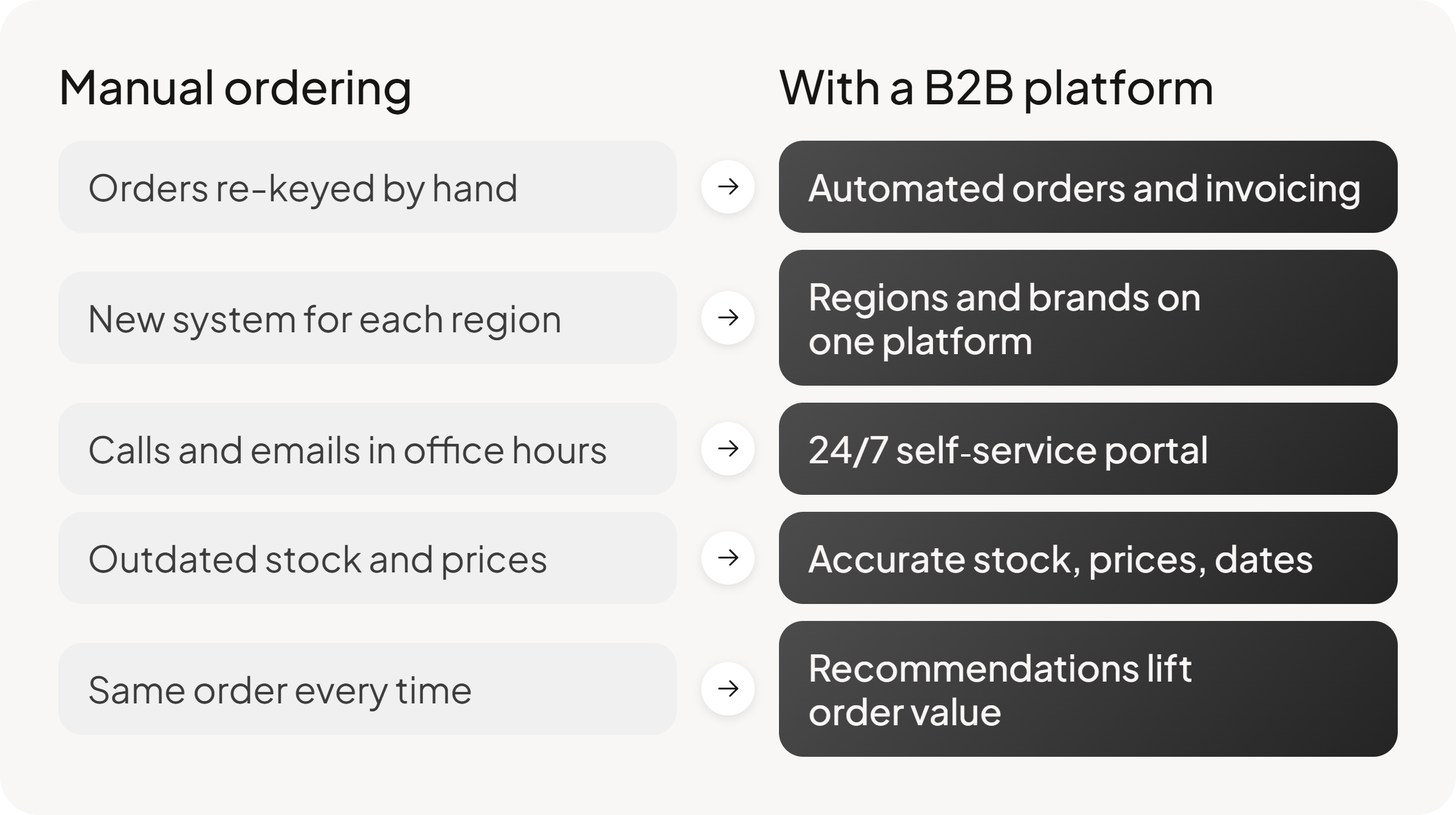
A B2B digital commerce platform helps reduce manual order processing, lower service costs, and make purchasing easier for customers.
- Operational efficiency: automated order capture and invoicing cut re-keying and errors.
- Faster expansion: new regions, brands, and multiple sales channels launch without new systems.
- 24/7 self-service: self-service portals for B2B buyers handle reorders and order status at any hour.
- Happier accounts: accurate stock, prices, and delivery dates improve customer satisfaction and customer retention.
- Bigger orders: recommendations and reorder lists encourage repeat purchases, lift average order value, and support sales growth per account.
Must-Have Features of a B2B Digital Commerce Platform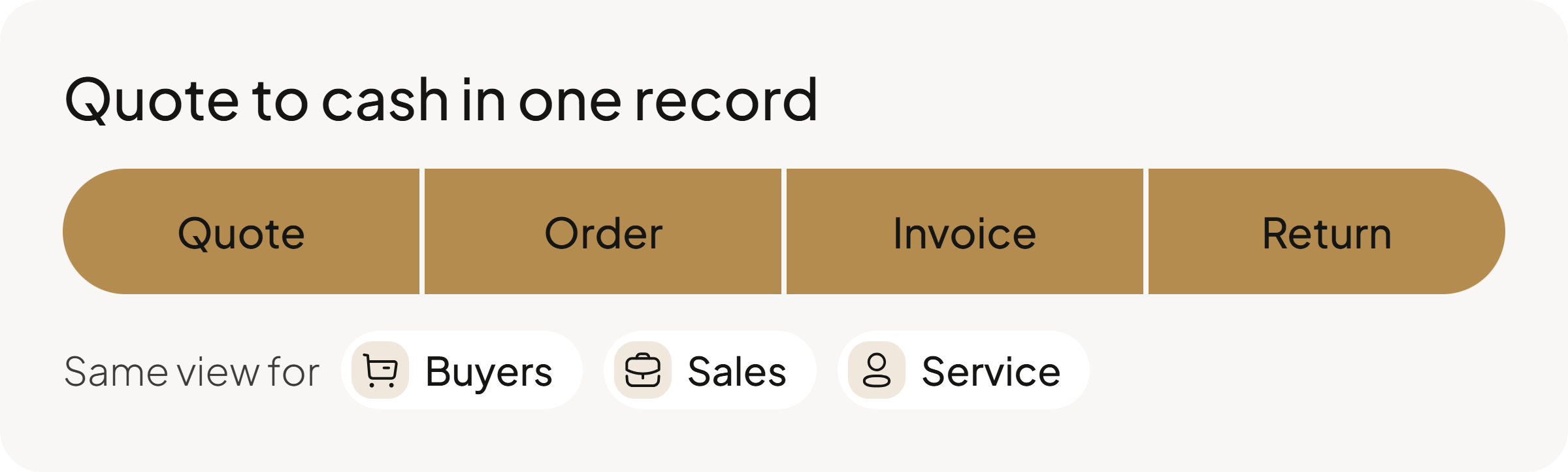
Every must-have feature on a B2B digital commerce platform fixes the same problem: buyers, sales, and service working from different data. Use the table below as your evaluation checklist.
Put quote-to-cash visibility first, so your teams and customers share one record.
| Feature | Buyer problem it solves | What to look for |
|---|---|---|
| Account management, quick ordering, and self-service | Buyers wait on sales for reorders and prices | Quick order forms and saved lists that win repeat business, customer-specific pricing on desktop and mobile devices, and self-service enabling customers to buy without a callback. Compare B2B self-service eCommerce platforms. |
| Quote-to-cash visibility in a single system | Teams and buyers see different order data | One shared record for quotes, orders, cases, and returns, so customer interactions stay in context and managers see the full sales process |
| Catalog, PIM (product information management), and pricing rules | Wrong specs or prices across sites | Central product data management, tiered pricing, volume discounts, contract pricing, and catalog search optimization |
| Quoting, RFQ, and CPQ (configure, price, quote) | Slow, error-prone quotes for configurable products | Online quote requests and approvals, custom pricing within set margins, and one-click quote-to-order conversion |
| Marketing campaigns and sales enablement | Generic offers and disconnected field teams | Segmentation by customer behavior, ABM (account-based marketing) that aligns marketing efforts across multiple channels, and a mobile app for customer engagement on site visits |
| AI and automation | Manual re-keying of emailed purchase orders | AI order entry, buyer assistants, sales copilots, and insights from business data. See these AI use cases in B2B commerce. |
| Security and compliance | Data exposure across accounts and users | SOC 2 and PCI DSS compliance for business transactions and card data, plus role-based access for every user |
ERP Integration and Order Management: The Make-or-Break Factor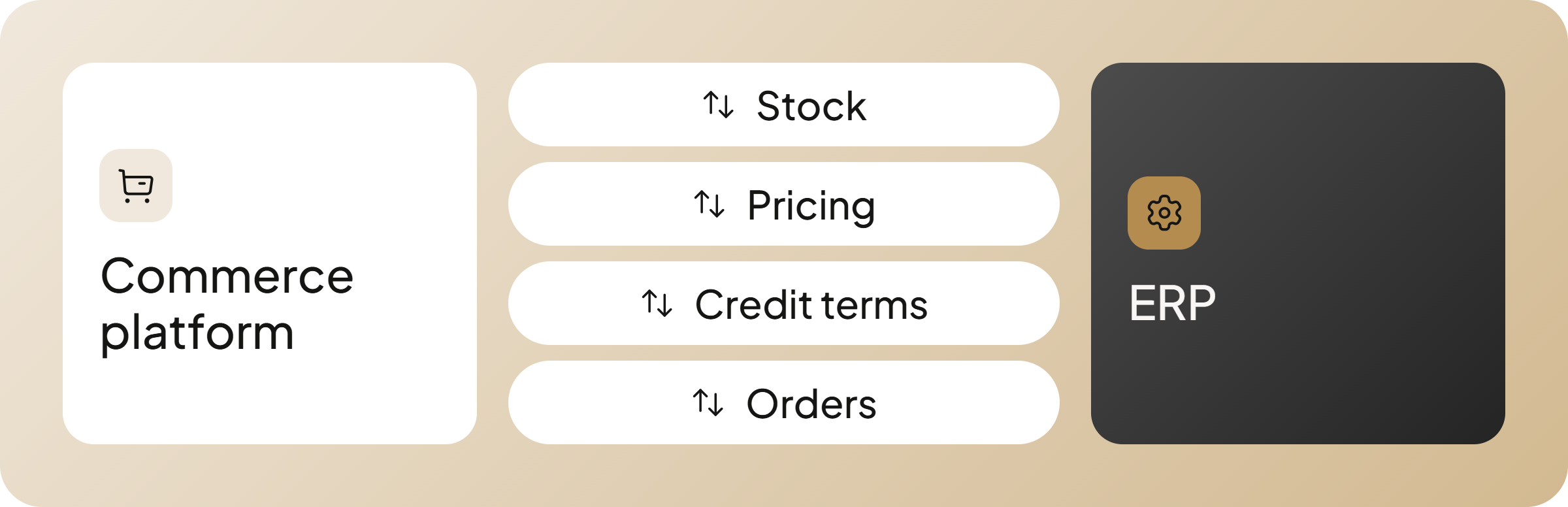
ERP fit decides whether your launch succeeds. Weak connections lead to stale stock and pricing, rekeyed orders and failed go-lives. Check ERP fit before any other criterion.
Why ERP fit decides launch success
Even a well-designed storefront can run into trouble if it can’t exchange data reliably with your ERP. Incorrect pricing, outdated info from your inventory management system, or missing customer credit terms can lead to failed orders and manual corrections. If these issues aren’t resolved before launch, they can delay go-live and undermine customer confidence from day one.
Pre-built connectors vs custom middleware
Pre-built connectors launch faster for common ERPs such as SAP, Oracle, Microsoft Dynamics, and Epicor. Custom middleware fits older or heavily modified systems, but it adds build and maintenance cost.
Which route is right for you? Compare vendors on API maturity first, starting with these ERP-integrated B2B platforms.
Order management and real-time sync limits
Your order management system needs clear rules on which data syncs in real time and which runs in batches. Ask every vendor:
1.How mature and well-documented are the REST or GraphQL APIs?
2.Do webhooks push order, stock, and price changes as events?
3.What sync frequency is realistic at peak volume for stock and order fulfillment status?
4.Which system owns catalog and pricing data?
5.How do the platform’s integration capabilities handle failures and retries?
SaaS vs Composable Headless vs Unified B2B Platforms
These approaches aren’t mutually exclusive. Software as a service (SaaS) describes how a platform is delivered, composable and headless describe architectural choices, and a unified suite refers to the functionality included in one product.
Each comes with different considerations around customization, integrations, costs, and ongoing maintenance. Understanding those differences will help you evaluate which setup makes sense for your business.
SaaS platforms: fast launch, less control
Multi-tenant SaaS is a subscription service the vendor hosts and upgrades for every customer at once. It suits wholesalers with standard catalogs who need to start selling within months.
The catch? Deep B2B workflows often require third-party apps.
Composable and headless: maximum flexibility, higher engineering effort
Composable commerce assembles best-of-breed services through APIs, and headless commerce separates the frontend from the commerce engine. The approach offers extensive customization capabilities. You’ll need a strong engineering team to build and maintain it, though.
Unified B2B suites: where the trade-off shrinks
A unified B2B suite brings commerce, quoting, customer management, and other B2B capabilities into one platform.
Because they share data and business logic, companies can reduce their reliance on separate applications and tailored solutions.
Unified platforms can also be delivered as SaaS, support headless storefronts, and connect with external systems where needed.
| Criteria | SaaS | Composable headless | Unified B2B suite |
|---|---|---|---|
| Time to launch | Fast | Slow | Moderate |
| Starter vs scale cost | Low start; fees rise with revenue and apps | High start; costs track engineering headcount | Moderate start; predictable at scale |
| Out-of-the-box B2B features | Basic to moderate | Few; you build most | Extensive |
| ERP connection effort | Apps or middleware | Custom builds | Pre-built connectors plus APIs |
| Engineering burden | Low | High | Low to moderate |
| Flexibility | Limited to the vendor’s release plans | Highest | High |
Top B2B Digital Commerce Platforms Compared
B2B eCommerce platforms vary considerably in what they offer out of the box and what requires additional development or third-party tools. Let’s look at five options and how they compare.
How we compared the five platforms
We compared five B2B digital commerce platforms based on their target use cases, architecture, and built-in B2B capabilities. The table provides a starting point for your shortlist, while factors like ERP compatibility, implementation costs, and scalability will need closer evaluation against your business requirements.
Our assessment draws on public vendor documentation, analyst and industry reports.
| Platform | Best for | Architecture | B2B depth |
|---|---|---|---|
| OroCommerce | Manufacturers, distributors, and wholesalers with complex B2B needs | Modular suite: Cloud SaaS, on-premises, or headless | Native RFQ, CPQ, multi-org accounts, quote-to-cash tools |
| Adobe Commerce | Brands already invested in Adobe products | PaaS or on-premises; SaaS edition available | B2B module with company accounts, shared catalogs, and quotes |
| BigCommerce B2B Edition | Mid-market sellers that want SaaS speed | Multi-tenant SaaS with open APIs | Buyer portal, quotes, and invoices |
| Shopify Plus | D2C brands adding a wholesale channel to a direct-to-consumer business model. | Multi-tenant SaaS | Company profiles, catalogs, and payment terms |
| commercetools | Enterprises with large engineering teams | Composable, API-first headless | Business units, quotes, and approval rules |
Need more detail? Suppliers can see this guide to choosing a B2B eCommerce platform for suppliers, and manufacturers can compare platforms for industrial B2B eCommerce.
See how Gartner scores digital commerce platforms for the B2B Commerce use case.
How to Choose a B2B Digital Commerce Platform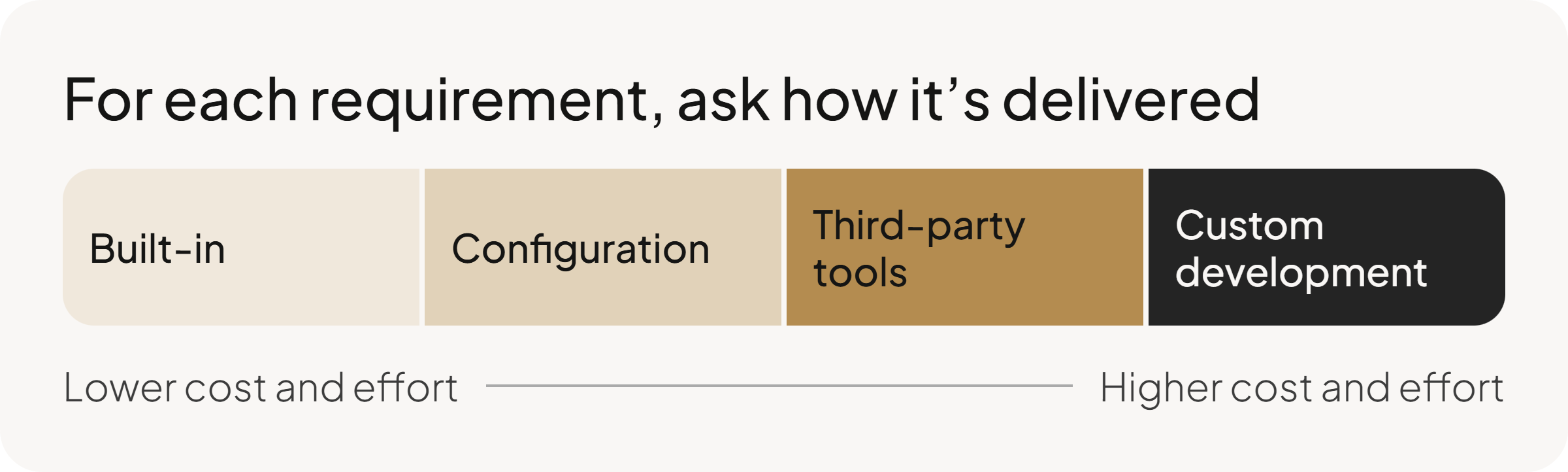
Before comparing platforms, you need a clear picture of what your business requires. Not sure where to start? Our guide to defining B2B eCommerce requirements walks you through who to involve, what to ask, and how to prioritize your needs.
Once you have that groundwork in place, use these questions to evaluate your options.
- Give every vendor the same scenario. Pick a demanding sales process involving bulk pricing, account approvals, or multiple warehouses. Ask vendors to demonstrate how their platform handles it, including what buyers and internal teams see.
- Find out what’s included and what needs building. For each requirement, distinguish between built-in functionality, configuration, third-party tools, and custom development. These differences affect both cost and implementation effort.
- Look closely at integration plans. Ask vendors to explain how data will move between your ERP and commerce platform, what existing connectors cover, and where development will be necessary.
- Compare costs against the same scope. Request estimates covering the same requirements, including implementation and ongoing expenses. Factor in future business growth, such as adding another brand, market, or ERP.
- Get evidence from comparable projects. Ask for examples involving similar business models and system environments. Find out what required customization and what customers would approach differently today.
Use our free B2B eCommerce RFP template to organize your requirements and compare vendor responses.
Before You Commit: TCO Calculation and Launch Planning
Compare the full cost of ownership
Look beyond licensing and implementation estimates. How will costs change as you add capabilities, increase order volumes, or upgrade? Our B2B eCommerce TCO guide covers what to include in a three-to-five-year forecast.
Agree on a rollout approach
Decide whether to launch across the business or start with selected markets or customer groups. Track online sales alongside overall sales performance to distinguish channel adoption from incremental growth.
Plan for migration
If you’re replacing an existing platform, establish how customer data, pricing rules, and order history will move. Include search engine optimization (SEO) requirements, particularly URL mapping and redirects, in the project scope from the beginning.
Why OroCommerce Is the Best B2B Digital Commerce Platform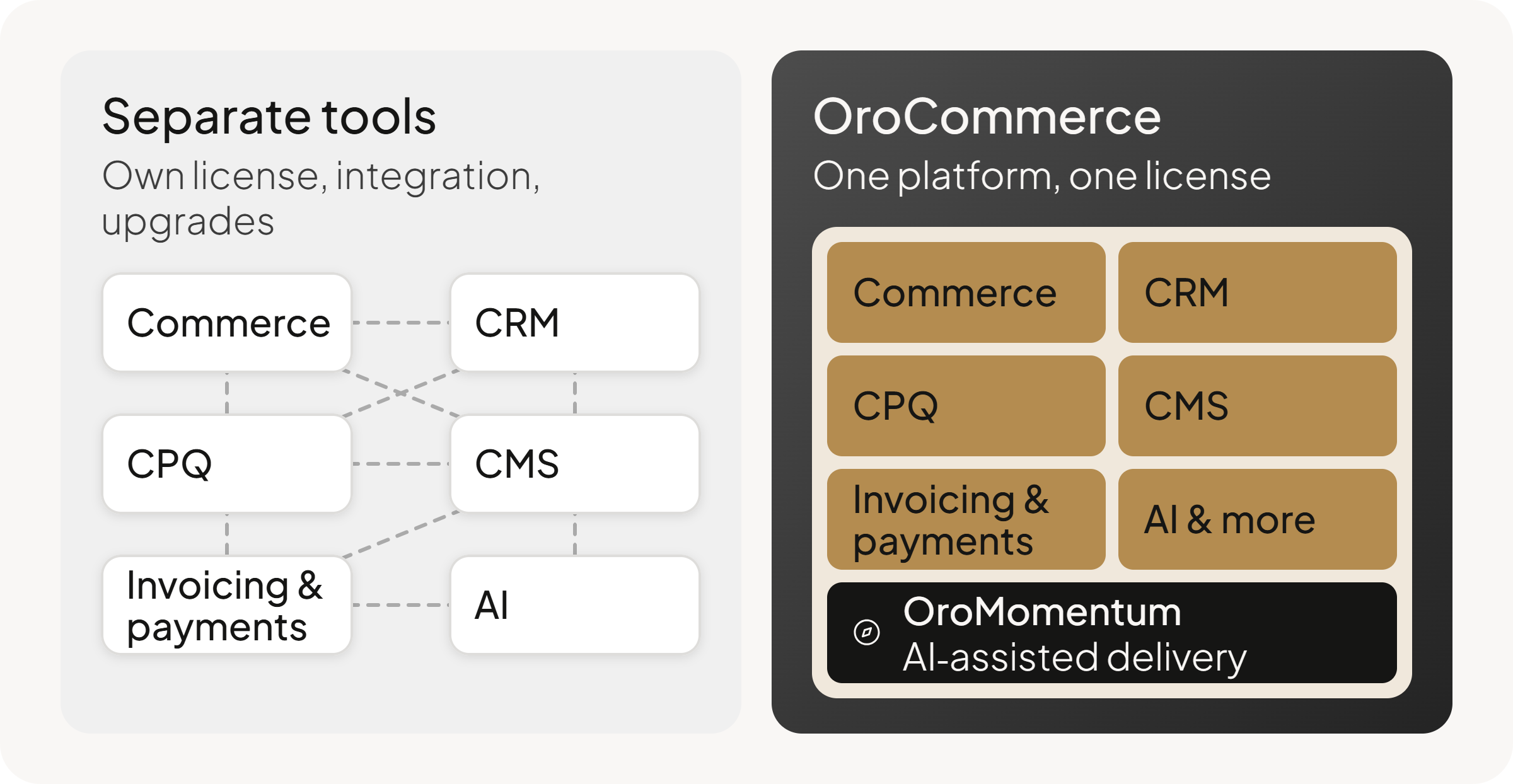
OroCommerce was built for manufacturers and distributors whose sales processes don’t fit a standard shopping cart. From negotiated pricing to multi-company operations, the capabilities other platforms often require you to build or add are already part of OroCommerce.
You start with most of what you need and customize the parts that make your business different.
Your B2B Business Model Comes First
Sell directly, through distributors and dealers, or across multiple channels on one platform.
- OroCommerce models each company as a customer, with users, roles, and permissions inside the account.
- Account hierarchies mirror parent companies, subsidiaries, and branches, each with personalized pricing and catalogs.
- A multi-organization backend enables businesses to add brands, regions, or acquired companies under central control.
One platform instead of five tools
- Storefront, CMS, PIM, and DAM share one product record instead of living in separate business tools.
- Native CPQ and RFQ connect quoting with ordering, while built-in customer relationship management (CRM) keeps accounts, sales activity, and service cases in one system.
- OroPay handles payment processing for cards, ACH, and invoices, reconciled with ERP and finance systems.
Deploy your way: cloud SaaS, modular, or headless
- Oro Cloud SaaS offers a hosted, managed start without giving up code-level control.
- Modular architecture and headless APIs support custom frontends where you need them.
- OroMomentum is an AI-powered development initiative that helps teams build customizations, modernize extensions, and upgrade OroCommerce faster.
ERP and API-first integration
- Self-service portals give buyers access to current pricing, inventory, and order history, helping enhance customer experiences and strengthen customer loyalty.
- An API-first architecture connects multiple ERP systems with warehouse, order management, and marketing applications.
AI built around real B2B workflows
- SmartOrder converts emailed and PDF purchase orders into draft orders, reducing manual data entry.
- SmartAgent helps buyers find products, check pricing and inventory, and manage orders through natural-language conversations.
- OroIQ brings SmartInsights and SmartAssistant together, letting teams analyze business data and automate back-office tasks using natural language.
Proof from real customers
- Braskem: The petrochemical giant processes 12,000 orders monthly through OroCommerce, saving over 22,000 work hours annually. As Larissa Salerno, Product Strategy Manager, puts it: “We can now offer sales order information and shipment tracking in real time.”
- Interstate Batteries: One of North America’s largest battery distributors uses OroCommerce to support its network of 30,000+ dealers and growing direct-to-consumer operations. “Speed was our primary requirement, but we couldn’t sacrifice B2B depth,” says Sunil Patel, Head of eCommerce.
- Wastequip: The North American equipment manufacturer saw 40% eCommerce sales growth in the first year of its Mountain Tarp rollout. “Our website has become a resource for our sales team,” says eCommerce Director Kevin Creese.
Analyst recognition and security
- Gartner Magic Quadrant™: OroCommerce was recognized in the 2026 Gartner Magic Quadrant for Digital Commerce Platforms for the sixth consecutive year.
- Gartner Critical Capabilities: OroCommerce ranked #2 for the B2B Commerce use case in the 2026 report.
- IDC MarketScape: Named a Leader in the 2026 IDC MarketScape for B2B Digital Commerce in both the Enterprise and Midmarket editions.
- Enterprise security: SOC 2-audited infrastructure, PCI DSS support, and granular role-based permissions provide a secure platform for B2B operations.
See how Gartner evaluated Oro and other digital commerce platforms in its 2026 Magic Quadrant™.
Final Words About B2B Digital Commerce Platform
Choosing a B2B digital commerce platform comes down to speed-to-value versus long-term flexibility.
OroCommerce, the unified B2B commerce platform for manufacturers, distributors, and wholesalers, removes most of that trade-off with native B2B depth, ERP connectivity, and flexible deployment.
Book a demo to see it handle your own price lists and workflows.
FAQs
Can e-commerce be B2B?
Yes. E-commerce is B2B whenever a company sells goods or services online to other companies instead of consumers.
Manufacturers, distributors, and wholesalers use buyer portals for bulk orders, account pricing, and reorders. According to McKinsey’s 2026 B2B Pulse Survey, 71% of B2B companies now offer e-commerce.
What is B2B, B2C, C2C, and D2C?
These four terms describe who sells to whom. B2B (business-to-business) is one company selling to another. B2C (business-to-consumer) is a company selling to individual consumers.
C2C (consumer-to-consumer) is people selling to each other on marketplaces. D2C (direct-to-consumer) is a manufacturer selling to shoppers without retailers.
Which platform is most popular for B2B marketing?
LinkedIn is the leading platform for B2B marketing. According to the Content Marketing Institute’s 2026 B2B Content and Marketing Trends report, 76% of marketers who publish thought leadership rank LinkedIn among their three most effective channels. No other channel in that survey scored higher.
What are the top 5 e-commerce platforms?
Five leading e-commerce platforms for B2B sellers are OroCommerce, Adobe’s Magento-based suite, BigCommerce B2B Edition, Shopify Plus, and commercetools.
OroCommerce suits complex manufacturing and distribution, while Shopify Plus and BigCommerce suit fast SaaS launches. Adobe fits companies already on its products, and commercetools fits teams building a composable stack.