navigation

A vendor demos their AI features. Product recommendations look sharp. Search handles natural language well. All expected, all useful tools.
Then someone asks about complex commerce workflows: approval chains, customer-specific catalogs, multi-tier pricing, quote management.
The demo thins out fast.
Turns out not many can offer AI commerce solutions for complex B2B US market operations beyond the basic storefront features. When account hierarchies go four levels deep and pricing changes by customer, algorithms built for retail break.
This guide evaluates top B2B commerce platforms and their AI capabilities by what works when complexity is the default.
What to Look for in AI Solutions for Complex B2B eCommerce
AI in B2B commerce isn’t just chatbots. The value shows up in order automation that reads unstructured documents and validates them against live inventory; in AI-powered search that respects customer-specific catalogs and contracted pricing; in predictive analytics that flag account drift before renewals come up.
Consumer AI assumes clean data and simple rules. B2B AI has to interpret messy reality while enforcing business logic that changes per customer, region, and sometimes per order.
Before comparing feature lists, ask whether the platform’s architecture can handle your commercial complexity.
What AI-Powered Platforms Must Handle in B2B
| Criteria | What to ask | Why it matters |
| Commercial context | Does the AI access your custom pricing, account hierarchies, and catalog restrictions by default or through configuration after the fact? | Configured access requires maintenance every time your commercial logic changes. Native access means the AI and your business logic share the same database or reliable performance. |
| Order automation | Can the platform process an offline purchase order and validate it against live inventory and negotiated pricing? | Most platforms handle digital orders well. The offline gap is where manual data entry lives. 81% of manufacturers and distributors have deployed order automation because it cuts processing time from 20+ minutes to under 2, directly impacting the customer experience. |
| Entitlement-aware search | Does the search handle complex queries while reflecting authorized catalogs and contracted prices? | Generic AI-powered search that ignores entitlements creates pricing errors and erodes customer relationships. Real-time data enforcement prevents your sales reps from explaining why the portal quoted the wrong price. |
| Approval workflows | Are approval chains enforced within the commerce platform or dependent on a backend ERP integration? | ERP-dependent approvals break when the integration breaks. Native workflows keep business processes moving when systems drift. |
| Data readiness | Does the platform’s AI require clean, standardized data to function, and what happens when your order history, pricing, or product attributes have gaps? | 63% of B2B companies cite inaccurate or incomplete historical data as their biggest barrier to AI tools. AI trained on inconsistent data points makes confident mistakes at scale. |
| Legacy system integration | How does the AI behave when your ERP data is siloed, inconsistent, or mid-migration? | 53% cite legacy system integration as their top barrier to AI adoption. Platforms that can normalize data across fragmented systems save you from waiting for ERP consolidation. |
| Data security | Where does your customer data go when the AI processes it? Is it used to train external AI models? | 46% cite data security as a top concern when adopting AI. Only 4% of organizations have comprehensive AI governance policies. Know whether your proprietary pricing and customer behavior data stays yours. |
| Audit trail | When the AI drafts an order or routes a request, where is the agent behavior logged? | Distributed audit trails across multiple systems create reconciliation problems. Unified commerce platforms log every AI action in the same system your sales teams and finance already monitor. |
| AI pricing model | Is AI included in the license or billed separately by action, token, or consumption? What does the cost look like at scale? | Consumption-based pricing is hard to forecast across large B2B order volumes. Bundled AI means predictable costs as you scale. |
| Roadmap transparency | Which features are generally available today and which are in pilot or planned? Can they demo what you need with your data? | The gap between announced and shipped varies significantly across vendors. Platforms built for B2B commerce have a different maturity than retail platforms adding enterprise features. |
| Protocol readiness | Does the platform expose commercial logic (pricing, entitlements, approvals) to external agents, or just the product catalog? | Catalog access alone is insufficient for AI agents handling procurement. Full protocol support means your platform is ready when buyer-side AI agents become standard. |
| B2B workflow depth | Does the platform handle bulk order management, quoting, and customer-specific catalogs natively or through third-party apps? | Third-party dependencies add integration cost and maintenance overhead. Native capabilities mean AI tools can access the full context of your sales and support teams immediately. |
Top 5 AI Commerce Solutions for Complex B2B Compared
Five platforms dominate conversations about AI-powered B2B commerce, but they approach the complexity problem from fundamentally different angles. The question is whether the platform understands your business processes by default or requires custom integration to make AI tools useful.
| Platform | Target Users | AI Architecture | ERP/CRM Integration | Best For |
| OroCommerce | Manufacturers and distributors running multi-ERP, multi-org operations | Native AI (OroIQ) works directly with the same native business objects and permissions that govern pricing rules, account hierarchies, and workflows | API-first; normalizes data across fragmented ERPs without waiting for consolidation | Enterprises needing full B2B commerce AI: storefront assistance, back-office automation, sales intelligence, and analytics through one native layer |
| Salesforce B2B Commerce | Enterprises deeply embedded in Salesforce CRM ecosystem | Agentforce AI (separate license, $125–550/user/month) connects buyer self-service to CRM data | Deep Salesforce CRM integration; requires Sales Cloud or Service Cloud to extract full value | Sales-led organizations where AI needs to bridge customer engagement data and commerce transactions |
| SAP Commerce Cloud | Global enterprises running SAP end-to-end across supply chain | CX AI Toolkit (requires AI Units that expire annually) plus cross-platform Joule copilot | Native SAP ERP integration; outside SAP environments, integration complexity increases sharply | Companies standardized on SAP infrastructure willing to navigate consumption-based AI pricing |
| commercetools | Development-heavy teams building headless, custom buyer experiences | Infrastructure for external AI to access commerce data (AI Hub, MCP Server); no native AI features | Headless architecture requires custom frontend development for every AI interaction | Organizations prioritizing visibility in third-party AI platforms (ChatGPT, Copilot) over native intelligence |
| Adobe Commerce | Content-rich B2B/B2C hybrid operations with marketing-led digital strategy | Live Search and Product Recommendations included; advanced AI requires Adobe Experience Platform (separate product) | Magento legacy architecture; deep integrations exist but often require custom development | Discovery and top-of-funnel product visibility; not optimized for post-purchase B2B complexity (approvals, quotes, entitlements) |
Top AI Commerce Solutions Overview
Breaking down what’s live, what’s roadmap, and how each architecture handles B2B complexity.
OroCommerce
OroCommerce was built for manufacturers and distributors running multiple ERPs, fragmented pricing logic, and orders that arrive as PDFs. The AI technology layer (OroIQ) has access to the same database as your pricing rules and account hierarchies. The intelligence sees your commercial context by default.
Watch a short video walkthrough of OroIQ
Best for
Back-office automation that processes offline orders, enforces customer-specific pricing, and handles approval workflows without custom integration.
AI Capabilities
- OroIQ is a conversational interface that connects to every AI capability in the platform and is governed by your existing roles and permissions.
- AI SmartOrder reads purchase orders from PDFs, emails, and faxes, then validates them against live inventory and negotiated pricing in under a minute.
- AI SmartAgent acts as a storefront buying assistant that understands natural language, enforces role-based access, and handles product discovery.
- AI SmartAssistant gives sales teams a back-office copilot. Reps create quotes, build customer segments, and pull account data using plain text.
- AI SmartInsights converts business intelligence into conversation. Users query data in plain English and get charts and KPIs back.
- Semantic search surfaces products when buyers search by application or partial SKU instead of exact matches.
- Product recommendations trained on your transaction history show items buyers actually purchase together.
- Content generation creates product descriptions and catalog copy at scale.
- MCP Server exposes pricing rules and approval workflows so external AI agents can transact with your commercial logic.
Pricing
Included in Enterprise license. Google Vertex AI for recommendations bills separately through Google.
See how OroCommerce handles complex B2B without exposing your data.
Salesforce B2B Commerce (Agentforce Commerce)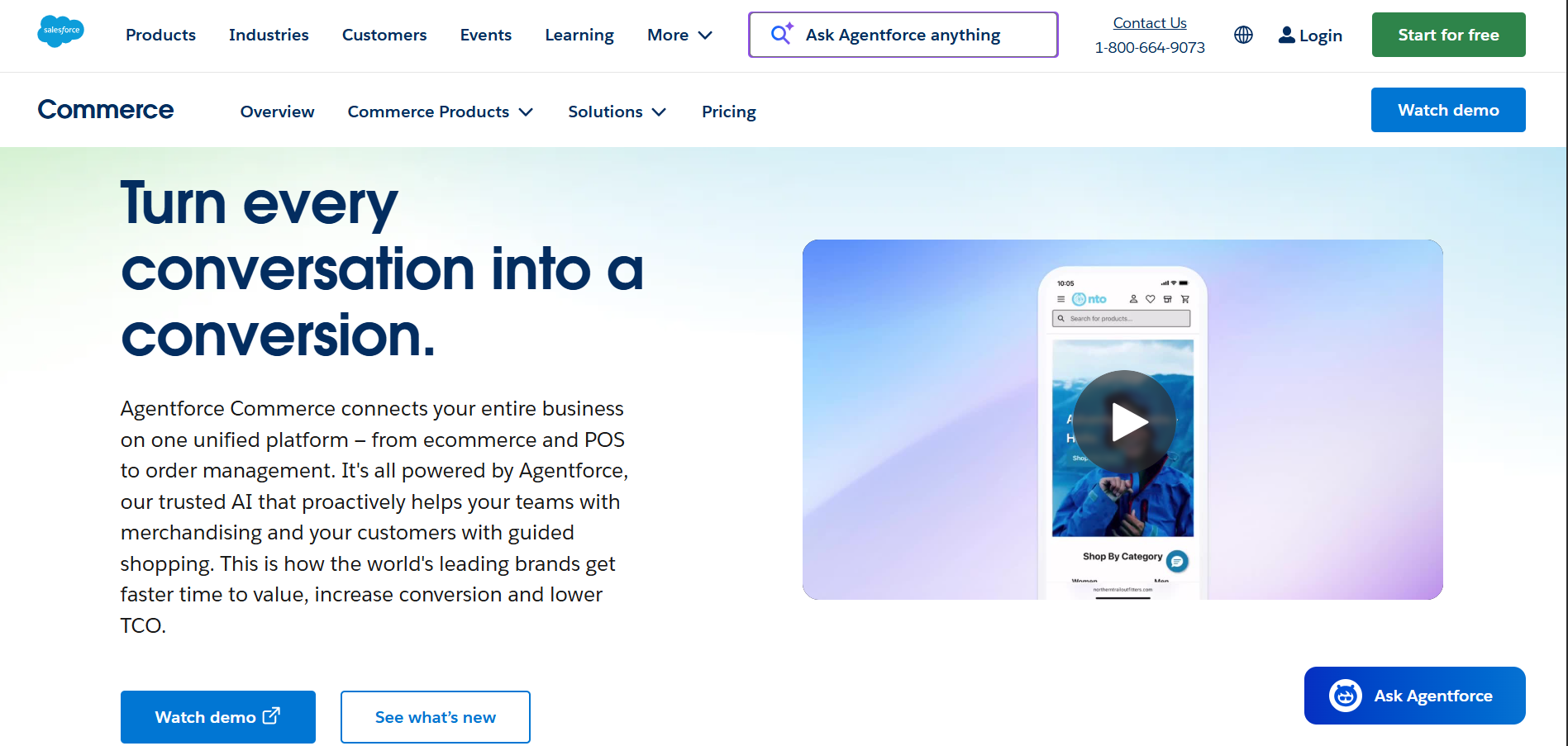
Salesforce focuses its AI solutions on storefront assistance and buyer self-service. Agentforce Buyer handles routine reordering and support questions, aiming to improve customer engagement without tying up sales teams. For companies running Salesforce CRM systems, the commerce layer can reference years of customer interaction history and behavioral data.
Best for
Companies already running Salesforce CRM who want commerce AI that can reference the same customer interaction history and behavioral data their sales teams use.
AI Capabilities
- Agentforce Buyer Agent handles product discovery, reordering, order tracking, and customer support against customer-specific pricing.
- Guided Shopping deploys service agents that understand buyer permissions and tiered pricing to guide buyers through complex queries.
- Einstein recommendations and predictive sort included in base license.
- Agentforce Localization lets AI agents interact with buyers across multiple languages and regions.
- Generative product descriptions create catalog content at scale.
Pricing
Agentforce requires a separate license at $125–550 per user per month. Einstein features included in base commerce license.
Adobe Commerce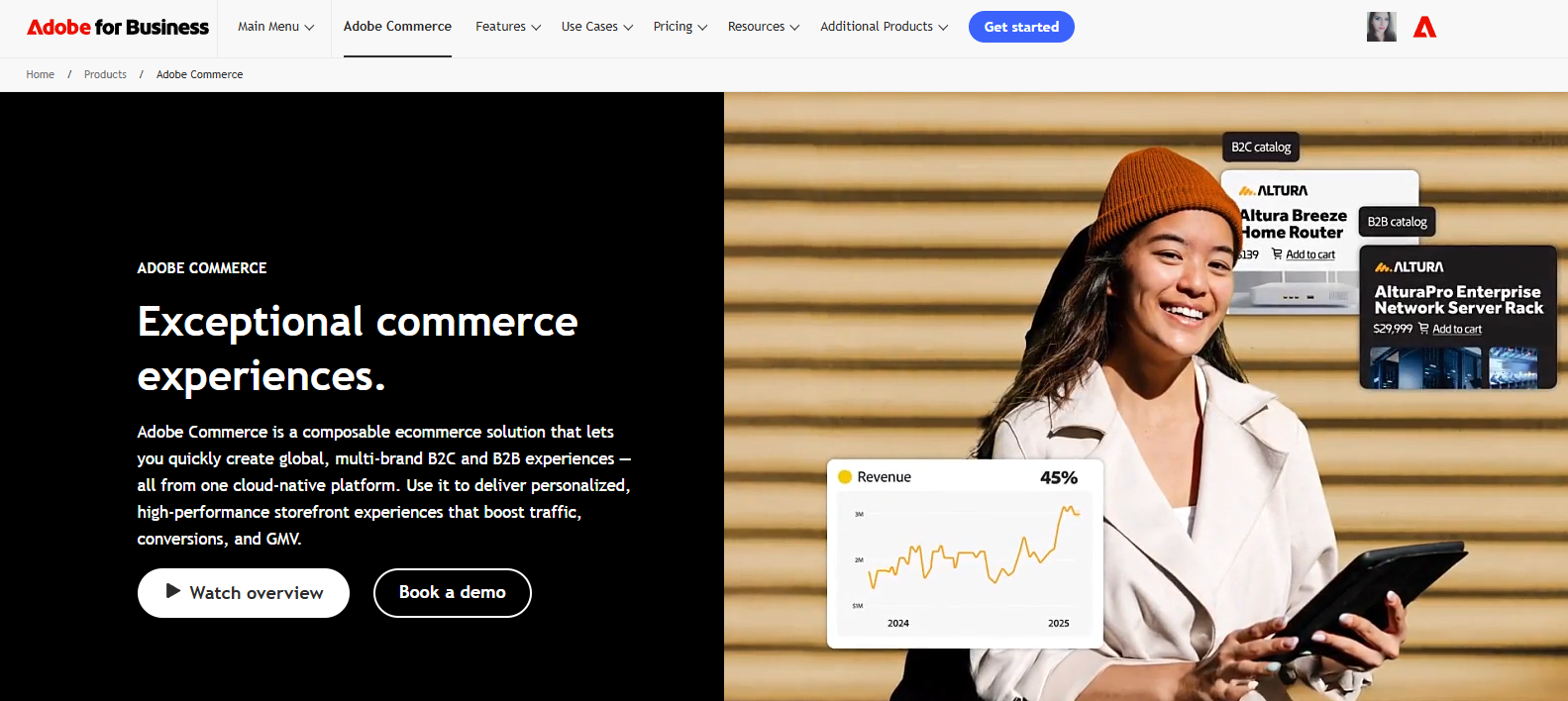
Adobe’s AI strength is discovery and content. Live Search and Product Recommendations are production-ready and included in the base license. Everything beyond product discovery either lives on the roadmap or requires purchasing Adobe Experience Platform as a separate product, which practitioners report can double or triple total implementation costs.
Best for
Organizations prioritizing top-of-funnel customer experience and product discovery where marketing-led content creation drives digital commerce strategy.
AI Capabilities
- Live Search delivers AI-powered search with intelligent re-ranking, handles user intent, and improves customer satisfaction with more relevant results.
- Product Recommendations covers 13 recommendation types including visual similarity and buyer behavior signals.
- Intelligent re-ranking ships alongside Live Search at no additional cost.
- AI content generation runs via Adobe Sensei and Firefly for product descriptions and catalog copy at scale.
Pricing
Live Search and Product Recommendations included in base license. Advanced agentic capabilities require Adobe Experience Platform (separate product with separate pricing).
commercetools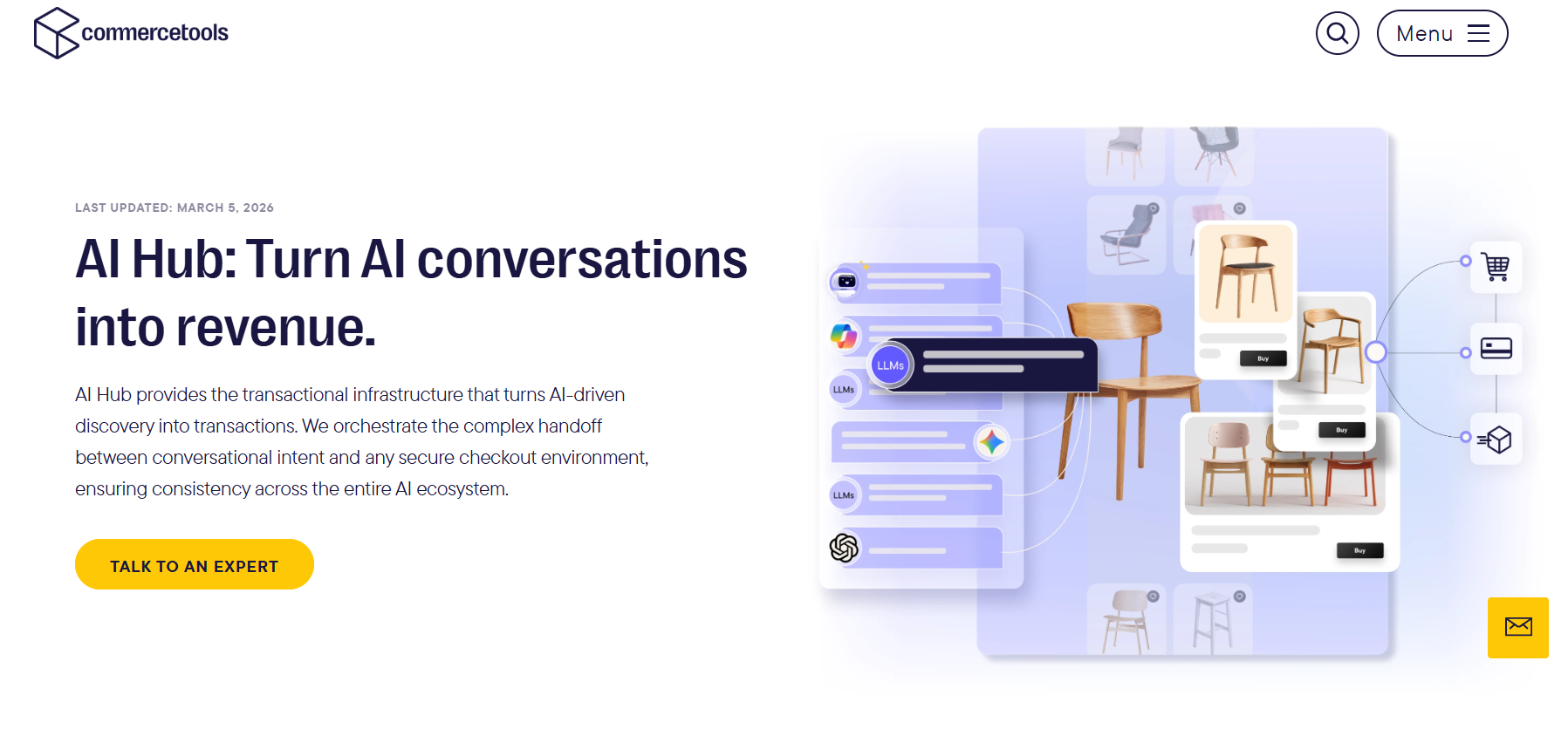
commercetools built infrastructure for AI commerce visibility. If buyers increasingly use large language models like ChatGPT or Perplexity to research and initiate purchases, AI Hub makes your catalog discoverable in those platforms without building separate integrations for each one.
Best for
Organizations betting that B2B procurement shifts to AI-mediated channels and prioritizing product discovery through external intelligent AI agents over native platform features.
AI Capabilities
- AI Hub gives external AI systems secure access to product data, pricing, inventory levels, and order logic.
- Commerce MCP Server standardizes how external AI agents read your commerce backend.
- Agentic Jumpstart connects to AI channels like ChatGPT and Gemini.
- AgenticLift connects legacy systems to agentic commerce channels without replatforming.
- Stripe Agentic Commerce Suite integration handles checkout and payment when AI agents transact.
Pricing
API consumption metrics tied to headless architecture.
SAP Commerce Cloud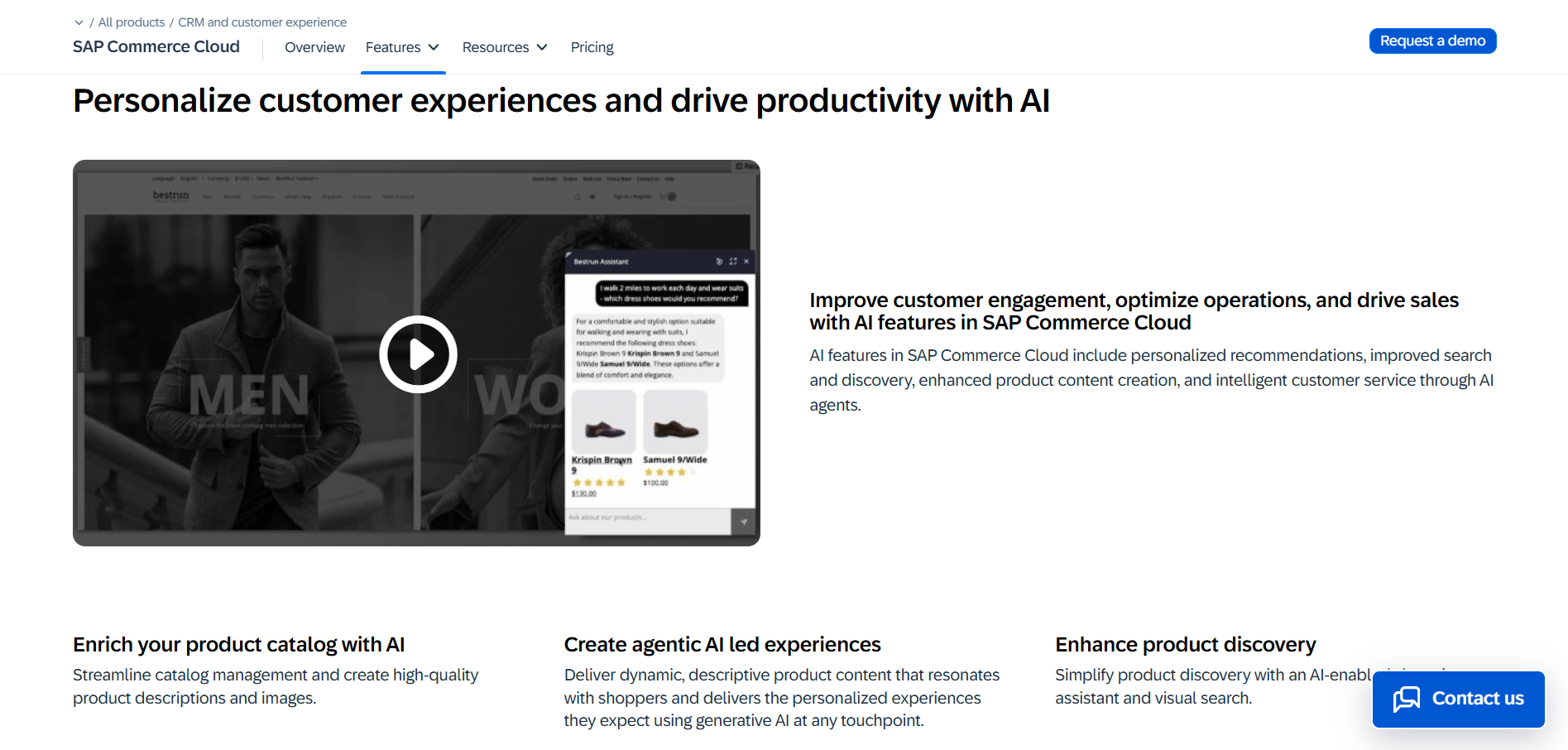
SAP built its AI on decades of enterprise ERP experience. For organizations running SAP end-to-end, the commerce AI inherits deep understanding of customer-specific pricing, multi-org structures, and tiered pricing logic. Outside the SAP ecosystem, that advantage disappears and integration complexity increases sharply.
Best for
Enterprises standardized on SAP infrastructure where allowing customers to transact through AI requires machine learning models that already understand your ERP’s commercial structure.
AI Capabilities
- CX AI Toolkit covers AI product description generation in bulk across multiple languages, Visual Search, a RAG-based AI Shopping Assistant, Product Image Designer, and natural language queries on product pages (requires AI Units).
- Intelligent Selling Services delivers machine learning-powered product recommendations with A/B testing on Professional or Enterprise editions.
- Joule Base is SAP’s cross-platform AI copilot, included at no extra cost, handling general tasks across all cloud subscriptions.
- Joule Studio hit GA in Q1 2026, letting teams build custom AI agents on top of the SAP stack.
- Quote Creation Agent converts email-based pricing requests into draft quotes, reducing significant manual effort that typically lands on sales teams.
Pricing
AI Units (the currency for premium AI features) expire annually whether used or not. Consumption rates per feature aren’t publicly documented.
Why OroCommerce Is The Best AI Commerce Solution for Complex B2B
OroCommerce was built for B2B commerce from day one. The architecture assumes complexity: multi-org structures, customer-specific pricing, approval workflows, and orders that arrive offline.
That foundation is what makes AI-powered automation useful instead of decorative.
Native AI Means No Integration Tax
When OroIQ has access to the same database as your business logic, AI agents see your commercial context by default. AI SmartOrder validates a 700-line purchase order against live inventory and negotiated pricing because both live in the same system.
AI SmartAgent enforces role-based permissions and delivers accurate responses because buyer entitlements aren’t queried through middleware.
Bolt-on AI solutions require developers to build custom bridges every time your pricing logic changes. OroCommerce’s native AI commerce eliminates that permanent cost.
DiversiTech: AI Working Across 12 ERPs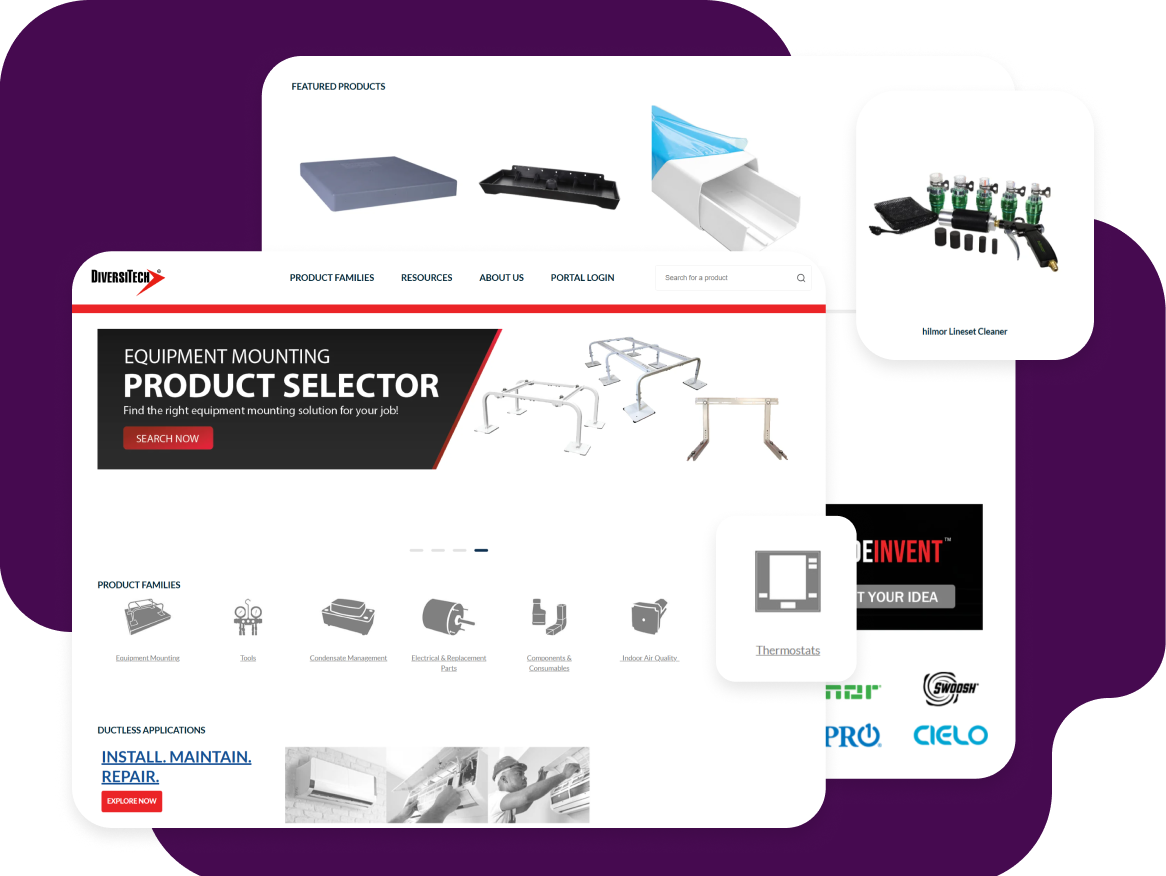
DiversiTech runs North America’s largest HVAC distribution operation. Acquisitions left them managing 12 ERPs across their supply chain. In Europe, nine legacy systems ran in parallel during a Dynamics 365 migration. Customer service reps manually rekeyed faxed orders, which required significant manual effort and created friction in the customer journey.
They deployed OroCommerce as their unified commerce layer. AI SmartOrder now:
- Processes orders from any format (PDF, email, fax)
- Routes correctly regardless of which ERP handles fulfillment
- Cut processing time from 30 minutes to under 2
- Delivered 20% productivity gains for customer service teams
The AI tools don’t wait for ERP consolidation. They normalize chaos today while improving customer experience and customer engagement.
Your Data Stays Yours
Most AI platforms send your data to external models for processing. OroCommerce runs AI on data inside your instance.
What stays internal:
- Customer behavior and purchase patterns
- Historical sales data
- Pricing negotiations and customer relationships
- Order data and fulfillment logic
Your proprietary information never leaves your environment unless you explicitly enable an external feature like Google Vertex AI for product recommendations. Even then, only the minimum data needed for training gets shared.
Why this matters
This architecture matters for organizations handling high-value accounts where pricing negotiations and customer relationships represent competitive advantage. Leaking that context to external AI models means training your competitors’ tools on your commercial strategy.
DiversiTech chose OroCommerce partly for this reason. Managing 12 ERPs across their supply chain meant order data, pricing logic, and customer engagement patterns couldn’t leave their infrastructure. AI SmartOrder processes orders, validates inventory, and routes fulfillment entirely within their controlled environment.
See how OroCommerce handles complex B2B without exposing your data.
How to Deploy AI in Complex B2B Operations
Most companies approach AI commerce backwards. They evaluate features, negotiate contracts, then realize their pricing rules live in spreadsheets and customer data is fragmented across different software systems.
The architecture decision comes first.
Build the Clean Layer First
You’re likely running multiple ERPs from acquisitions. Consolidation is planned but years away. Don’t wait.
Use the Strangler Pattern: put a unified commerce platform in front of fragmented backends. That layer becomes where customer records, pricing logic, and order workflows converge. AI tools operate there while legacy systems keep running.
This matters because AI agents can’t enforce business logic they can’t see. Customer-specific pricing in one ERP, entitlements in another, approval workflows in spreadsheets – external AI platforms require custom middleware to bridge these gaps. Native AI commerce inherits the context by default, allowing customers to transact without the system guessing at their permissions.
Deploy in Sequence, Not All at Once
Start with document processing
If you’re evaluating AI use cases in B2B commerce, AI-powered order processing is a good place to start. AI that converts purchase orders from PDFs and emails into structured data delivers immediate value. No clean catalog required. No governance debates. Just eliminating the significant manual effort of rekeying orders while achieving enhanced customer service through faster confirmations.
Fix catalog data next
While order automation runs, structure your product attributes. AI-powered search and product discovery can’t work when half your SKUs are missing technical specs. Better search also improves search engine rankings and helps teams manage inventory visibility. The companies stuck piloting search aren’t waiting on better algorithms, they’re cleaning data.
Add predictive capabilities
Once you have two years of clean transaction history, deploy AI-driven personalization, predictive lead scoring, and demand forecasting. These surface target accounts at risk of customer attrition and drive revenue growth through smarter recommendations and better inventory planning. Predictive analytics also enable data-driven decisions about which high-value accounts need attention.
Solve governance before pricing AI
Real-time dynamic pricing can improve margins by 2-6%, but it requires organizational alignment first. Before deploying the algorithm, answer these questions with documented decisions:
- Who sets the boundaries? Finance typically owns margin floors and competitive ceilings. Document those guardrails as hard rules the AI can’t override.
- Who approves exceptions? When a high-value account requests pricing outside the model’s range, which role has authority to approve? Regional VP? Corporate pricing team? Map the escalation path before the first exception arrives.
- How transparent is the model? Sales teams need to explain pricing to customers. If the AI can’t show why it quoted a specific number, reps lose trust and stop using it. Require explainable outputs from day one.
Half the market is piloting dynamic pricing while only 15% deployed, according to our 2026 AI Benchmark survey report.
Sales, finance, and leadership need to agree on who controls pricing decisions after the AI makes its recommendation. Solve that question in a room with whiteboards before you sign the software contract.
B2B Commerce AI Built for Operational Reality
Most AI commerce platforms handle a clean demo well. The question is whether they survive the operational reality of B2B. Platforms built for this complexity share a common trait: the AI and your business logic live in the same system. That architecture determines your integration costs, deployment timeline, and ability to add capabilities later.
Companies gaining competitive edge from AI fixed infrastructure first, deployed in sequence, and let each phase fund the next.
The architecture you choose today sets your ceiling for the next decade.
See how OroCommerce handles complex B2B operations.