
navigation

Most eCommerce platforms are built for retailers. Manufacturers work in a different world: configurable products, multi-tier distributor relationships, ERP-connected pricing, and production-linked inventory.
A generic storefront won’t solve those problems. What manufacturers need is a digital sales layer integrated with production and fulfillment systems, not a bolt-on shop.
This article compares five B2B eCommerce platforms for manufacturers built to handle that complexity: OroCommerce, Adobe Commerce, NetSuite SuiteCommerce, Unilog, and Optimizely.
Each is evaluated on CPQ and product configurability, ERP integration depth, dealer and distributor portal support, complex sales processes, and total cost of ownership.
What to Look for in a B2B eCommerce Platform for Manufacturers
Not all B2B eCommerce platforms handle manufacturing requirements equally. Before shortlisting any solution, map your needs against these core capabilities. They’re what separate purpose-built B2B platforms from tools adapted from B2C or ERP roots.
- Product configurability and CPQ: Support for BOM-level data, variant logic, and configure-price-quote workflows for engineered or custom products. CPQ needs to be native, not an add-on.
- ERP integration depth: Real-time sync of pricing, inventory data, and order records. Batch jobs and middleware create stockouts and duplicate orders, which aren’t acceptable at manufacturing scale.
- Dealer and distributor portal management: Personalized B2B portals per channel partner with account-specific pricing, custom catalogs, and order history. Not a shared wholesale login.
- Punchout catalog and EDI support: Essential for business buyers using procurement systems like Coupa or Ariba. EDI eliminates the manual processes and phone calls that slow down high-volume channel orders.
- Customer-specific pricing and contract management: Pricing tiers, volume discounts, negotiated pricing, and contract pricing by account or region. Flat pricing models break down at scale.
- Self-service buyer portal: Enabling customers to reorder, access invoices, and manage accounts without contacting a sales rep delivers cost savings, helps enhance customer experiences, and meets growing customer expectations around digital convenience.
- Multi-channel support: Managing direct B2B sales, distributor portals, and D2C from a single backend without channel conflict.
- Real-time inventory visibility: Stock levels, backorders, and warehouse locations visible to buyers and internal teams simultaneously. Lagging data creates oversells.
- Total cost of ownership: Factor in ERP integration build, customization, and ongoing support, not just licensing. Read the total cost of ownership for eCommerce guide for a full framework.
Getting these requirements right up front is the difference between a platform that supports long-term business growth and one that creates new integration headaches.
The enterprise B2B eCommerce guide goes deeper into what enterprise manufacturers should demand from a platform.
5 B2B eCommerce Platforms for Manufacturers at a Glance
Here’s how the five platforms compare, covering the main channels manufacturers sell through and the B2B capabilities each brings.
| Platform | G2 Rating | Best For | Top B2B Feature | Pricing Model |
| OroCommerce | 4.3/5 | Mid-market to enterprise manufacturers | Native CPQ, RFQ, and distributor portals | GMV-based; one license, no per-site fees |
| Adobe Commerce | 4.0/5 | Large manufacturers with B2C alongside B2B | Shared catalogs and customer group pricing | PaaS model; based on customization scope |
| NetSuite SuiteCommerce | 3.9/5 | NetSuite ERP users adding a B2B web store | Native ERP sync, no middleware required | Add-on to NetSuite subscription |
| Unilog | 4.2/5 | Distributors and manufacturers with complex catalogs | PIM-driven catalog management and ERP integration | Custom; based on catalog size and ERP scope |
| Optimizely | 4.1/5 | Enterprises prioritizing content and experimentation | Headless commerce with content management | Custom; based on deployment and features |
Explore Extended Comparison of 12 Best B2B eCommerce Platforms
5 Best B2B eCommerce Platforms for Manufacturers in 2026
Every manufacturing operation has a different profile: different channel complexity, ERP footprint, and product configuration requirements. Here are the five strongest options currently available:
- OroCommerce: purpose-built for B2B manufacturing
- Adobe Commerce: enterprise-grade with B2C depth
- NetSuite SuiteCommerce: native to NetSuite ERP
- Unilog: catalog-first for industrial distributors and manufacturers
- Optimizely: headless and content-led for enterprise digital commerce
Each platform below is covered with an overview, best-fit profile, key features, and pricing model.
1. OroCommerce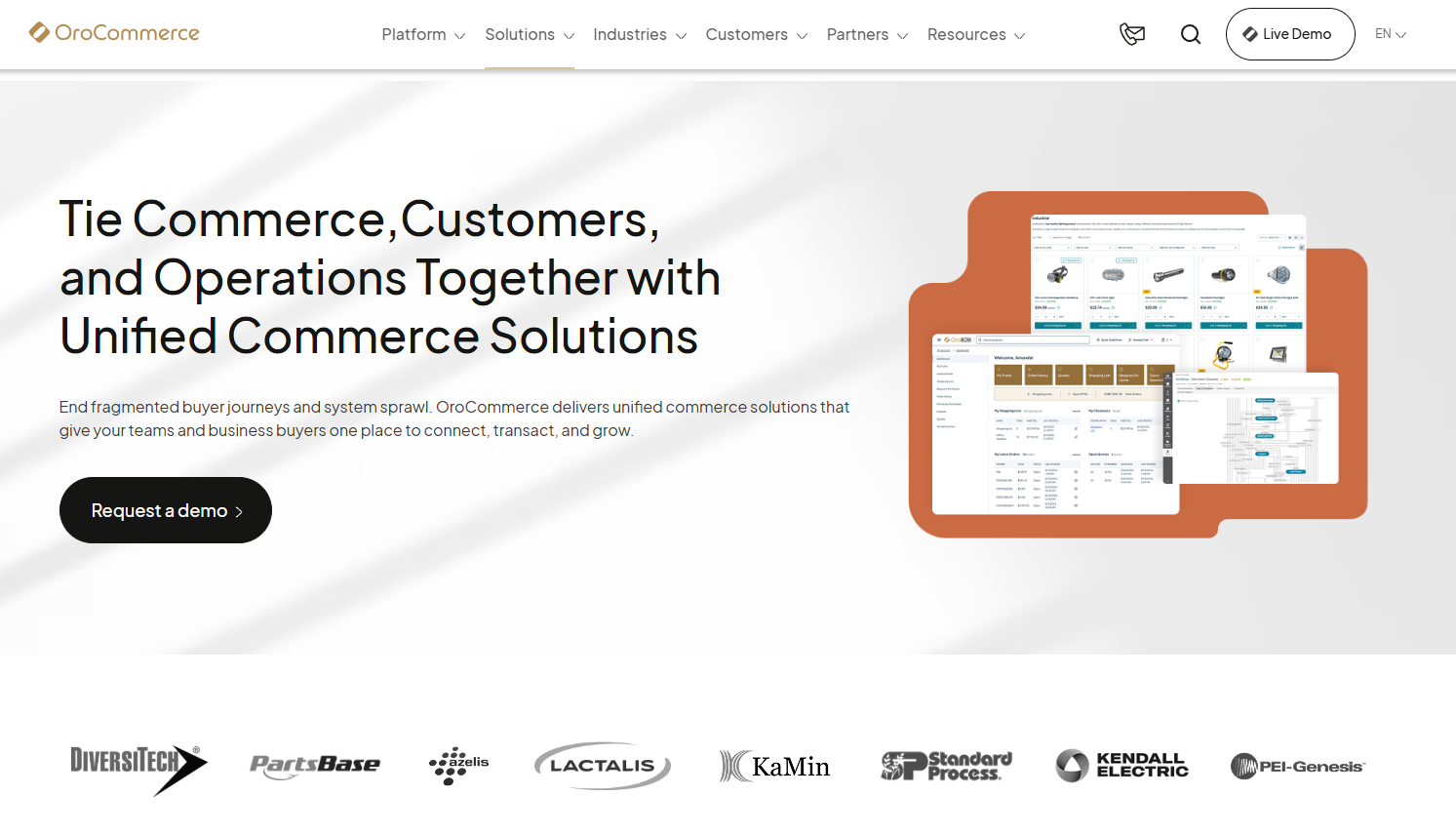
OroCommerce is a unified B2B platform that pulls eCommerce, CRM, CPQ, CMS, DAM, and marketplace models into a single platform under one license, with no additional fees for adding websites, warehouses, organizations, or locations.
Every essential B2B feature ships out of the box: corporate account hierarchies, configure-price-quote, a rule-based pricing engine, automated workflows, and AI tools for B2B use cases.
Gartner has consistently recognized OroCommerce in its Magic Quadrant for Digital Commerce.
Best for
Mid-market and large enterprises in manufacturing, distribution, and wholesale that need robust B2B functionality, complex pricing, multi-organization buyer structures, and deep ERP integration on one customizable platform without stacking separate product modules.
Key features
- Account hierarchies and customer accounts: Map complex buyer org structures with multiple purchasing roles, granular permissions, and delegated purchasing across business units and branches.
- Dealer portal management: Each channel partner gets a dedicated portal with their negotiated pricing, tailored product catalog, and order history, all managed from a single backend.
- Customer-specific catalogs and custom pricing: Account-level and segment-level price books, a combined price list engine, and negotiated contract management are all native, enabling customers to see only the products and pricing relevant to their account.
- Integrated CPQ and RFQ: Native quote-to-order workflows, configurable product logic, and multi-round negotiation tools. A low-code workflow engine routes approvals and order logic without custom development.
- OroIQ native AI: OroCommerce’s built-in AI layer handles order automation, buyer self-service, and back-office task execution, with more tools in active development.
- Seamless ERP integration: Direct, seamless integration with Microsoft Dynamics, SAP, NetSuite, JD Edwards, and Infor via pre-built connectors that syncs pricing, inventory, and order data in real time.
- Customer self-service: A full buyer portal covers order history, reorder tools, invoice access, and multiple payment methods through OroPay, taking pressure off the sales team.
- Multi-org and multi-site: Run multiple brands, sales channels, and marketplaces from a single backend.
Pricing
OroCommerce uses a “one platform, one license” model with no per-site fees and no usage-based charges. Request a tailored quote based on your scale and requirements.
2. Adobe Commerce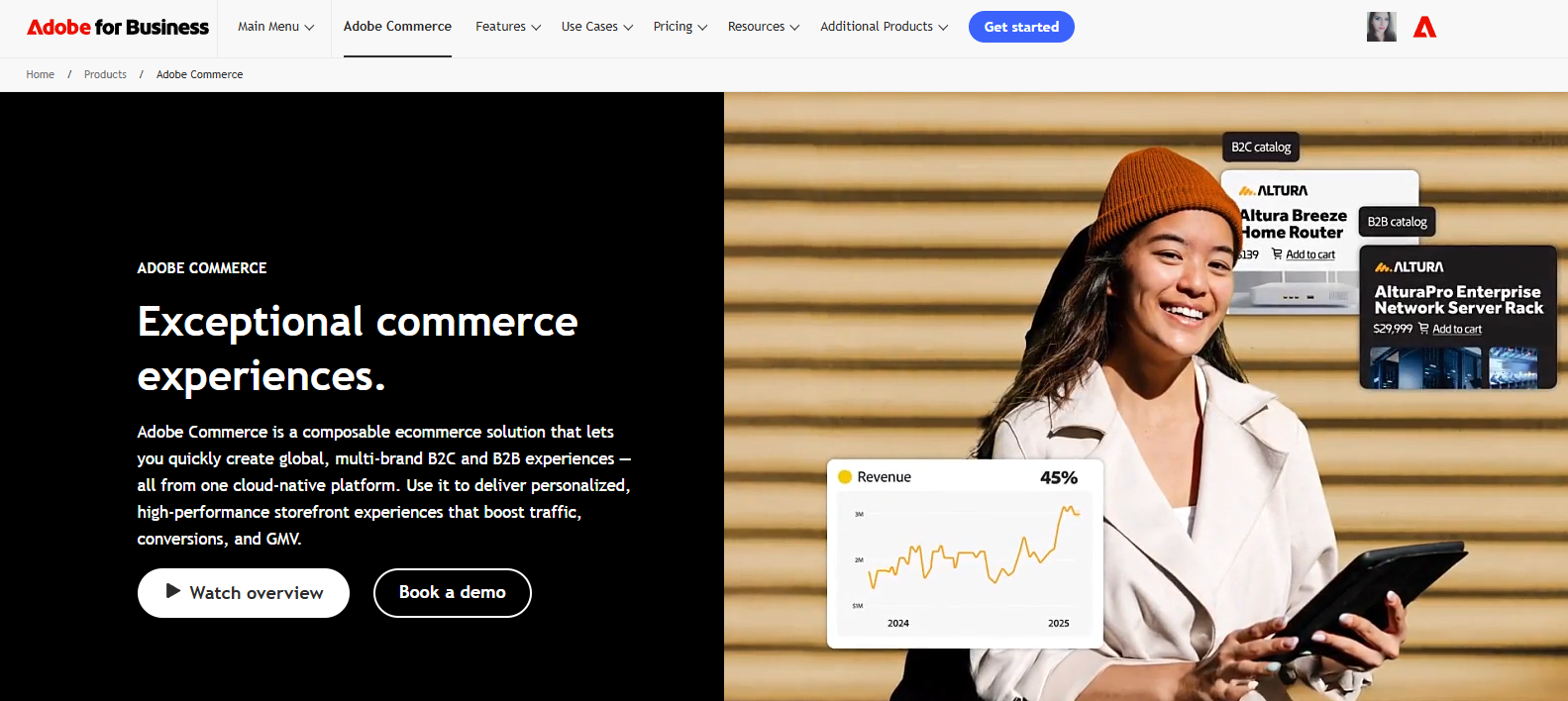
Adobe Commerce is a cloud-based enterprise eCommerce platform built on the open-source Magento foundation.
Manufacturers running B2C volume alongside complex B2B operations use it widely, and its integration with Adobe Experience Manager, Marketo Engage, and Adobe Analytics makes it a strong fit if you’re already invested in the Adobe stack.
B2B capabilities (company accounts, requisition lists, purchase order workflows, and credit limits) are included natively. CPQ and advanced manufacturing requirements typically need third-party extensions or additional development.
Learn more about Adobe Commerce competitors.
Best for
Large manufacturers with substantial B2C alongside B2B, strong internal development teams, and existing investment in the Adobe stack.
Key features
- Native B2B accounts: Company accounts, requisition lists, purchase order workflows, and credit limits included natively.
- Customer group pricing: Shared catalogs and account-level price books.
- Catalog management: Advanced support for configurable products, grouped products, and bundled SKUs.
- Customization: Extensive options via the open-source foundation and the Commerce Marketplace extension network.
- Adobe Experience Cloud integrations: Native connections for content, analytics, and marketing automation.
- Multi-brand and multi-site management: Run multiple brands from a single installation.
- Inventory management: Multi-source support with shipping rules, backorder handling, and warehouse support.
- Headless support: Custom front-end builds via GraphQL API.
Pricing
Adobe Commerce runs on a PaaS model; costs are based on customization scope and deployment requirements.
3. NetSuite SuiteCommerce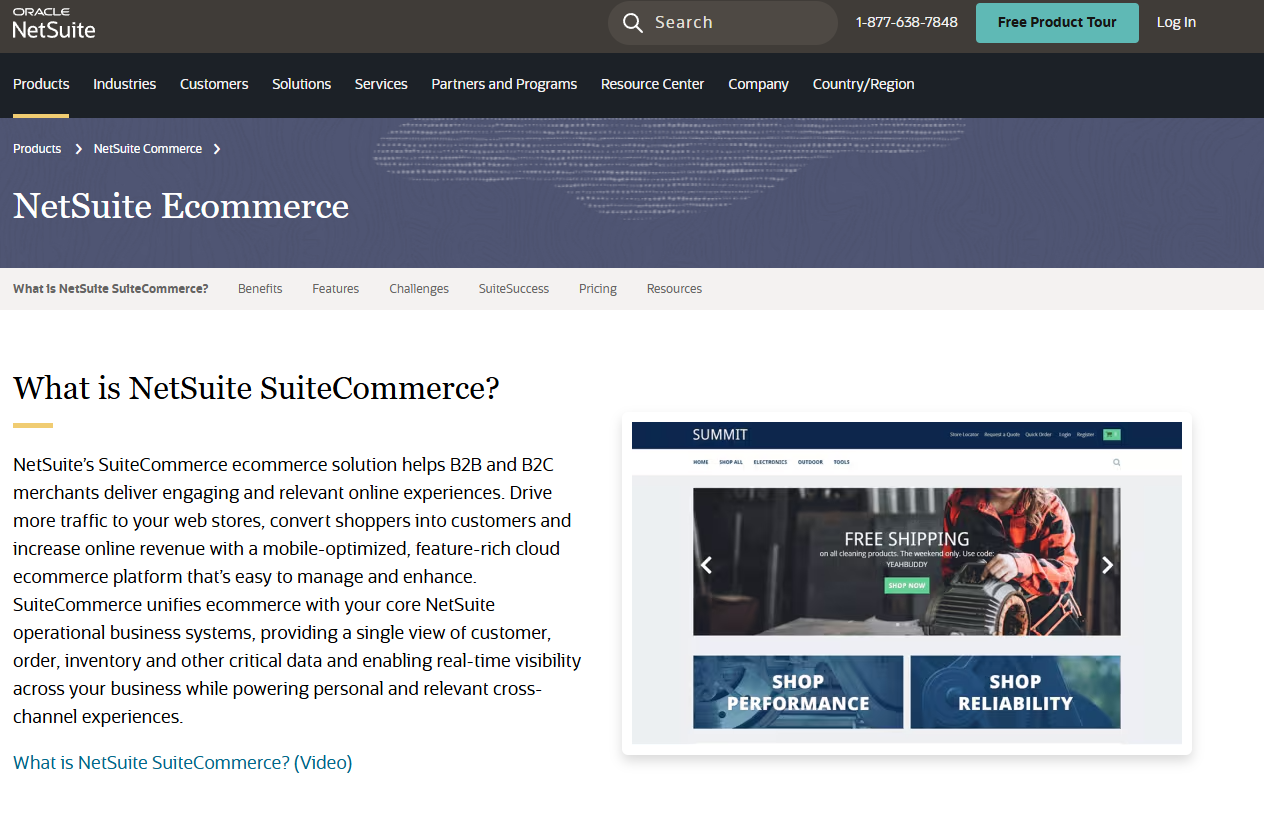
NetSuite SuiteCommerce is a native eCommerce module embedded within the NetSuite ERP platform. If you’re already running NetSuite, you can add a B2B web store without managing a separate platform or integration layer.
All commerce data lives in the same system as finance, production, and fulfillment, which eliminates the sync latency that affects separate eCommerce deployments.
Best for
Manufacturers already on NetSuite ERP who want to add B2B eCommerce capabilities without introducing a second platform or a custom integration build.
Key features
- Native ERP connection: Pricing, inventory data, customer accounts, and orders flow directly from NetSuite with no sync required.
- Account-specific pricing: Personalized catalogs and contract pricing terms pulled directly from ERP records.
- Customer portal: Order history, invoice access, and reordering without contacting a rep.
- Real-time inventory visibility: Stock levels across multiple warehouse locations via the NetSuite WMS.
- CPQ and quote management: Tied directly to NetSuite sales order workflows.
- Multi-currency support: Multi-language and multi-subsidiary capability for global manufacturing operations.
- Responsive storefront: Mobile support and SEO tools built in.
Pricing
SuiteCommerce is licensed as an add-on to an existing NetSuite ERP subscription. The cost is bundled into the NetSuite contract and scales with the overall NetSuite plan. It’s cost-effective only for businesses already on the NetSuite platform.
4. Unilog
Unilog is a B2B eCommerce and product information management platform built for distributors and manufacturers. Its CIMM2 platform combines a PIM-driven online catalog with eCommerce functionality and pre-built ERP integrations.
Unilog focuses on catalog management, data quality, and ERP connectivity, which are the three priorities that matter most in manufacturing eCommerce, where product data complexity is often the primary barrier to online selling.
Best for
Industrial distributors and manufacturers with large SKU counts, complex product data requirements, and existing ERP systems that need tight integration.
Key features
- PIM-driven catalog management: Handles complex product attributes, specifications, and large SKU volumes.
- ERP and accounting integrations: Pre-built connectors for SAP, Epicor, Infor, and NetSuite.
- Customer-specific catalogs and pricing: Account-based selling with tailored catalogs and pricing per customer.
- Bulk ordering and reorder: Built for B2B buying patterns and high-volume transactions.
- Inventory management: Supply chain visibility features across the full product catalog.
- Customer portal: Self-service account management, order tracking, and invoice access.
Pricing
Unilog prices on a custom basis. Fees are structured around catalog size, ERP integration scope, and deployment requirements, typically quoted as an annual subscription with implementation services included.
5. Optimizely
Optimizely is a digital experience platform that combines headless commerce, content management, and experimentation capabilities.
Its strength is content-led digital commerce: delivering personalized customer experiences, running A/B tests, and managing complex content alongside the buying journey.
Manufacturers with large digital teams who need sophisticated content programs alongside B2B commerce will find a strong fit here.
For manufacturers prioritizing CPQ or native ERP integration, additional custom integrations are typically required.
Best for
Enterprise manufacturers with large digital teams, strong content requirements, accounting systems, and existing investments in composable architecture.
Key features
- Headless commerce architecture: Decoupled front end for full front-end flexibility.
- Content management: Built-in digital experience personalization across the buying journey.
- Experimentation: A/B and multivariate testing across product pages, catalogs, and checkout flows.
- B2B commerce features: Account management, price lists, and catalog segmentation.
- Integration ecosystem: API-based connections to existing systems.
- Multi-currency transactions and multi-language: Support for global operations.
- Scalable architecture: Suited to enterprise digital commerce programs.
Pricing
Optimizely is priced on an enterprise contract basis. On this scalable platform, fees grow with traffic, feature modules, and the number of sites or markets, typically structured as an annual SaaS subscription with implementation and support costs agreed separately.
Why OroCommerce Is the Best B2B eCommerce Platform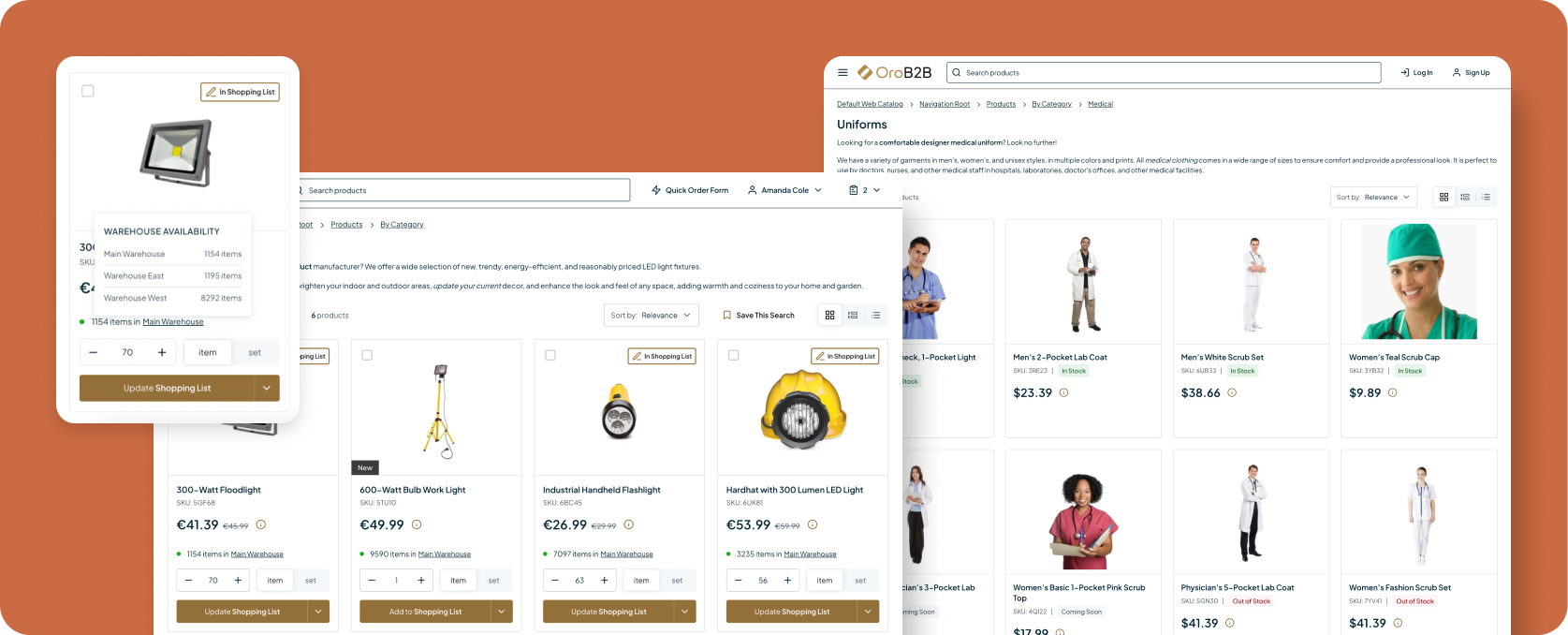
Every platform on this list serves a different type of manufacturer well. For operations where B2B complexity is the primary requirement, though, OroCommerce covers more ground natively than any other.
Built for manufacturing B2B from day one
Every other platform on this list started as something else: a B2C solution, an ERP module, or a composable toolkit. OroCommerce was built specifically for B2B manufacturers, distributors, and wholesalers from the start.
CPQ, RFQ, approval workflows, corporate account hierarchies, and dealer portals are native capabilities, not extensions.
Covering 70-80% of manufacturing B2B requirements natively means less time spent integrating tools and more time spent scaling the eCommerce business.
One platform across every sales channel
Your manufacturing business probably sells through multiple channels at once: direct B2B portals, dealer storefronts, and D2C, each with separate pricing rules, catalogs, and approval workflows.
Running all of that from a single backend without channel conflict or data duplication is one of the hardest problems in manufacturing eCommerce.
OroCommerce handles it natively. Manufacturers run all sales channels from a single backend, with channel-specific pricing, custom catalogs, and separate workflows per channel.
The built-in CRM, CPQ, and PIM share a single data model, so the sales team, distributors, and self-service buyers all work from the same pricing and inventory data simultaneously.
Check 8 B2B eCommerce capabilities live before you replatform, with a practical list of what to verify in a demo.
The difference native B2B makes
- DiversiTech, North America’s largest HVAC component manufacturer and distributor, was running 12 ERPs and handling orders through email and fax. OroCommerce helped eliminate manual rekeying in North America (20% productivity gain) and normalized orders across nine European ERPs during their consolidation.
- Lactalis, a global dairy leader, onboarded 15,000 customers across 12 markets in two years, saw 230% year-over-year growth in digital orders, and cut manual data entry by 44%.
- Braskem, the largest thermoplastic resin producer in the Americas, now processes 12,000 orders monthly across 800+ customers, saved over 22,000 internal work hours annually, and increased customer satisfaction by 13%.
The lowest total cost of ownership for complex B2B
Platforms like Adobe Commerce and Salesforce Commerce Cloud require stacking additional products to match what OroCommerce ships natively. Each addition increases licensing, integration, and maintenance costs over a five-year horizon.
OroCommerce’s GMV-based model includes eCommerce, CRM, CPQ, PIM, and AI under one license, with no per-site, per-transaction, or per-API-call fees.
SaaS, private cloud, and on-premise deployment under that same license gives regulated and global manufacturers more control than SaaS-only competitors.
Use the B2B eCommerce ROI calculator to model the impact on cash flow and total cost for your operation.
Bring your specific pricing, ERP, and channel requirements to the conversation.
How Manufacturers Can Digitize Sales Without Disrupting Distributor Channels
Going digital isn’t just a technology decision for manufacturers.
It’s a channel strategy decision. Launching an online store or a D2C channel while maintaining distributor relationships requires careful execution, because the wrong approach loses channel partners who feel bypassed.
The right approach opens new markets and keeps existing customers well-served.
Separate pricing tiers by channel
Maintain distributor-level discounts through dedicated portals while offering different pricing on direct D2C channels. This avoids channel conflict and strengthens customer relationships on both sides.
Review dynamic pricing eCommerce strategies for B2B for implementation approaches.
Build personalized dealer portals, not generic wholesale pages
Each distributor should have their own branded portal with account-specific catalogs, negotiated pricing, and order history. Custom catalogs and pricing tiers signal genuine investment in the relationship rather than a generic wholesale portal experience.
Route D2C orders back to distributors
Manufacturers can route orders placed through D2C channels to the appropriate distributor based on geography, inventory, or performance criteria. This keeps partners involved in fulfillment and removes the friction that makes distributors resistant to the manufacturer’s digital programs.
Enable punchout and EDI for procurement-driven buyers
Large distributors and retail chains using Coupa or Ariba need punchout catalogs to connect procurement workflows to your online catalog. EDI eliminates the remaining manual processes and helps streamline operations across high-volume channel relationships.
Align sales reps and self-service
Sales reps should be able to operate inside the same ecommerce system: building quotes, submitting orders on behalf of buyers, and accessing account history. That way, digital convenience and human relationship management reinforce each other. This is what modern enterprise B2B eCommerce looks like in practice.
A well-executed channel digitization strategy gives manufacturers instant access to better order data, faster fulfillment, and the ability to capture growth opportunities that manual, rep-dependent sales processes can’t scale into.
Conclusion on B2B eCommerce Platform for Manufacturers
Choosing the right B2B ecommerce platform for manufacturers comes down to knowing where your complexity lives.
- OroCommerce is the strongest purpose-built option for manufacturers with complex B2B requirements: native CPQ, deep ERP integration, distributor portal management, and multi-channel support under one license.
- Adobe Commerce fits large manufacturers with significant B2C volume and development resources to maintain an open-source platform.
- NetSuite SuiteCommerce is the right call for manufacturers already on NetSuite ERP who want native ecommerce without a second platform.
- Unilog serves industrial distributors and manufacturers whose primary challenge is catalog complexity and ERP connectivity.
- Optimizely suits enterprise manufacturers with large digital teams and content-led ecommerce strategies.
Choosing the right platform starts with auditing your product configurability needs, ERP integration depth, distributor portal requirements, and channel strategy. The enterprise B2B eCommerce platform comparison, the eCommerce architecture guide, and the B2B eCommerce trends 2026 report are all worth reading before you finalize a direction.
For manufacturers who need real B2B depth, including complex pricing, ERP and CRM systems integration, multi-org account structures and distributor portal management, OroCommerce covers those requirements natively at the lowest total cost of ownership on this list.
See how OroCommerce handles your specific manufacturing requirements
FAQs About B2B eCommerce Platforms for Manufacturers
What makes a B2B eCommerce platform suitable for manufacturers?
A suitable platform must support CPQ workflows, real-time ERP integration, customer-specific pricing and catalogs, and distributor portal management, all natively. Platforms built for B2C or retail don’t have the account hierarchy, approval workflows, and pricing engine depth that manufacturing eCommerce demands.
Which B2B eCommerce platform is best for manufacturers with configurable products?
OroCommerce is the strongest option. Its native CPQ and RFQ handle multi-round quote negotiation, BOM-level product configuration, and approval routing without third-party extensions. Adobe Commerce supports configurable products but requires additional tools for full CPQ functionality.
How does B2B eCommerce help manufacturers manage distributor relationships?
It enables personalized portals per distributor with custom catalogs, negotiated pricing, and order history. Combined with tiered pricing by channel and punchout catalog support, manufacturers can scale online sales while keeping distributors active in the fulfillment chain.
Do manufacturers need a separate platform for D2C and B2B sales?
No. Platforms like OroCommerce support both channels from a single backend with separate pricing rules, catalogs, and workflows per channel. This eliminates the integration overhead of two separate ecommerce sites and simplifies supply chain management.
How important is ERP integration for a manufacturing eCommerce platform?
Critical. Without real-time ERP sync, pricing errors, inventory oversells, and duplicate orders follow. The best platforms offer native connectors, not middleware, to keep pricing, inventory, and order data consistent across all systems at all times.