
navigation

SAP ended mainstream maintenance for SAP Commerce on premise in July 2026, putting SAP Hybris migration on the agenda for businesses still using it. But where you move next deserves careful consideration. Your choice will affect future costs and how easily you can adapt your B2B commerce operations.
SAP Hybris migration is the process of moving your existing commerce system to SAP Commerce Cloud or another platform. This involves transferring business data, adapting integrations, and deciding which customizations to keep or replace.
This article explores your migration options, their costs and timelines, and the steps involved in planning a successful move.
We’ll also look at what manufacturers and distributors should consider when choosing a platform that supports their B2B requirements while keeping SAP ERP in place.
Key Takeaways
- Your Hybris system still runs, but it no longer gets patches or new features.
- Three paths exist: move to SAP Commerce Cloud, rebuild as composable, or replatform.
- SAP Commerce Cloud takes around 18 months and keeps the legacy architecture.
- A modern B2B platform can go live in six to eight months and keep SAP ERP in place.
- Phase the rollout, protect SEO, and measure success against your Hybris baseline.
What Is SAP Hybris Migration and Why Now?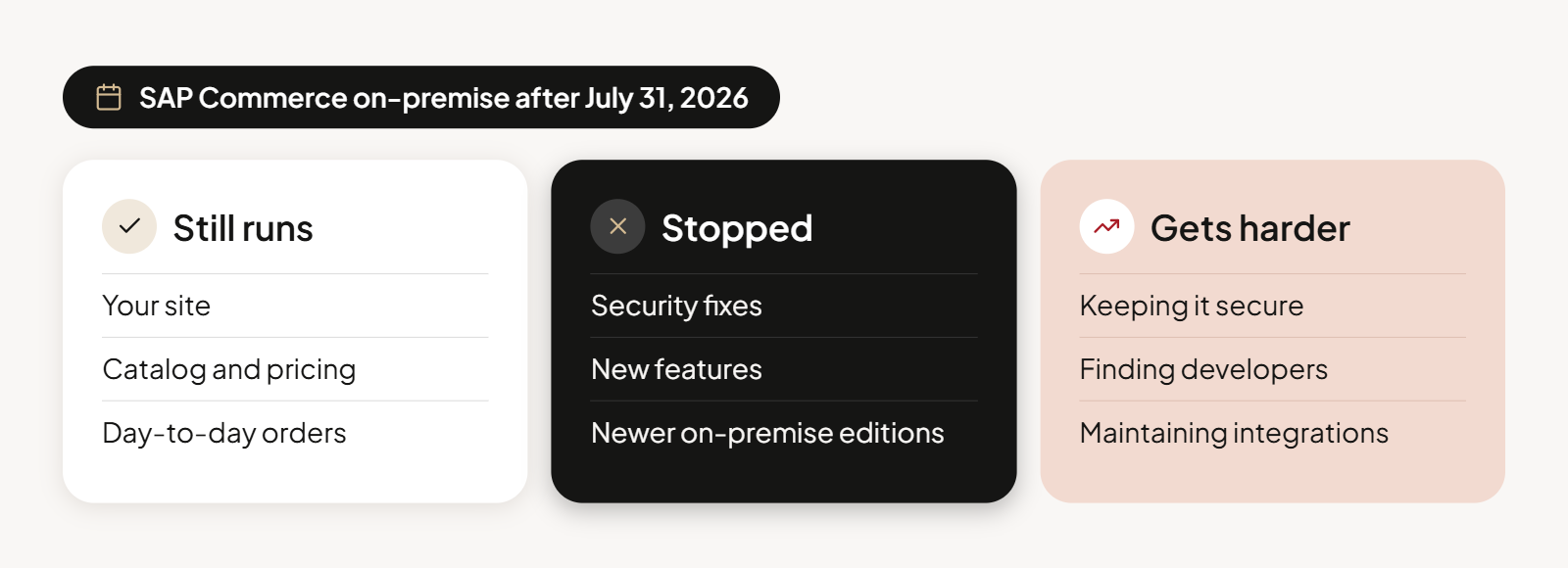
SAP Hybris migration can mean moving to SAP Commerce Cloud or replatforming to a different B2B eCommerce solution. Both paths involve migrating commerce data, adapting integrations, and reviewing existing customizations.
With mainstream maintenance for SAP Commerce on-premise now over, businesses need to consider the implications of staying on the platform. Limited support raises concerns about security and long-term maintenance.
Meanwhile, companies in manufacturing and distribution face growing demand for self-service purchasing experiences that offer the convenience buyers are used to from consumer commerce.
Hybris, SAP Commerce, and SAP Commerce Cloud explained
Hybris is the original name of the commerce product SAP acquired. SAP Commerce is its current name, sold as the self-hosted on-premise edition or as SAP Commerce Cloud, SAP’s cloud-hosted successor. SAP Commerce Cloud still relies on the same Hybris codebase, so the cloud edition changes where your code runs while the architecture stays.
The 2026 end-of-life deadline
SAP ended mainstream maintenance for the on-premise edition on July 31, 2026. Version 2205 is the final on-premise edition, and no newer one is planned. Teams often call this SAP Hybris end of life, though SAP’s own term is end of mainstream maintenance.
Since then, only customer-specific maintenance remains: a reduced support tier with no guaranteed response times or new security fixes. SAP steers customers toward SAP Commerce Cloud, the edition that keeps receiving regular updates, and has announced no extended on-premise track.
Why staying on Hybris is a business risk
Running Hybris without mainstream support exposes your business on five fronts:
- Security and compliance exposure on a system that no longer receives fixes for new vulnerabilities.
- Rising infrastructure and licensing costs for a platform that stopped improving.
- Growing upgrade debt and dependence on a shrinking pool of specialized developers.
- Integrations that get harder to maintain with every change in connected systems.
- Slow release cycles that delay innovation and the B2B capabilities your customer experience needs.
How to Make the Stay-or-Replace Decision
Your SAP Hybris Migration Options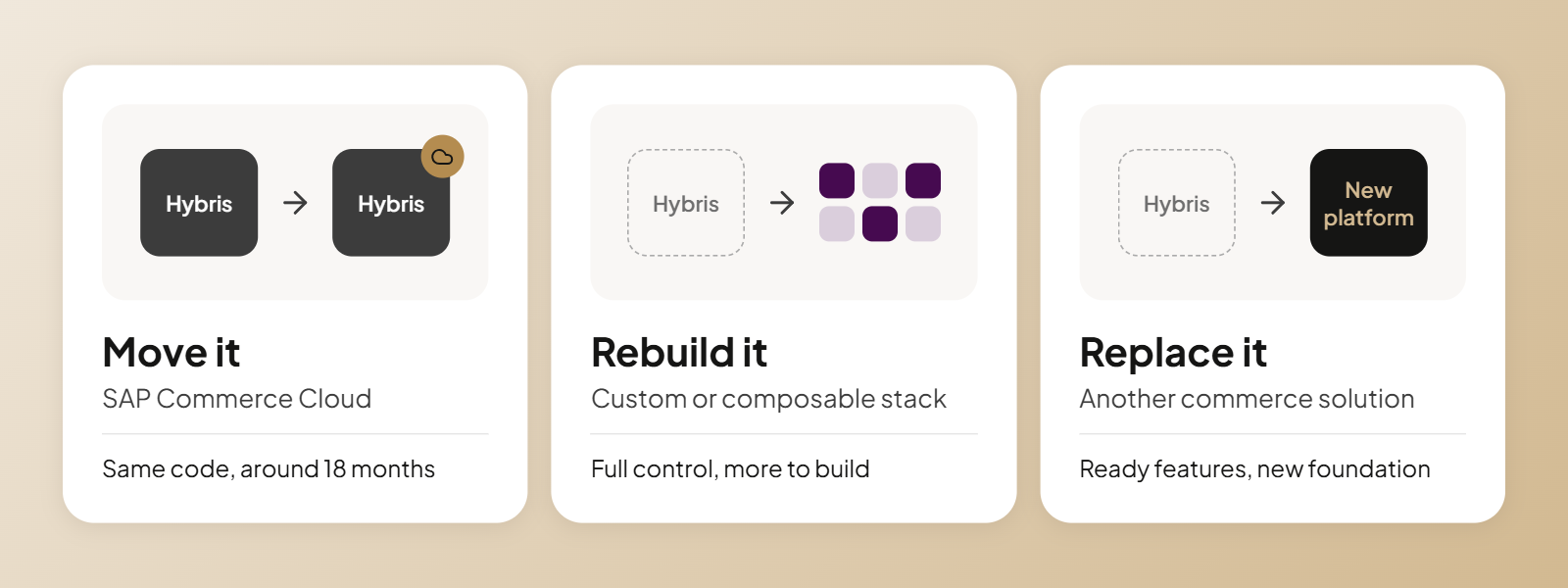
Your SAP Hybris migration has three realistic destinations, and each one trades speed, control, B2B depth, and total cost differently. The premise is simple: if you have to spend the budget anyway, the investment should buy a modern B2B foundation.
The difference between rehosting Hybris and replacing it
Rehosting moves the same codebase to new infrastructure. Replacing it removes the limits of the architecture. The three options below sit on either side of that line, and Table 1 compares them on the criteria your steering group will ask about.
Option 1: Move to SAP Commerce Cloud
Option 1 is the closest path to your current setup, which is why companies often start there. It keeps the same legacy Hybris codebase and moves it to SAP’s cloud.
SAP estimates that most migrations to SAP Commerce Cloud take four to eight months, although heavily customized implementations with multiple integrations can take considerably longer. The wider SAP operating model often adds paid products, such as SAP Business Technology Platform (BTP) middleware, to connect storefront capabilities to the ERP.
Option 2: Rebuild on a custom or composable stack
You can build a commerce system from scratch or assemble one using API-connected services from different vendors. Both approaches offer considerable flexibility, but require investment in development, integrations, and ongoing maintenance.
Our B2B eCommerce build vs. buy guide explores these trade-offs, including how AI changes the cost of custom development.
Option 3: Replatform to another commerce solution
Moving away from SAP Commerce makes sense when high customization and maintenance costs keep growing or when your business needs more flexibility. It also lets you pick a platform with more native B2B capabilities, more agility, and lower long-term ownership costs. Use the list of best enterprise B2B eCommerce platforms as your shortlist.
Table 1: SAP Hybris migration options compared
| Option | Speed | Control | B2B depth | Total cost |
|---|---|---|---|---|
| Move to SAP Commerce Cloud | Around 18 months | Limited by SAP’s update cycle | Through extensions | High, plus adjacent SAP products |
| Build custom or composable | Slower, many integrations | Maximum | Built from separate parts | Variable; ongoing development and maintenance |
| Replatform to a B2B platform | Faster when B2B is native | Depends on the platform | Native when B2B-first | Lower when licensing consolidates |
Considering a Move Away From SAP Hybris? Compare Your Options.
Why You Should Choose OroCommerce as an SAP Hybris Alternative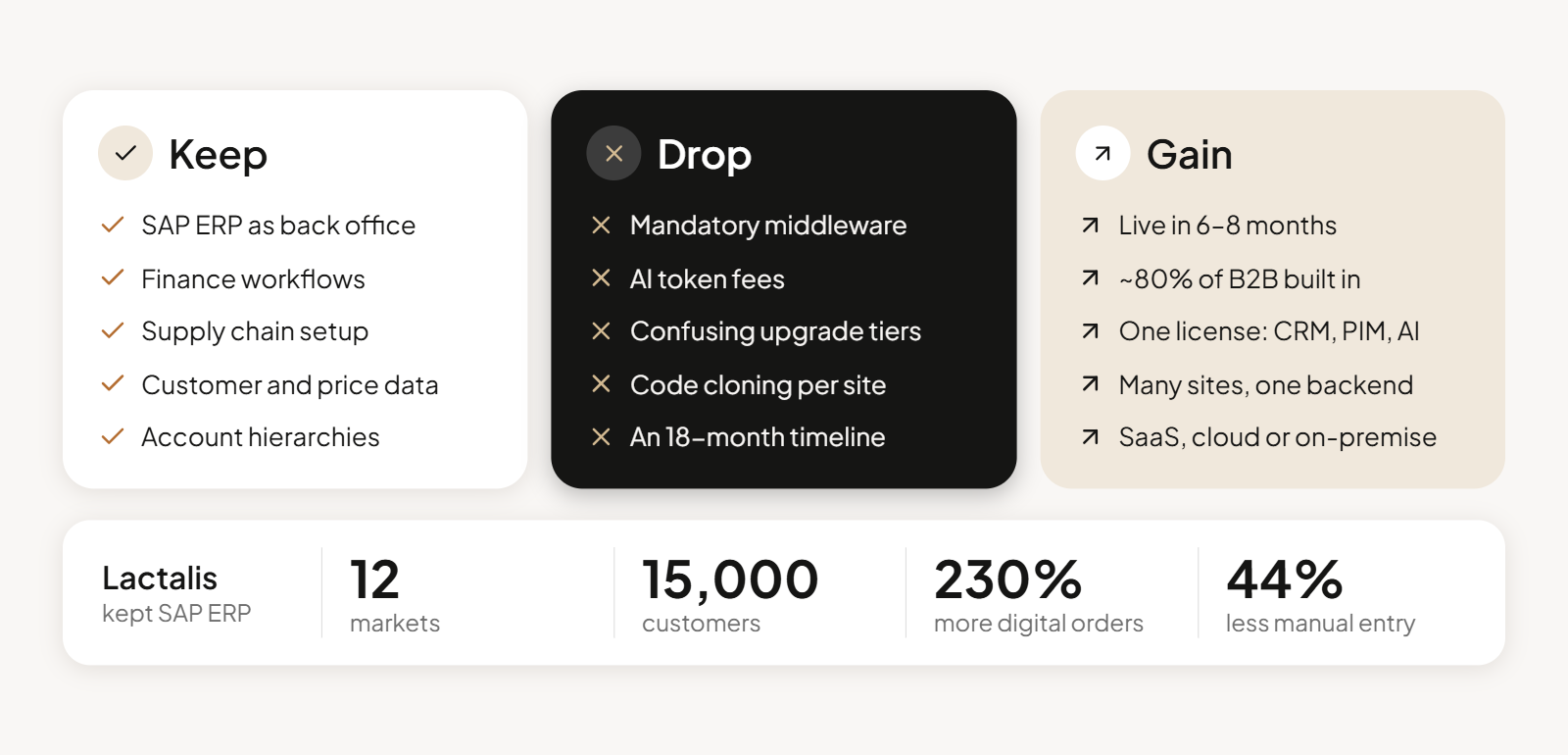
OroCommerce is an AI-enabled digital commerce platform built specifically for B2B manufacturers and distributors. It comes with native capabilities for managing account hierarchies, approval workflows, and other B2B eCommerce requirements.
Unlike platforms adapted from retail, OroCommerce was designed around B2B sales processes from the start. Buyers and sales reps work with the same customer accounts and order data.
OroCommerce covers around 80% of typical B2B requirements out of the box, giving you the flexibility to customize the remaining 20% to fit your business.
Want to see how much of your requirements OroCommerce can cover? Book a demo.
Live in 6-8 months
If you have to show finance a shorter timeline, speed and cost are where the difference shows first:
- Complex enterprise deployments launch in six to eight months, against around 18 for a move to SAP Commerce Cloud.
- Deploy on SOC 2-compliant SaaS, public cloud, private cloud, or on-premise infrastructure, backed by the SOC 2 certification.
- A single licensing fee keeps total cost of ownership 50% below SAP averages.
Keep SAP ERP and drop the middleware tax
SAP ERP stays your back-office standard, so your finance and supply chain teams keep the system they know. The OroCommerce partnership with SAP supports that setup:
- Commerce connects directly to the ERP through APIs, with no mandatory middleware layer to license and maintain.
- CRM, PIM, marketplace, and the AI suite come in one license, and quoting and approval workflows ship with the platform.
- There are no consumption-based AI token fees or confusing upgrade tiers.
Lactalis kept its SAP ERP and built its commerce layer on OroCommerce. In two years across 12 markets, it saw a 230% increase in digital orders and 44% fewer manual processes.
The same rollout onboarded 15,000 customers over those two years. Aurélien Devaux, Head of Digital and eCommerce at Lactalis, says, “Market deployments that previously took several years now take a few months.”
Multi-site done right
OroCommerce manages many brands and regions from one backend:
- Independent brands and regional business units in large organizations run from one central backend, each with its own storefront and pricing.
- Global catalog structures and complex pricing logic are shared across localized sites.
- There’s no code cloning or manual syncing between instances.
- New market storefronts launch in days instead of quarters.
Table 2 shows how the two platforms compare on the criteria that matter most when you leave Hybris, so your steering group can check each claim against your own requirements.
Table 2: OroCommerce vs SAP Commerce Cloud
| Criteria | OroCommerce | SAP Commerce Cloud |
|---|---|---|
| Best fit | Complex B2B, multi-org structures, and high-touch sales | Large enterprises with B2B, B2C, or hybrid commerce needs |
| Core B2B capabilities | B2B-first, with native pricing engine, RFQ, approvals, and hierarchies | Account hierarchies, customer pricing, quotes, and approvals |
| Workflow automation | Advanced native workflows: approvals, RFQ, automation engine | Configurable order approvals and business workflows |
| Catalog and merchandising complexity | High: PIM, complex catalogs, pricing rules | Advanced catalog management, classification, and PIM |
| Multi-site and global capabilities | Multi-org, multi-site in one instance | Multi-storefront, localization, and multicurrency support |
| Typical deployment time | Six to eight months for complex projects | Up to 18 months for a complex Hybris migration |
| ERP connection and middleware | Direct API, no mandatory middleware | Often requires paid SAP BTP middleware |
| Licensing model | Single license with essential B2B features included; based on GMV | Subscription based on orders or GMV; additional SAP products priced separately |
For the full vendor comparison, read the roundup of SAP Commerce Cloud competitors. If you want to check these rows against your own accounts and SAP ERP setup, book a demo with an OroCommerce expert.
SAP Hybris Migration Costs, Complexity, and Timing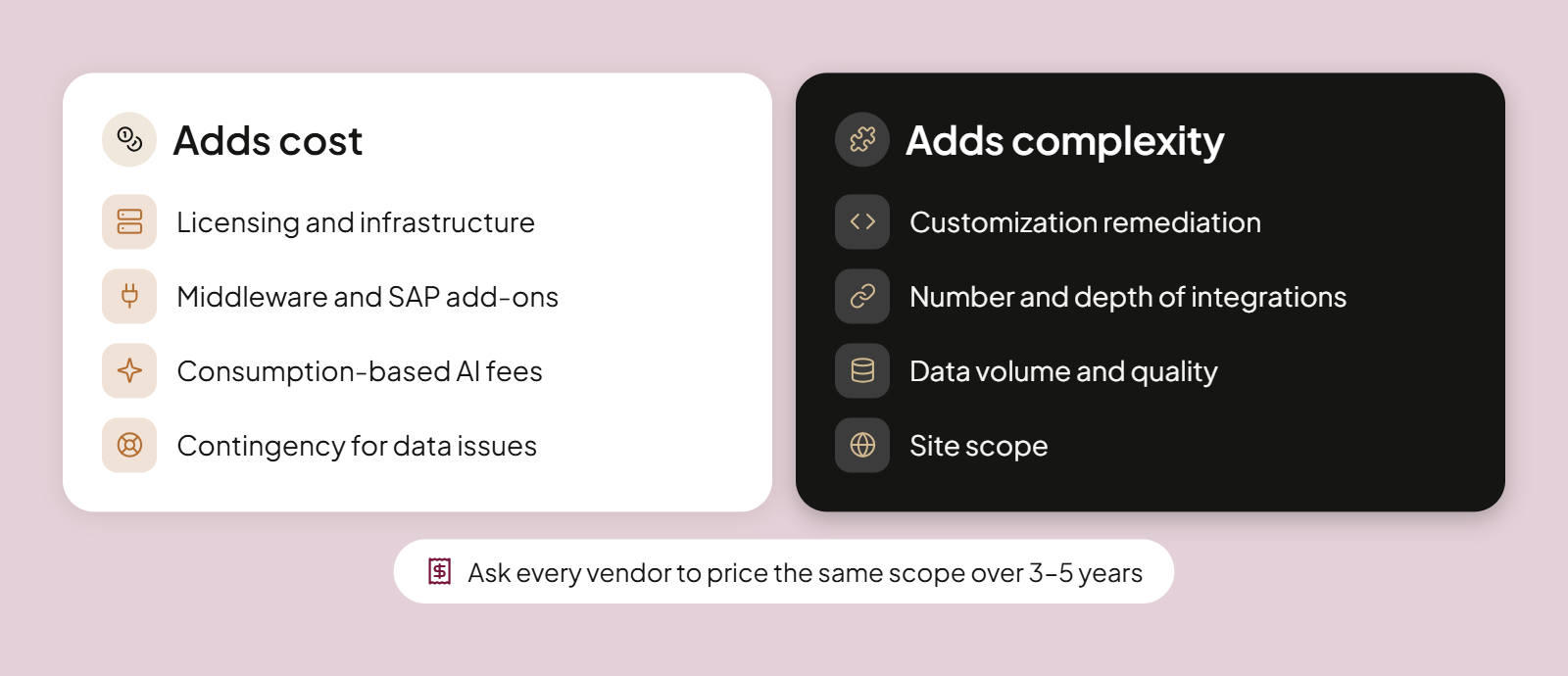
When evaluating your migration options, look beyond the initial project cost. Compare the total cost of ownership over three to five years, weigh the expected benefits against the investment to estimate ROI, and consider how each option fits your timeline and budget.
What drives cost and complexity
Build your budget on a total cost of ownership for eCommerce model that covers these drivers:
- Licensing and infrastructure.
- Middleware and adjacent product costs.
- Consumption-based AI fees.
- Customization remediation.
- Number and depth of integrations.
- Data volume and quality.
- Storefront scope.
- A contingency for data migration issues.
Ask every vendor to price each line against the same scope, so the three-to-five-year comparison holds up when finance reviews it.
Choosing the right time to migrate
The right time to migrate is the earliest window that clears your peak season and your team’s capacity, which isn’t necessarily tomorrow. Check these five criteria:
- Distance from the 2026 deadline: every month on customer-specific maintenance adds exposure.
- Realistic project duration for each option, since 18 months and six to eight months set different cutover dates.
- Commercial calendar: keep cutover away from October, November, and December peaks and from a June fiscal year-end.
- Internal team capacity for testing and training.
- Measurable readiness criteria agreed before kickoff.
Write the cutover window and the go or no-go criteria into the project charter, so nobody renegotiates them under deadline pressure.
How to Plan Your SAP Hybris Migration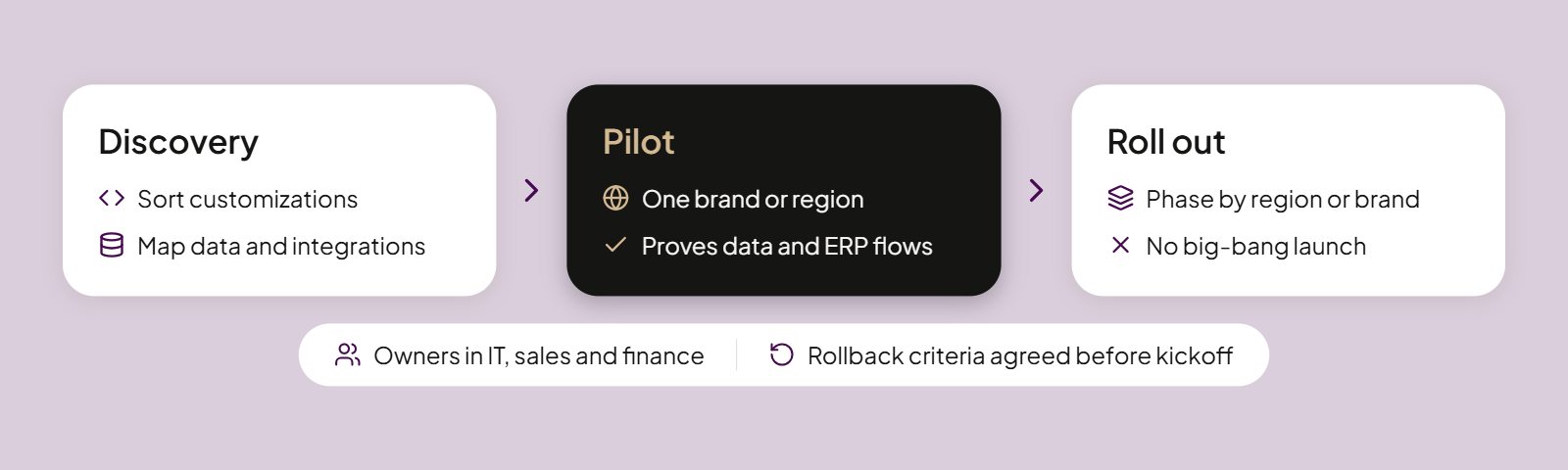
Discovery and planning prevent most overruns because they catch costly mistakes early, so give them real time before you create a single storefront page. Write your migration strategy and desirable business outcomes so business stakeholders can follow it as well as IT.
Inventory customizations and extensions
List every custom extension and accelerator change, along with the integrations each one relies on, because a custom extension often hides a batch job or a direct database call. Mark each one as keep, replace with native functionality, or drop, and treat default platform features as your baseline.
For example, a custom pricing extension may duplicate contract pricing that the new platform handles natively.
Document data and integrations
Map your product catalog alongside customer and pricing data. Document every SAP ERP and third-party integration, such as CRM and marketing automation tools, with its data owner, including any middleware you use today.
A data owner who can approve mapping decisions saves weeks of back-and-forth.
Set a phased delivery plan
A phased plan has four steps:
- Define the MVP scope for the first launch.
- Phase the rollout by region, brand, business unit, or sales channels instead of one big bang.
- Assign owners across IT, sales, and finance.
- Agree rollback criteria before kickoff to cap the risk of a failed cutover.
A pilot brand or region proves your data mapping, and ERP flows on real orders before the rest follow. Phasing also helps you avoid the risks of eCommerce replatforming that come with a single launch.
Migrating Data and Reconnecting SAP ERP
A B2B data migration succeeds when you cleanse and map the structures that break most easily, then rebuild the ERP connection before the first trial run. Most data challenges sit in account hierarchies and pricing.
Cleansing and mapping B2B data
Define cleansing rules before the first trial migration, then map:
- Products and attributes.
- Catalogs.
- B2B units and customer hierarchies.
- User roles.
- Price lists and contract pricing.
- Payment terms.
- Order history.
Connecting SAP ERP directly via API
Confirm the system of record for items, inventory, pricing, customers, and orders. Decide which system owns each field, because two systems that both edit prices overwrite each other. Then set up direct API flows and plan for the shift away from brokered middleware.
Test each flow end to end, including ERP-synced pricing. Your SAP ERP may run ECC or S/4HANA, and the SAP ERP eCommerce integration guide shows how this works in practice.
Protecting data integrity
Protect your data with five steps:
- Take full backups before any move.
- Run a trial migration on staging.
- Reconcile record counts.
- Run a final delta sync.
- Document the rollback procedure.
Use the trial migration to measure how long the final load takes and to find records that fail validation.
Testing, Launch, and SEO Protection
Testing and cutover decide whether your buyers and your organic traffic survive the switch with minimal disruption.
Testing storefront and buyer journeys
Test with real buyer accounts and real price lists, since test data hides the exceptions that live customers hit. Define pass criteria for each flow before testing starts, then cover every path your buyers take:
- Account logins and roles.
- Contract pricing.
- Quotes and approvals.
- Quick order and reorder.
- Checkout and payments.
- ERP sync, including prices that update automatically.
- Performance under peak load.
Cutover and SEO continuity
Use these B2B SEO strategy tips alongside the launch steps:
- Set a controlled cutover window.
- Build a 1:1 301 redirect map for every old URL.
- Preserve metadata and structured data.
- Turn monitoring on at go-live.
- Keep the support team on standby.
- Tell buyers about the change before go-live.
Measuring SAP Hybris Migration Success
Prove the migration paid off by comparing six metrics against your Hybris baseline, which you capture before kickoff. Agree on the targets with sales and finance, so the scorecard reflects what each team needs.
Table 3: SAP Hybris migration success scorecard
| Metric | Baseline on Hybris | Target | How to measure |
|---|---|---|---|
| Time to launch a new market or brand | Months from approval to go-live on your last launch | Days to weeks | Project tracker |
| Site availability | Uptime over the last 12 months | At or above baseline, including cutover week | Uptime monitoring |
| Conversion rate | Visit-to-order rate before kickoff | Above baseline after launch | Analytics with the same definition |
| Digital order share | Share of orders placed online | Higher each quarter | ERP order data by channel |
| Manual processes | Orders keyed in by hand per week | Lower than baseline | Order desk logs and ERP exceptions |
| Total cost of ownership | Annual licensing, hosting, and support today | Below baseline over three to five years | Annual finance review |
After launch, document the priorities that support growth: new self-service features, additional regions or brands, and AI-assisted ordering. As buyers adopt AI agents for routine ordering, clean product and account data becomes part of your readiness.
Conclusion About SAP Hybris Migration
Every SAP Hybris customer now faces a migration, so the real decision is whether to rehost the same architecture or replace it. For B2B manufacturers, distributors, and wholesalers, OroCommerce offers a faster, lower-cost exit that keeps SAP ERP in place and removes middleware and multi-site cloning while cutting customization overhead.
Customer-specific maintenance is a bridge with a fixed end, so set an exit plan now. The future belongs to teams that choose a foundation built for B2B.
See what moving from SAP Hybris to OroCommerce could look like
FAQs About SAP Hybris Migration
What is SAP Hybris migration?
SAP Hybris migration moves your storefront, catalog, customer and pricing data, custom extensions, and integrations off the on-premise edition of SAP Commerce, formerly called Hybris. The target can be SAP Commerce Cloud or a different commerce platform. Most projects run in phases and keep the ERP as the system of record.
When does SAP Hybris reach end of life?
SAP ended mainstream maintenance for the on-premise edition of SAP Commerce, formerly Hybris, on July 31, 2026. The final on-premise edition is 2205. SAP has announced no final sunset, so your system keeps running under customer-specific maintenance, but without regular security fixes or feature updates.
Is SAP Commerce Cloud different from SAP Hybris?
SAP Commerce Cloud is SAP’s cloud-hosted successor to Hybris, and it runs on the same Hybris codebase. The main differences are hosting and update schedule. Your data model and customizations carry over, so the move changes your hosting more than your architecture.
How long does an SAP Hybris migration take?
Duration depends on the target platform and the scope of your customizations and integrations. A move to SAP Commerce Cloud typically takes around 18 months just to maintain the status quo, while OroCommerce reports six to eight months for complex deployments. Data quality and the number of ERP integrations usually decide where your project lands.
Can I keep SAP ERP if I move off SAP Commerce?
Yes. SAP ERP stays the system of record for pricing and orders, and the new commerce platform connects to it through APIs. OroCommerce connects directly with no mandatory middleware, and Lactalis kept its SAP ERP across 12 markets while moving its commerce layer to OroCommerce.
What is the best SAP Hybris replacement for B2B?
The best replacement is the platform that fits your ERP and your B2B processes. For manufacturers, distributors, and wholesalers, a unified B2B platform such as OroCommerce offers native quoting and account pricing, plus CRM and a direct SAP ERP connection. Compare at least three options on speed, control, B2B depth, and total cost.