
Many manufacturers and distributors are unknowingly overspending on their digital strategy.
Leadership teams view B2B eCommerce as a simple digital branch, a place to capture online orders. Because of that view, they assume the platform can’t handle the real work of the business.
This assumption creates expensive workarounds. Companies spend years customizing B2C platforms to handle corporate hierarchies or stretching their ERPs to manage customer-facing logic. They are building custom software for problems the industry already solved.
To understand why so many companies are still doing it the hard way, we have to look at how the technology – and the expectations – shifted.
How We Got Here
Most B2B commerce stacks weren’t drawn up on a whiteboard. They were layered over time. You can usually read that history in three quick phases. We’re currently shifting into a third phase, but most companies are still running on the infrastructure of the first two.
2010–2015: The Brochure Era
In this phase, digital was a secondary concern owned by marketing. The website was essentially a PDF with a search bar. The customer did their research online, then picked up the phone to call their rep to place the order. The website had no transactional responsibility. It was a billboard.
2016–2021: The Checkout Era
Then came the Amazon Business effect. B2B buyers started demanding the ability to buy online, and manufacturers and distributors rushed to respond. This period saw a massive spike in bolt-on stacks:
- A retail-centric storefront bolted onto a legacy ERP.
- A thin layer of middleware trying to force the two to talk.
- An ERP module stretched to its breaking point to act as a storefront.
This worked for simple, repeat transactions. But anything involving contract pricing, approvals, or multi-location fulfillment quickly fell back to spreadsheets and phone calls.
2022–Present: The Unified Commerce Era
We have now hit the ceiling of the checkout era. The “Buy” button is now the least interesting part of the system. In a B2C transaction, the button just captures a credit card and an address.
In B2B, that same button is the trigger for a massive sequence of logic: it must validate a 50-page contract, check a specific customer’s tiered credit limit, confirm inventory reservations across three different regional warehouses, and apply a negotiated shipping rate.
Most companies looked at this complexity and assumed eCommerce couldn’t handle it. The bolt-on solutions from the checkout era certainly couldn’t. So companies either kept patching what they had or gave up on meaningful digitization entirely.
What they didn’t realize: the platform category had evolved underneath them.
What Changed (And What Most Companies Missed)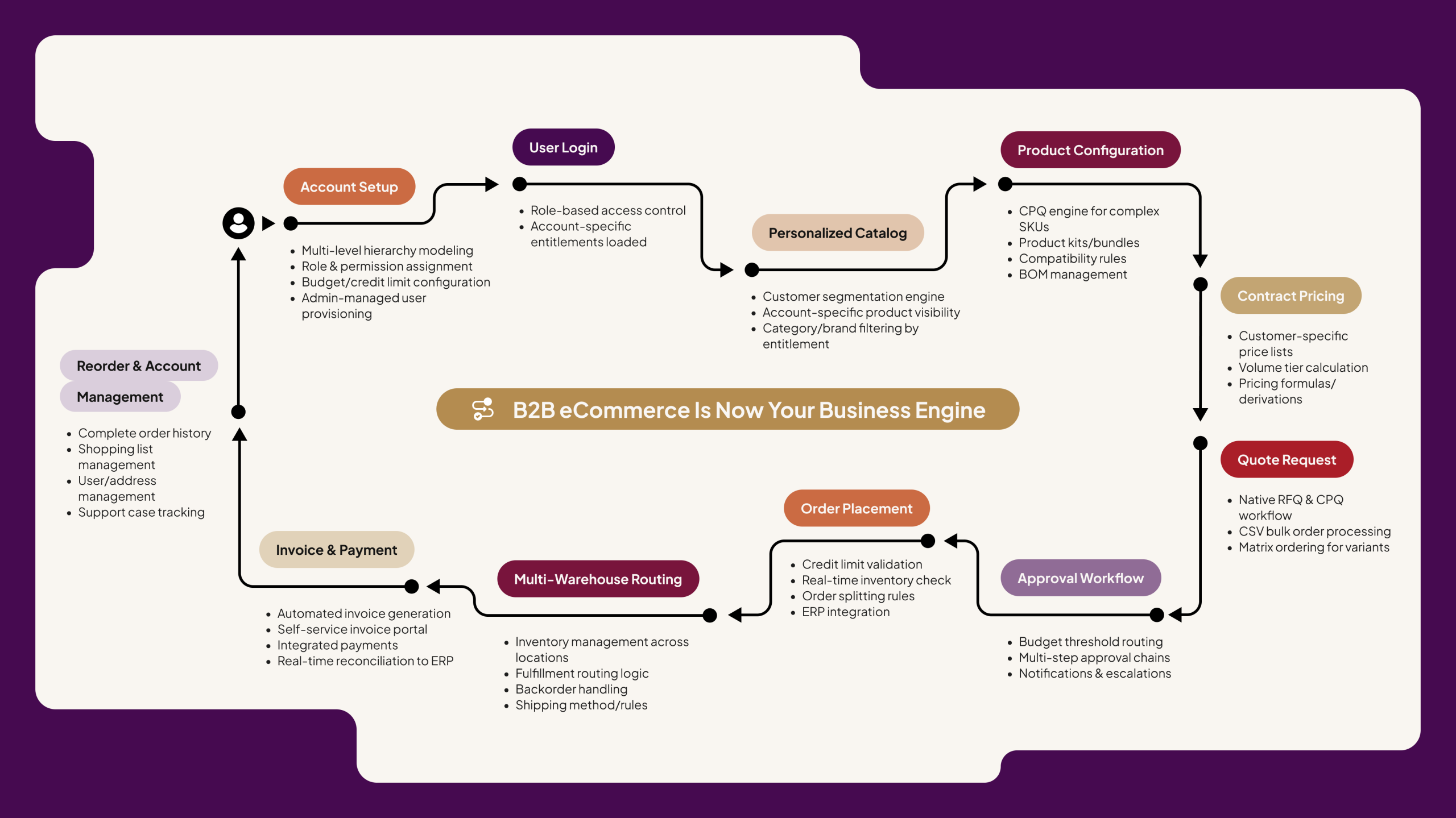
While manufacturers were wrestling with bolt-on solutions, a different type of B2B platform emerged – one purpose-built for operational complexity instead of retrofitted from retail.
Checkout era platforms ask: “Can we make this work for B2B?” Then they bolt on plugins, custom code, and workarounds until something limps across the finish line.
Unified B2B commerce platforms ask: “What does B2B actually require?” Then they build account hierarchies, contract pricing engines, configure-price-quote logic, approval workflows, and multi-org management into the foundation.
This changes the core question leadership should be asking:
- Old question: Which platform has the best product pages and checkout flow?
- New question: Which platform can absorb our business complexity, inventory, and customer data, and transform it into a cohesive quote-to-cash experience? Can it handle AI that works in B2B workflows, not just consumer chatbots? Can we launch new business models without rebuilding the stack?
If you’re still evaluating platforms based on checkout era criteria, you’ll keep choosing checkout era solutions. Then you’ll wonder why they can’t handle what comes next.
So what does unified commerce actually enable when it’s built right?
What This Looks Like In Practice
When B2B eCommerce is built for operational complexity from the ground up, three things change:
1. Sales Teams Stop Being Middleware
In the old model, eCommerce competed with sales teams for their sales volume and obscured their visibility.
In the unified commerce model, the platform becomes their primary sales tool. Because the platform holds the complex business logic, sales reps stop working in spreadsheets and start working inside the commerce engine.
This enables a more efficient workflow:
- Automated order entry: The system does the data entry; the rep handles exceptions and strategy. For example, at UFP Industries, sales reps used AI within the commerce platform to automate order intake from customer PDFs. The system reads the purchase order and creates a draft, turning a 20-minute manual task into a 2-minute review process. This reduced the sales team’s administrative workload by an estimated 30%.
- Seller-assisted buying: Reps can step into the buyer’s exact view through impersonation. They see contract pricing as the customer sees it, check allocated inventory from the customer’s perspective, and build quotes directly in the customer’s environment. When pricing or inventory shifts, both parties see the same truth.
- Centralized account management: Reps can see a customer’s complete history (orders, invoices, support tickets) in a single interface, instead of jumping between a separate CRM and ERP.
The result is a measurable reduction in administrative debt. Braskem saved over 22,000 internal work hours annually by automating high-volume order processing. Lactalis reduced manual processes by 44% across 15,000 customers. This allows the sales team to focus on selling, not just on data entry.
Further Reading: B2B Sales Enablement Best Practices
2. Buyers Get Operational Tools, Not Shopping Carts
B2B portals often fail because they treat the buyer like a consumer. They offer a catalog and a cart, but they ignore the complex internal reality of the corporate buyer.
A true B2B eCommerce system treats the customer as an organization. It provides the utility required to manage their business, not just buy your products.
- Mirroring the org chart: The platform allows the customer to replicate their corporate hierarchy online. A procurement manager can assign roles to local branch managers, giving them purchasing power while retaining oversight.
- Enforcing budget discipline: Instead of emailing spreadsheets for approval, the system enforces order approval workflows natively. If a junior buyer tries to exceed their $5,000 limit, the system automatically routes the cart to their supervisor for digital sign-off.
- Operational self-service: Buyers manage ship-to addresses across facilities, retrieve invoices for audits, check credit status, upload bulk orders via CSV, and maintain project-based shopping lists. Support tickets drop because routine operations happen without human intervention.
- Hybrid interactions: When buyers need help, the platform supports hybrid interactions. They can request quotes, ask questions via AI chat that understands their account context and contract terms, or open support cases without leaving the order flow. Sales and service teams respond in the same system where the transaction lives.
ICL deployed customer portals across 20+ markets connecting to four different ERPs. Within the first rollout wave, 60% of customers moved to digital ordering. The shift happened because they stopped asking the buyer to adapt to their processes and provided a utility that fits their procurement workflow.
A Guide To The Next Generation Of B2B Commerce Portals
3. IT Job Shifts from Maintenance to Innovation
The most critical shift is architectural. Historically, IT tried to force the ERP to manage customer-facing logic. This created rigid, expensive systems.
The new model separates the stable system of record from the dynamic system of interaction.
- The ERP remains the system of record focused on the general ledger and physical inventory.
- The B2B eCommerce platform takes over the dynamic business logic, including pricing rules, catalog visibility, and customer interactions.
This separation allows for scale without fragility.
DiversiTech, an HVAC manufacturer, runs a unified digital experience on top of 12 different legacy ERPs. The commerce layer absorbs the complexity, standardizing the quote-to-cash process without waiting years for a full ERP consolidation. This makes their front-end customer experience consistent, even when their back-end systems are fragmented.
This architecture also enables complex selling models. A manufacturer can run direct corporate accounts, regional dealer networks, and marketplace sellers from the same platform. PartsBase operates a $2B aviation parts network this way: vendors list inventory, buyers search across suppliers, and the platform handles transaction splitting and payment routing.
Multi-org deployments work the same way. Azelis launched 146 country-specific portals from one platform instance, each with local products, pricing, compliance rules, and languages. Because commercial logic is centralized, launching a new market is configuration work, not development.
Further Reading: The IT Case for Unifying B2B Commerce Operations
What the B2B eCommerce Platform Architecture Needs to Support
The Unified Commerce era raises the bar. The redefined B2B eCommerce of this era has to run the commercial rules your teams currently enforce by hand, so the business can scale without adding more people to glue systems together.
To operate in this era, your platform needs to:

Company hierarchies, roles, budgets, and approvals have to live in the platform, not in shared logins and email threads.

Contract pricing, customer-specific catalogs, and negotiated terms need to apply consistently across every order path.

Reps and buyers need to work from the same order context, with tools like impersonation, quoting, and assisted ordering built in.

Buyers should be able to pull invoices, track orders, manage ship-tos, reorder fast, and resolve routine needs without a ticket.

Multi-org, multi-site, and B2B2X setups should be configuration work, not a rebuild every time the org changes.

The platform should orchestrate commerce while ERPs stay systems of record without daily reconciliation as a permanent job.
This is exactly what OroCommerce is designed to deliver. It was built for manufacturers and distributors that need B2B workflows, account-aware selling, and complex pricing to be standard platform behavior rather than custom projects stacked on top of a retail storefront.
Why Unified B2B Commerce Is the Infrastructure AI Requires
This foundation is also what makes AI usable. When product, customer, pricing, order history, and permissions already live in one place, AI can work inside the workflows your teams use every day.
In OroCommerce, that shows up as native capabilities:
- AI SmartOrder converts unstructured POs (PDFs, emails, documents) into draft orders, flags issues, and reduces rekeying.
- AI SmartAgent answers buyer questions on pricing and availability and supports ordering through chat, based on role and account context.
- Upcoming AI tools that simplify admin tasks and provide insights into trends, metrics, and performance.
That matters because the next wave of AI won’t succeed on access to data alone. It needs the rules and guardrails. A unified commerce layer provides the rules, context, and controls AI depends on without turning your stack into another collection of add-ons to maintain.
The Definition Changes Here
The checkout era taught a lot of companies a strange lesson: you can look digital and still run manually. Every rekeyed order and spreadsheet quote is proof that the platform is still just a shell around the real process.
The move to a unified architecture is the point where that shell becomes the process. It is the moment the logic that makes an order valid finally lives in the same place it is executed.
The definition of B2B commerce changes right there. The goal stops being “get more orders online” and becomes “make the digital channel behave like the business.”
When the architecture is right, you stop paying a premium for administrative friction and start investing in the judgment of your people. You get a system your customers can rely on and a foundation your company can actually scale.