navigation

Buyers now expect to manage their customer accounts online, the same way they do everywhere else.
Most companies fall short because pricing, stock, and orders live in separate systems that don’t talk to each other. A contract might promise customer-specific pricing, but the storefront still shows the list price. Stock counts lag behind the ERP, and reorders still move through email and spreadsheets instead of a portal.
The best eCommerce platforms for B2B self-service connect directly to the ERP for real-time customer data and support contract and tiered pricing. They also give buyers a self-service portal for ordering, reordering, and account management.
This article ranks and compares the top five B2B ecommerce platforms moving business transactions out of email and onto self-service: OroCommerce, Adobe Commerce, SAP Commerce Cloud, Shopify Plus, and BigCommerce.
We compare them on ERP integration, pricing flexibility, and self-service depth, so you can shortlist the right fit before you sit through five different demos.
Selection Criteria for B2B eCommerce Platforms
Not every e-commerce platform earns a spot on this list. Each one had to prove itself against five criteria. Together, these standards show which platforms streamline operations, enabling businesses to run a leaner sales team.
Here’s what we scored:
- ERP integration and real-time customer data: does pricing, stock, and order history match the ERP the moment a buyer logs in?
- Custom pricing and contract pricing capability: can the platform enforce negotiated terms per account without manual overrides?
- Bulk ordering and quick-reorder features: can buyers repeat large orders in a few clicks instead of rebuilding a cart line by line?
- Developer effort, total cost of ownership, and cost-savings potential: how much custom development do you need to reach a workable self-service experience?
- Customer satisfaction and scalability: does the platform hold up as transaction volumes, account counts, and catalog size grow?
Want to run your own evaluation? Use OroCommerce enterprise B2B eCommerce integration checklist to audit ERP readiness before you shortlist anyone.
Best B2B eCommerce Platforms for Self-Service at a Glance
Here’s how the five platforms compare on rating, ideal use case, key benefits, and starting price.
| Platform | G2 Rating | Best For | Top B2B Feature | Starting Price |
| OroCommerce | 4.3/5 | Manufacturers, distributors, and wholesalers needing native B2B self-service | Built-in CRM, CPQ, and ERP-synced customer portal | Custom, all-in-one |
| Adobe Commerce | 4.0/5 | Enterprises needing deep customization | Customer-specific catalogs and price books | Custom enterprise pricing |
| SAP Commerce Cloud | 4.3/5 | Enterprises standardized on SAP ERP | Native S/4HANA pricing and order sync | Custom enterprise pricing |
| Shopify Plus | 4.4/5 | Brands blending B2C and wholesale in one store | Built-in B2B storefront on the Shopify admin | From $2,300/month |
| BigCommerce | 4.2/5 | Hybrid B2B/B2C sellers needing open APIs | Open-Source Buyer Portal with price lists | Custom enterprise pricing |
5 Best B2B eCommerce Platforms for Self-Service in 2026
Here’s what each platform works, who it fits, its key features, and pricing.
OroCommerce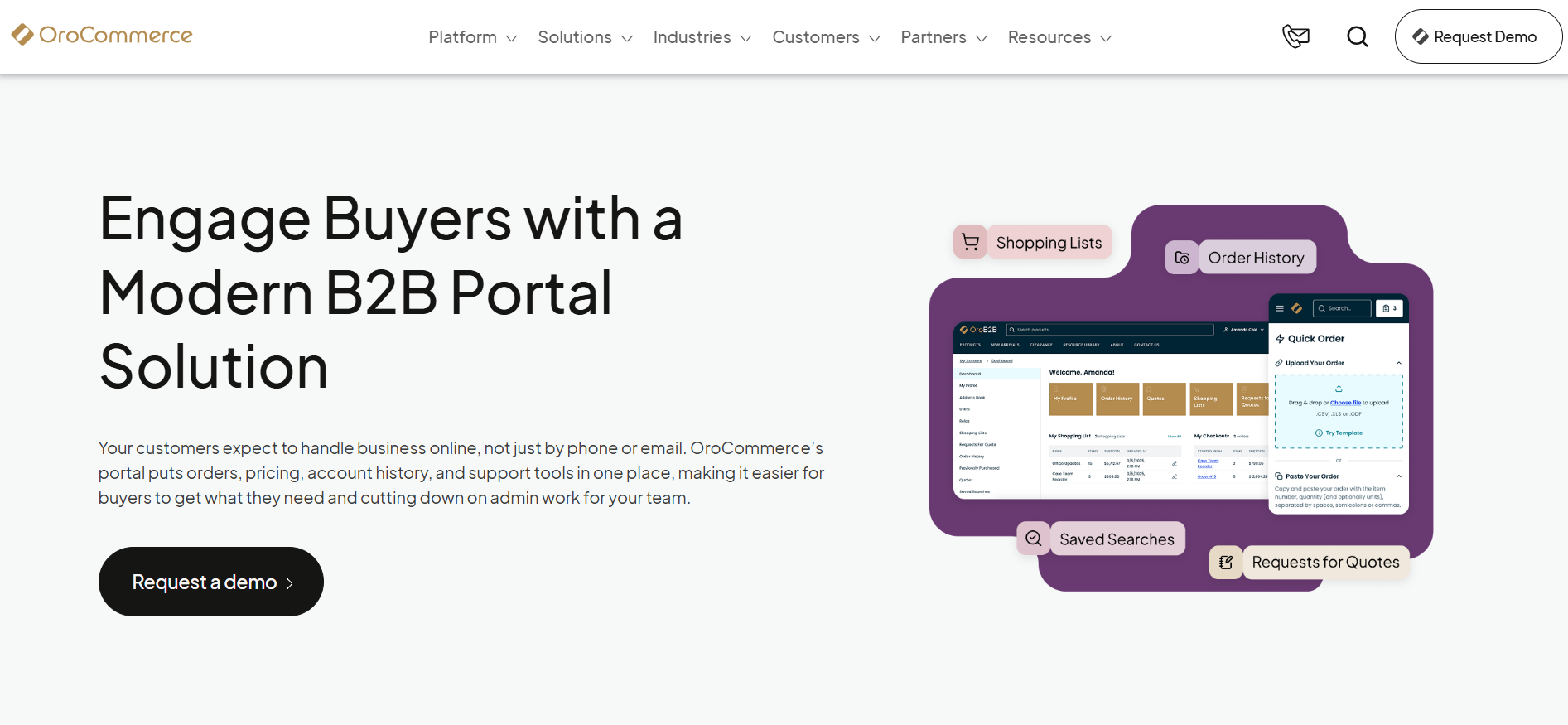
OroCommerce is an open-source B2B eCommerce platform built for manufacturers, distributors, and wholesalers running complex sales processes. It ships as a single-tenant SaaS platform with advanced B2B features for self-service, including contract pricing, live stock, and order history pulled directly from the ERP.
OroCommerce serves clients in more than 100 countries, and being open-source means the platform can be extended or customized without waiting on the vendor’s roadmap.
Best for
Wholesalers, manufacturers and distributors that need native B2B self-service without stitching together separate CRM, quoting, and portal tools.
Key features
- Account and organization management: Supports multiple business units, buyer roles, approval levels, credit limits, and account hierarchies, so each customer sees the products, prices, and functions that apply to them.
- Order management: Covers bulk orders, quick reorders, shopping lists, order history, shipment tracking, and inventory management in one place.
- RFQ and quote management: Handles quote requests for large or custom orders, with negotiation and approval workflows that can turn accepted quotes directly into orders.
- Sales-assisted buying: Reps can work from the buyer’s account, access their shopping lists and conversation history, step into a live cart, and place orders on their behalf.
- Invoice and payment management via OroPay: Brings invoices, balances, payment history, and payment processing into the customer portal, giving buyers access to the financial side of their account too.
Pricing
OroCommerce uses custom enterprise pricing based primarily on GMV, admin users, and deployment requirements. There are no per-site, per-customer, or transaction fees.
Book a demo to discuss pricing for your business.
Adobe Commerce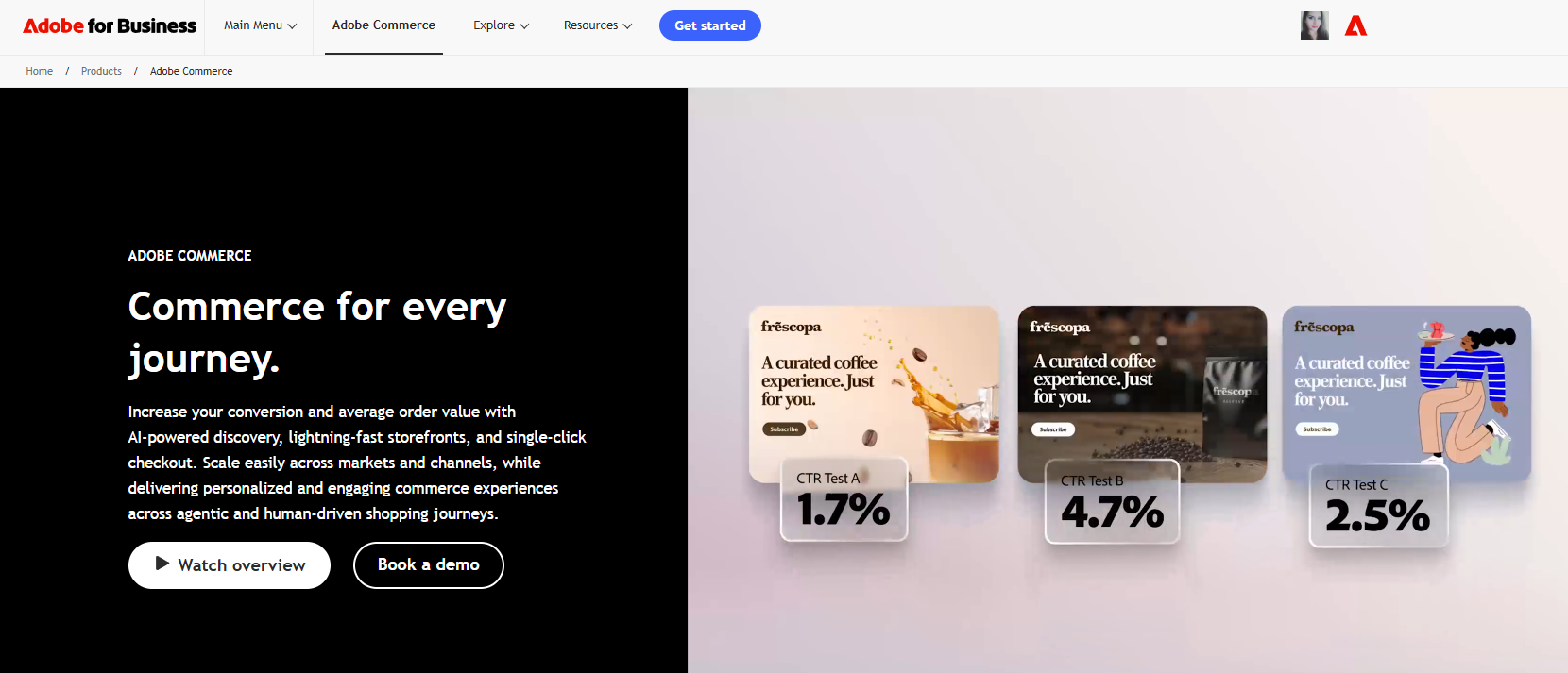
Adobe Commerce, formerly Magento Commerce, is an enterprise eCommerce platform built on a composable, API-first architecture.
It supports both B2B and B2C operations from a single instance. It sits within the Adobe Experience Cloud, so it can connect to Adobe Experience Manager and Adobe Analytics for teams already using those products.
The platform is also built to scale to catalogs with millions of SKUs across multiple price points.
Learn more:
- Adobe Commerce competitors
- Adobe Magento vs Salesforce Commerce Cloud
- commercetools vs Adobe Commerce
- Adobe Commerce vs Shopify comparison
Best for
Enterprises that need extensive customization and have development resources to build a highly tailored buying process.
Key features
- Company accounts: Support multiple buyers, roles, and purchasing permissions per account.
- Customer-specific catalogs and pricing: Tailor content, promotions, and price books to individual buyers.
- Purchase approval workflows: Route orders through the right approver before checkout.
- Requisition lists: Business users save and reorder frequently purchased items in a few clicks.
- Sales rep tools: Reps log in to place orders and prepare quotes on a customer’s behalf.
Pricing
Adobe doesn’t publish flat rates. Commerce leaders should expect custom enterprise pricing based on gross merchandise volume and deployment model (SaaS, PaaS, or the Adobe Commerce Optimizer storefront layer).
SAP Commerce Cloud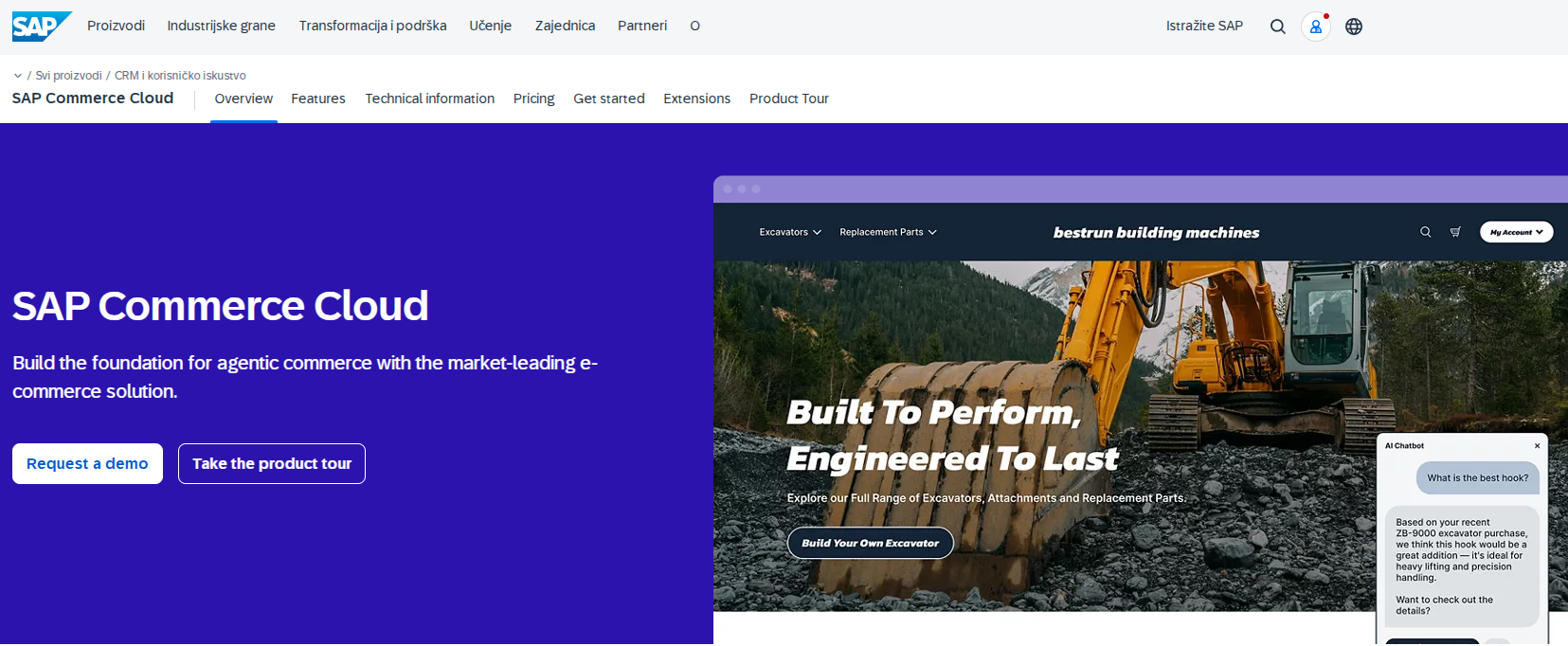
SAP Commerce Cloud is SAP’s enterprise digital commerce platform, connecting natively to SAP S/4HANA and other supply chain systems. It’s part of the SAP Customer Experience portfolio and was formerly known as SAP Hybris.
It isn’t a standalone CRM, but it connects to CRM and other data systems to support personalized buyer journeys.
Learn more about SAP Commerce Cloud competitors.
Best for
Enterprises already standardized on SAP ERP that want commerce and back-office data to stay in lockstep.
Key features
- Order and invoice self-service: Customers can check order details anytime, freeing sales and support teams from routine status checks.
- B2B Self-Service Portal: Connects with SAP Cloud ERP to give customers access to order status, invoices, and other ERP data through a customer-facing portal.
- Native S/4HANA pricing: Supports complex pricing across standard and configurable products.
- Omnichannel support: Runs B2B, B2C, and B2B2C models from a single platform.
Pricing
SAP Commerce Cloud pricing is custom and quote-based. It scales to transaction volumes, module selection, and existing SAP licensing.
Shopify Plus
Shopify Plus is Shopify’s enterprise-tier SaaS platform. It extends the core Shopify online store with built-in B2B tools, so merchants can run wholesale and direct-to-consumer sales channels from one admin.
It targets high-volume merchants, typically brands doing at least $1 million in annual revenue, and carries Level 1 PCI DSS and SOC2 certification.
Learn more:
Best for
Brands that want to launch a B2B storefront quickly alongside an existing consumer store, without heavy custom development.
Key features
- Customer-specific catalogs and pricing: Assign catalogs to companies and company locations, with quantity rules and volume pricing for B2B orders.
- Company profiles: Support multiple company locations, buyers, permissions, pricing, and payment terms under a single account.
- Self-service ordering: Support bulk orders, reordering, and recurring orders for B2B customers.
- ERP and CRM integrations: Connects with external ERP and CRM systems through APIs and apps.
Pricing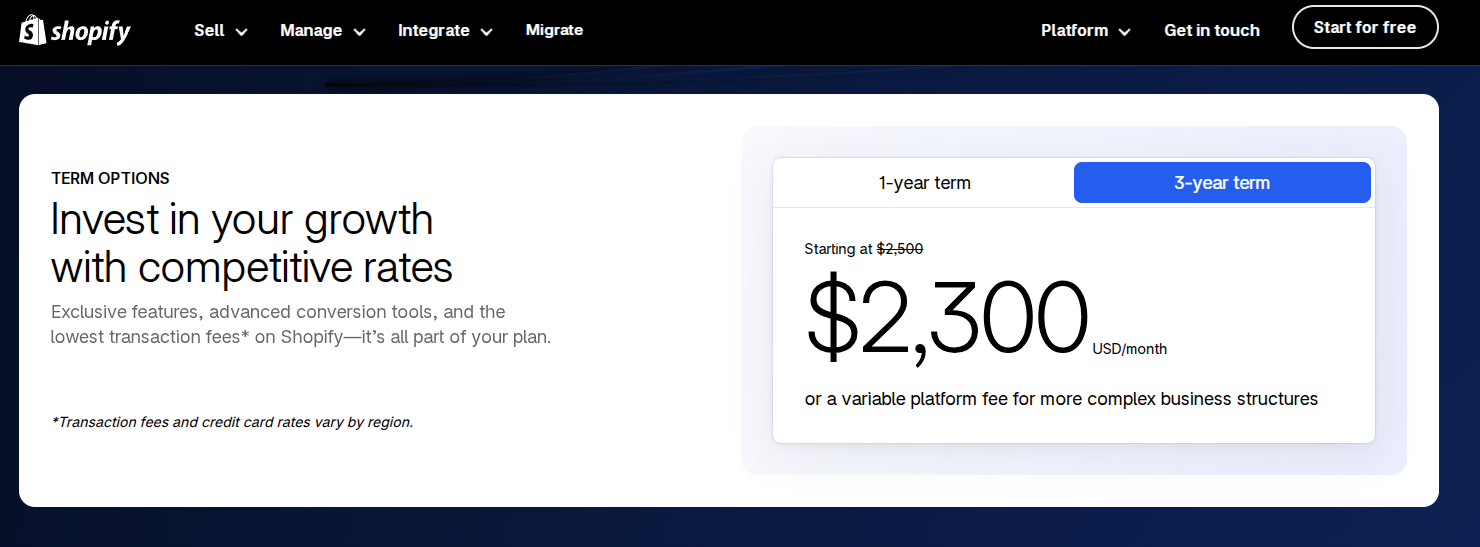
Shopify Plus starts at $2,300/month on a three-year term or $2,500/month on a one-year term. B2B features are included, with Plus adding capabilities such as unlimited catalogs, direct company-level catalog assignment, deposits, and partial payments. Additional costs can include third-party apps, custom development, and payment or platform fees depending on the setup.
BigCommerce
BigCommerce is an open SaaS eCommerce platform with a dedicated B2B Edition for manufacturers, distributors, and other businesses selling to corporate buyers. B2B Edition adds company account management, custom pricing, quoting, and buyer self-service to the core commerce platform.
Best for
Hybrid B2B/B2C sellers that want open APIs and complete control over the front-end build.
Key features
- Company account management: Supports company accounts, multiple buyers, roles, permissions, and customer-specific pricing.
- Customer-specific pricing: Assign price lists and discounts to customer groups and companies, including SKU-level pricing.
- B2B buyer portal: Gives buyers access to quotes, orders, invoices, shopping lists, and account information from a self-service portal.
- Quote management: Lets buyers request quotes and sales teams create, edit, and manage quotes before turning them into orders.
- Sales rep access: Sales representatives can access a customer’s account and place orders on their behalf.
Pricing
BigCommerce Enterprise for B2B runs on custom enterprise pricing based on transaction volumes and required integration capabilities.
How to Choose the Right B2B eCommerce Platform
Evaluate every option systematically against your ERP, pricing model, and buyer workflows before you sign a contract.
Most eCommerce platforms treat B2B as an add-on module. The strongest options below build self-service into the core system instead, so rollout disrupts normal business operations as little as possible.
Evaluate ERP and customer data flow
The ERP is the system of record for pricing, stock, and order status. Any platform you consider must synchronize customer data across ERP systems in real time, not once a day.
For a deeper technical walkthrough of what this integration should look like end to end, see this eCommerce ERP integration guide.
- Test how each candidate handles order, invoice, and stock fidelity against a live ERP feed, not a demo environment with sample data.
- Get the vendor’s sync frequency in writing as part of the SLA, not just a sales rep’s verbal promise.
- Check that ERP integration covers both inbound (stock, pricing) and outbound (orders, payments) data flows.
Estimate pricing models and contract pricing
Pricing errors are the fastest way to damage customer relationships. Before anything else, compare custom pricing capabilities across your shortlisted platforms.
- Verify that each system supports contract pricing and volume-based tiered pricing natively, not through a bolted-on app.
- Test how quickly the platform evaluates pricing rules against a heavy catalog. A system that takes seconds to calculate negotiated pricing on a large order will frustrate buyers at checkout.
- Confirm the platform can apply different rates to different wholesale customers without manual price-list maintenance.
Assess contract pricing vs. custom pricing
Map each negotiated contract to the platform’s actual pricing features before you assume it will “just work” at go-live.
- Test custom pricing configurations against representative accounts, including your largest wholesale customers and most complex account hierarchies.
- Document fallback and override rules for every exception case. Sales reps need a clear process when a quoted price doesn’t match the system default.
- Confirm business users can see which price applies, whether contract, tiered, or list, without contacting support.
Prioritize self-service and bulk ordering needs
Self-service adoption depends on how well a platform handles repeat and bulk purchasing, not just the initial checkout flow.
- Require a live test of quick-order forms, CSV upload, and saved order templates before you shortlist any vendor.
- Evaluate the buyer portal’s approval-chain workflows for company accounts with multiple purchasers.
- Measure how self-service capabilities affect customer satisfaction by tracking support-ticket volume before and after rollout. Enhancing customer satisfaction this way is the clearest sign the rollout worked.
Consider total cost and cost savings
Calculate both implementation cost and annual operating cost for each platform, not just the license fee. Oro’s eCommerce total cost of ownership calculator is a useful starting point for building these scenarios.
- Include the third-party tools and custom development often needed to fill feature gaps.
- Factor in projected labor savings from automating order entry, invoice lookups, and account changes that currently go through a service cloud or support desk.
- Build ROI scenarios tied specifically to reduced customer-service-rep workload. That’s the line item finance teams will ask about first.
Factor in data-driven decisions and analytics
Built-in reporting turns a self-service portal into a source of intelligence, not just a transaction tool. The right platform should connect customer behavior with marketing tools, analytics, and other systems that teams use to understand and engage buyers.
- Demand analytics that track conversion and customer behavior, not just traffic and pageviews.
- Confirm the platform exports consistent customer data to your BI stack, so leadership can make data-driven decisions instead of relying on spreadsheets pulled from three systems.
- Validate that reporting covers customer satisfaction metrics directly tied to self-service adoption.
Which Option Is Best for Your Use Case?
The right eCommerce platform depends on your ERP, buyer complexity, and timeline more than any single feature checklist.
| Platform | Best For |
| OroCommerce | Built around B2B accounts and buyer relationships from the start, with self-service and CPQ native to the platform, not added onto a B2C foundation later |
| Adobe Commerce | Deep customization needs, for teams with the development resources to build out B2B depth that isn’t there out of the box |
| SAP Commerce Cloud | SAP ERP ecosystems, where native S/4HANA integration matters more than out-of-the-box B2B features |
| Shopify Plus | Rapid, cost-effective launches, especially for brands adding B2B self-service on top of an existing B2C-first storefront |
| BigCommerce | Hybrid B2B/B2C sellers who want open APIs and are comfortable adding CRM and CPQ through third-party integrations |
Want a structured way to run this evaluation with vendors? See our B2B eCommerce RFP guide.
Why OroCommerce Is the Best eCommerce Platform for B2B Self-Service
Most B2B buyers still can’t get accurate pricing, real-time stock, or order history without contacting a rep. That turns simple account questions and reorders into sales calls that could have been handled through self-service. That’s because the systems behind self-service, ERP, CRM, quoting and invoicing live in separate tools that don’t talk to each other.
Every extra system in that stack is another place for customer preferences and order data to fall out of sync.
How OroCommerce closes the gap
OroCommerce, an open-source B2B eCommerce platform for manufacturers, distributors, and wholesalers, was built to close that gap. Instead of patching self-service onto a fragmented stack, it gives buyers one unified platform backed by a single data layer, reducing the need to connect other platforms for CRM, quoting, payments, and account management.
OroCommerce vs. the competition
| Adobe Commerce | Matches OroCommerce on flexibility but requires more custom development to reach the same out-of-the-box B2B depth |
| SAP Commerce Cloud | Strong ERP fidelity for SAP shops, but less B2B-native out of the box than OroCommerce |
| Shopify Plus | Faster to launch, but B2B self-service capabilities are layered onto a B2C-first architecture |
| BigCommerce | Open and API-friendly, but lacks OroCommerce’s native account management depth and CPQ |
What buyers get in practice
In practice, that plays out four ways:
- Buyers see accurate, real-time data. The customer portal pulls contract pricing, live stock, and order history straight from the ERP, so buyers never see a number the system can’t back up.
- Self-service covers the full order lifecycle. Native CPQ/RFQ, an invoice portal, and integrated payments (OroPay) live in one place instead of three disconnected tools.
- AI reduces friction instead of adding another tool. SmartAgent helps buyers get answers and complete tasks, while OroIQ and Smart Assistant help teams work with quotes, orders, and other operations.
- It scales without adding system sprawl. A multi-org backend lets manufacturers manage multiple brands, regions, or acquired business units on one platform, making it easier to enter new markets without standing up a new instance for every unit.
Real results from OroCommerce customers

The results back this up. Lactalis grew digital orders 230% and cut manual processes 44% after unifying its regional businesses on OroCommerce. DiversiTech consolidated 12 disconnected ERPs into a single ordering system after years of acquisitions.
Azelis now runs 150+ localized self-service portals covering 90,000 products from a single backend. IT manages everything centrally instead of maintaining dozens of separate sites.
OroCommerce was also recognized in Gartner’s 2025 Critical Capabilities for Digital Commerce report. Gartner cited its extensive functionality in a single platform, including built-in storefront, CMS, DAM, search, order management, RFQ, and CRM.
See how OroCommerce connects self-service with the systems behind your business.
Final Recommendations and Next Steps
Before you commit budget to any single vendor, work through this short action plan:
- Create a shortlist of three platforms to run as a proof-of-concept, not just a sales demo.
- Run ERP integration and pricing tests for each shortlisted vendor against live account data.
- Draft KPI targets tied to customer satisfaction and measurable cost savings, not just go-live dates.
- Schedule stakeholder demos focused specifically on bulk ordering workflows. That’s where most self-service value gets realized.
Want a longer view of where B2B buying is headed next? See Oro’s B2B eCommerce trends 2026 report.
Conclusion About Best Ecommerce Platforms for B2B Self-Service
OroCommerce fits manufacturers and distributors that need native B2B self-service without a patchwork of tools. Adobe Commerce suits enterprises that need extensive customization and have the development team to build it. SAP Commerce Cloud is the strongest fit for enterprises already standardized on SAP’s ERP ecosystem.
Shopify Plus suits brands wanting a fast, cost-effective wholesale launch alongside an existing consumer store. BigCommerce serves hybrid B2B/B2C sellers who want open APIs and control over the front end.
Of these, OroCommerce remains the strongest purpose-built choice for B2B self-service and long-term business success. It was designed around the buyer portal and the ERP relationship from day one, not added on later.
See how OroCommerce supports complex B2B buying from one platform.
FAQs About Best eCommerce Platforms for B2B Self-Service
What platforms are best for B2B e-commerce?
OroCommerce, Adobe Commerce, SAP Commerce Cloud, Shopify Plus, and BigCommerce rank among the best platforms for B2B e-commerce in 2026. OroCommerce leads for native self-service and ERP synchronization, while the others fit specific needs like deep customization, SAP integration, or blended B2C/B2B storefronts.
What are the top 10 B2B e-commerce platforms?
Beyond the five compared here, commonly cited platforms include Salesforce Commerce Cloud, Unilog, Spryker, Intershop, and Commercetools. Each targets a different combination of catalog complexity, ERP ecosystem, and customization depth, so the right list depends on your specific requirements.
Which platform is best for B2B clients?
OroCommerce is best for B2B clients needing native self-service, contract pricing, and CRM in one system. SAP Commerce Cloud suits SAP-standardized enterprises, and Adobe Commerce fits organizations with heavy customization needs and dedicated development resources.
Is eCommerce still profitable in 2026?
Yes. B2B buyers increasingly expect self-service ordering, and businesses that give existing customers accurate pricing and fast reordering see higher repeat purchase rates and lower service costs. Profitability now depends more on operational efficiency than on simply running an e-commerce store or e-commerce platform without the systems behind it connected.