navigation

Some enterprise eCommerce platforms grow with you. Others just grow around you like ivy, until no one remembers what’s underneath. Enterprise eCommerce in 2025-2026 is about clearing the overgrowth and choosing the foundation that can hold the weight of your business.
This guide explains how to assess modern enterprise eCommerce solutions: what defines them, which capabilities truly matter at scale, and how leading B2B organizations are using them to simplify global operations while preparing for the next phase of growth.
What Defines an Enterprise eCommerce Platform for B2B
Enterprise eCommerce platforms are designed for scale, coordination, control, and efficient payment processing. They connect digital sales with the rest of the business, linking customer data, pricing, inventory, and fulfillment into one system that can grow with organizational complexity.
Beyond Transactional Websites
Enterprise platforms manage far more than online orders. They support different business models, divisions, and partner channels within a single environment. A manufacturer, for instance, may run dealer portals, B2C sites, and internal ordering tools on one shared backbone, ensuring data accuracy and consistent processes across regions.
Key Differentiators from SMB Platforms
Enterprise solutions are defined less by size and more by what they can handle.
Typical characteristics include:
- Managing extensive catalogs with detailed product structures.
- Operating multiple sites or business units from one instance.
- Handling complex pricing, quoting, and contract terms.
- Enforcing permissions and approval layers across large buying teams.
- Integrating deeply with ERP, CRM, and logistics systems.
These capabilities make enterprise platforms strategic infrastructure rather than standalone commerce tools.
Examples of Enterprise-Level Use Cases
- Global manufacturers aligning hundreds of distributors under one platform.
- Large distributors synchronizing pricing and stock across multi-warehouse networks.
- Enterprises expanding internationally while maintaining localized catalogs, currencies, and tax logic.
Core B2B Capabilities That Matter for Enterprise eCommerce
Finding the best enterprise eCommerce platform means matching technology to business needs, not a feature checklist. An effective eCommerce site for an enterprise business should rely on strong architecture and native features that support scale, control, and integration without endless customization.
Scalability and Performance at Volume
Enterprise platforms have to process huge data sets, not just high order counts. A global distributor might manage several million SKUs, each tied to inventory, price, and sales volume data that changes by the minute. Every update ripples through connected systems — ERPs, WMSs, CRMs — requiring hundreds of thousands of API calls each day.
When an eCommerce platform scales correctly, these updates happen continuously without slowing order entry, search results, or quoting. Performance isn’t measured by how fast one page loads, but by how many synchronized transactions the system can handle before users notice a delay.
This is why architecture matters more than hosting size. A well-designed enterprise platform maintains real-time visibility across catalogs and warehouses, even when order volume spikes or when thousands of users log in simultaneously.
Example: ICL’s implementation handles data from four ERPs feeding into one eCommerce platform layer. Over 9,000 users access live inventory and pricing without latency across 20 markets — proof that the scalability of an eCommerce site depends on design, not just infrastructure.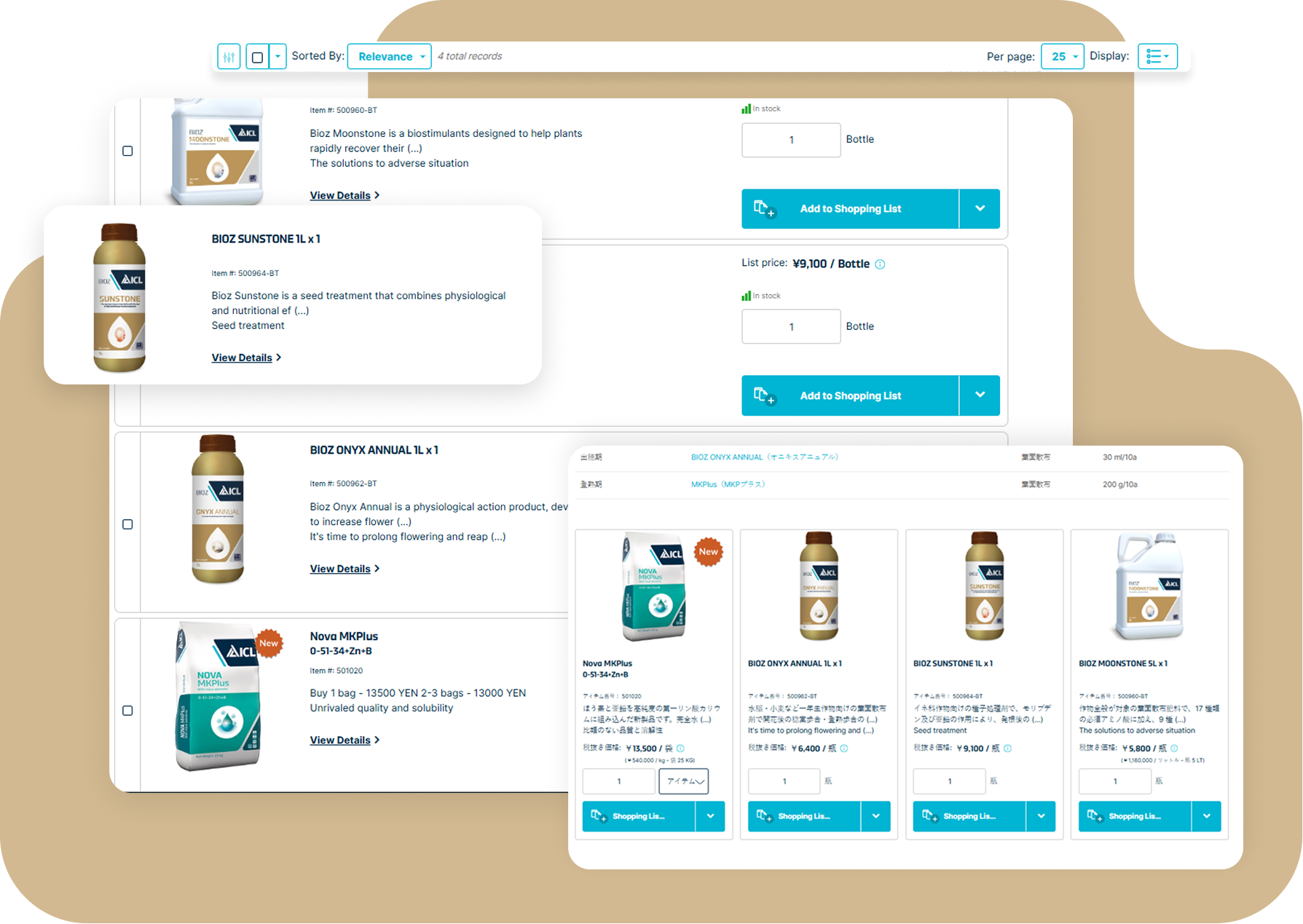
Integration Depth
For most enterprises, integration with other platforms is the real test of a commerce platform. Mergers, regional divisions, and legacy systems often leave IT teams managing several ERPs, CRMs, and logistics tools that were never built to work together. When each system stores a version of customer data or pricing, the platform must unify it — not duplicate it.
A strong enterprise solution uses open, consistent APIs that move data in both directions. It connects orders, invoices, and product information in real time, so inventory and pricing updates in one system appear immediately across every channel. That synchronization is what prevents quoting errors, backorders, and mismatched records between finance, operations, and sales.
For organizations shaped by acquisitions, integration flexibility becomes a survival requirement. A platform that can connect to multiple ERPs and CRMs without manual imports shortens rollout timelines and avoids re-engineering entire back-office workflows.
Free Guide: Mastering eCommerce ERP Integration for B2B Organizations
Flexibility and Workflow Control
Flexibility doesn’t mean building from scratch — it means shaping business rules without rewriting code. A visual workflow automation engine lets teams adjust approval steps, automate notifications, or introduce new validation logic as policies evolve. The goal is to keep every change auditable and consistent while freeing IT from constant development cycles.
In practice, this level of control determines how efficiently sales and service teams operate. It ensures that a pricing manager in one division and an account rep in another can both work within the same system while following different approval paths.
Example: Manufacturers using OroCommerce configure multi-step quote and order approvals that reflect their own hierarchy — from sales rep to regional director to finance — without additional custom code. These workflows reduce manual checks and keep complex transactions moving without delays or inconsistencies.
Seller–Buyer Interaction Enablement
In enterprise commerce, digital and sales-assisted channels are merging into one workflow. eCommerce is becoming the core system where deals are shaped, not just recorded.
Gartner notes that B2B buyers are 1.8× more likely to close high-quality deals when using supplier-provided digital tools with a sales rep, and that by 2026, 30% of B2B sales cycles will be managed through digital sales rooms. This requires enterprise eCommerce platforms to support collaborative quoting, account-based pricing, and shared visibility into customer data, inventory, and order progress.
The right enterprise eCommerce platform gives teams direct control over how they engage customers, combining advanced features like assisted quoting, buyer impersonation, and analytics to strengthen relationships and improve deal quality across every digital sales channel.
Gartner Insight: How to Shrink Sales Cycles With Digital Commerce
Multi-Organization and Multi-Channel Management
Large manufacturers and distributors often operate multiple entities, brands, or regional divisions that each serve different buyer groups. An enterprise platform must manage those structures from one backend while maintaining distinct catalogs, pricing, and permissions for every unit.
Centralized control is what keeps operations coherent. Shared data models allow IT to maintain one product and customer database while giving each business unit freedom to localize content, manage its own price lists, or serve specific customer segments.
Example: Azelis manages over a hundred localized portals from a single OroCommerce instance. Each market has its own language, currency, and catalog logic, yet product and pricing data stay aligned globally — a model that enables expansion without multiplying systems.
Security and Compliance
Enterprises operate under strict IT, privacy, and audit standards, especially when using cloud hosted solution. An eCommerce platform must fit into that environment, not sit outside it. That means enforcing permissions, monitoring every action, and ensuring data is stored and processed according to corporate and regional policies.
The right platform allows fine-grained control over users and organizations. Administrators can define roles, restrict access to specific data, and track every change through detailed audit logs. Features such as single sign-on, two-factor authentication, and LDAP integration align with enterprise identity management systems rather than replacing them.
Maintainability and Long-Term Control
Enterprise systems live for years, often across multiple organizational shifts and technology cycles. A platform’s real value shows in how easily it adapts — whether that means connecting to new systems, supporting new business models, or scaling to additional markets.
Maintainability depends on clear architecture and predictable ownership. Open, modular platforms give internal teams control over updates and integrations without depending on vendor-specific code or third-party plug-ins. This prevents the slow erosion of agility that often follows heavy customization.
Evaluating the Market: 2025-2026 Enterprise eCommerce Solutions for B2B
Enterprise eCommerce has matured into distinct categories. Each major platform serves a different purpose, shaped by its origins. Understanding those roots helps determine which technology can realistically support complex B2B operations.
How to Read the Enterprise eCommerce Platform Market
Analyst reports often group platforms together under the same label, yet their architectures differ fundamentally. Some are optimized for retail transactions, others for marketing automation, and a few for process-heavy B2B sales.
A practical evaluation of eCommerce software starts with where the product was built to excel: how it handles data ownership, system integration, and multi-organization control.
| Category | Example Platforms | Primary Strengths | Common Constraints in Enterprise B2B |
| Retail Platforms Expanding into B2B | Shopify, BigCommerce | Fast deployment, accessible design tools | Rooted in B2C architecture. B2B functions such as quoting, multi-buyer accounts, and approval workflows depend on apps or workarounds. Limited flexibility for large catalogs or custom integrations. |
| CRM-Driven Platforms | Salesforce Commerce Cloud | Tight integration with Sales Cloud and marketing automation | Separate licensing and products for commerce, CRM, and CPQ. B2B workflows depend on complex configuration and connectors. |
| ERP-Centric Platforms | SAP Commerce Cloud | Strong data alignment within SAP ecosystem | High implementation cost, narrow deployment flexibility, and user adoption challenges outside SAP environments. |
| Experience-Led Platforms | Adobe Commerce (Magento Enterprise) | Rich content and design capabilities, strong ecosystem | Requires extensions for B2B functions like workflow automation and contract pricing. Maintenance overhead increases with scale. |
| B2B-First Platforms | OroCommerce | Built around enterprise buying logic: multi-org management, quoting, and contract pricing handled natively. Unified eCommerce, CRM, and CPQ tools under one license. | Best fit for manufacturers, distributors, and wholesalers with multi-system or multi-brand operations. |
Download feature-by-feature B2B eCommerce software comparison chart
Interpreting the Differences
eCommerce platform choice reflects business model maturity. Retail-centric or ERP-attached tools can deliver short-term wins but often limit control once complexity increases.
B2B-first platforms begin with a different foundation. They assume a single enterprise may operate multiple business units, pricing models, and workflows — each with its own hierarchy of buyers and approvers — and that these structures must stay synchronized across every connected system.
Choosing that foundation means fewer integrations to maintain, predictable upgrade paths, and one environment that scales globally without fragmenting operations.
Proof from Enterprise eCommerce Adopters
Leading global enterprises that chose OroCommerce, a B2B-native platform, have shown measurable results:
- Lactalis Group unified 12 regional systems across 15,000 customers, cutting manual processes by 44% and increasing digital orders by 230%.
- Interstate Batteries transformed nationwide dealer ordering for 30,000 dealers.
- Braskem now processes 12,000 orders per month across 800 companies, supporting $2.8B in digital revenue.
These examples illustrate the compounding value of choosing an eCommerce software architecture designed around enterprise B2B complexity from the start.
Deployment Strategy: Enterprise eCommerce Hosting Options
Enterprises are re-evaluating how much control they want over their eCommerce platform and hosting model. Most have already moved to cloud-hosted environments; the focus now is finding balance between vendor-managed efficiency and internal flexibility.
Many organizations that once ran self-hosted platforms now prefer managed or single-tenant SaaS solutions to lower maintenance costs and protect secure customer data, while keeping control over custom integrations and APIs. Others adopt hybrid setups — vendor-managed infrastructure with in-house ownership of extensions and business systems.
This approach is reshaping the enterprise eCommerce market. Adobe Commerce and SAP Commerce Cloud highlight managed cloud offerings, while Salesforce Commerce Cloud remains a fully hosted SaaS platform. OroCommerce combines both models with a single-tenant SaaS deployment that gives enterprises full access to code, integrations, and eCommerce features without the overhead of self-management.
For large manufacturers and distributors, the decision comes down to aligning the right enterprise eCommerce platform with governance, scalability, and long-term operational efficiency.
How to Choose the Right Enterprise Platform
Start with your operating model (this steers you toward the right category)
Pick the statement that fits how you work today and where you’re headed:
- Consolidated core: We want one instance to run multiple brands/divisions/regions with shared data and governance. Shortlist: B2B-first unified platforms; consider Experience-led if content teams drive heavy CMS needs.
- Federated divisions: Units run semi-independently and adopt at different speeds (often post-M&A), but need consistent pricing, catalogs, and reporting. Shortlist: B2B-first unified platforms or CRM-driven.
- ERP-anchored IT: ERP dictates most processes and you want tight alignment there, even if commerce flexibility suffers. Shortlist: ERP-centric platforms (accept higher ownership cost, longer timelines).
Development Costs: What to Include and Watch For
Development costs often vary more than licensing or hosting — and they’re where many enterprise eCommerce platforms go over budget. The total depends on scope, integrations, and how much custom work is needed to fit the eCommerce solution into existing systems.
When evaluating proposals, break development into four areas:
- Build: storefronts, workflows, and pricing logic configured to match your structure.
- Integrations: ERP, CRM, tax, shipping, and payment providers and processing connections, even with connectors, data mapping usually adds time.
- Data: migration, cleanup, and product enrichment.
- Testing and rollout: performance, training, and staged go-lives for different regions or brands.
A good partner should estimate each area clearly and explain what can be configured versus what must be custom-built. Favor platforms with strong native eCommerce features that reduce development time and reliance on third-party apps.
Once this baseline is clear, it feeds directly into your TCO model — the scenarios that show how development spend changes as you grow, expand into new markets, or integrate additional systems.
Enterprise Platform Implementation Risk Assessment Template
Bring a structured approach to software evaluation with our template
Model TCO with three scenarios (best way to avoid “surprise” spend)
Ask vendors for pricing under the same three-year scenario set:
- Base year: Current sites/brands, current volume.
- Organic growth: +30% orders, +2 new brands, +1 ERP.
- M&A event: +1 acquired division, +300k SKUs, new price logic.
Include: license, hosting, number of environments required, mandatory add-ons, SI hours, upgrade effort, transaction fees, support tiers.
Flag platforms where cost scales by add-on count (apps, modules) instead of by predictable units (orders/sites).
Governance and risk checks (the bits that bite later)
- Permissions map: Align platform roles with yours (sales, CS, pricing, finance, ops). Confirm who can change price logic, not just who can view it.
- Auditability: Every quote, approval, and price change should have a timestamped trail exportable to your BI.
- Data residency & identity: SSO, 2FA, LDAP/AD, regional hosting needs, and data export rights in the MSA.
- Exit plan: Contractually guarantee data exports (catalog, accounts, pricing, orders) in open formats.
Change management and adoption readiness
Platform success depends on how easily existing teams can absorb new processes. Map out which roles will own pricing, product data, content, and approvals after launch, and test whether those tasks can be handled inside the platform, not through IT tickets.
Shortlist platforms that let sales, marketing, and operations users configure workflows and permissions themselves, while providing centralized oversight for governance.
During selection, ask vendors to outline the resources and time required for each role to become self-sufficient, not just the technical go-live date.
If You Build It, Will They Come? How to Drive Adoption for B2B Technology [Free guide]
Vendor ecosystem and longevity
Enterprises should treat vendor evaluation as seriously as eCommerce platform evaluation. Review not just financial stability but also ecosystem depth:
- How many certified partners operate in your region
- How often the product is updated
- And how upgrades impact customizations.
Shortlist vendors that publish detailed release notes, maintain transparent roadmaps, and provide clear backward-compatibility policies.
If your organization expects multi-year rollouts or multiple integrations, verify that the same partner or internal team can support future phases without starting over.
Trends Shaping Enterprise Commerce
Enterprise B2B commerce is shifting from fragmented digital projects to connected operating systems. Three patterns define how manufacturers and distributors are evolving their commerce strategies in 2025-2026.
Enterprise Consolidation
Enterprises are moving from fragmented digital ecosystems to unified commerce platforms. After years of regional builds, acquisitions, and department-level projects, many now manage overlapping systems that can’t share data or governance. The focus is shifting toward single, multi-organization infrastructures that keep pricing, customer, and product data consistent across every division.
Companies like ICL Group and Azelis have already moved from dozens of regional sites to one global instance, reducing maintenance while gaining a consistent view of operations. Their experience reflects a wider trend toward simplifying digital ecosystems so business growth through new markets or M&A no longer adds another disconnected system to the pile.
Operational Intelligence
Enterprises are embedding intelligence directly into operations instead of treating analytics as a separate function.
For years, teams waited on reports or IT to turn data into action. Now, eCommerce AI is being used to make those answers instant — from automating purchase order entry to surfacing sales and inventory insights in real time.
OroCommerce’s roadmap reflects this shift, introducing tools like AI SmartAssistant for natural language task automation and AI SmartInsights for quick, data-driven answers. These capabilities illustrate where enterprise commerce is heading: decisions happening inside the workflow, not after it.
Where Enterprise Commerce Is Headed — and Why OroCommerce Is Already There
Enterprise commerce is entering a new phase defined by consolidation, collaboration, and intelligence.
The leaders in this shift focus on coherence: aligning people, systems, and partners around shared data and predictable processes. The goal has evolved from digitizing transactions to building the infrastructure that runs the business.
Over the past year, more large enterprises have moved their operations to OroCommerce than ever before. Most new customers now come from organizations in the $500 M–$10 B range, with enterprise groups ($1 B+) becoming our fastest-growing segment.
These companies run 100+ portals from a single platform, manage catalogs with over 8 million SKUs, and connect a dozen or more ERP systems into one environment. The scale is impressive, but what stands out most is how unified their operations have become — one platform, one source of truth, and room to keep evolving.
If you’re rethinking how your enterprise sells and scales, this is where the conversation starts.
See what enterprise eCommerce built for B2B looks like
Questions and Answers
What is an enterprise eCommerce platform?
An enterprise eCommerce platform is software designed to run large or complex online businesses. It supports multiple storefronts, custom pricing, inventory management, and customer relationship management while integrating with ERP, PIM, and other business systems.
What are the top enterprise eCommerce platforms?
The popular eCommerce platforms in 2025-2026 fall into two groups: retail-focused and B2B-oriented. Salesforce Commerce Cloud, Adobe Commerce (Magento Commerce), and SAP Commerce Cloud are strong SaaS eCommerce platforms for B2C and hybrid models, offering rich content tools and marketing automation but requiring more technical expertise and connectors for complex B2B workflows.
Platforms built for B2B, such as OroCommerce, prioritize custom pricing, account hierarchies, and native features for quoting and multi-organization management. Choosing the right ecommerce platform depends on your business needs, existing business systems, and how much control you want over integrations, scalability, and total cost of ownership.
What’s the average cost of an enterprise eCommerce platform?
The total cost of ownership depends on scale and complexity. It typically includes licensing or subscription fees, development costs, implementation, and integrations. SaaS eCommerce platforms have predictable pricing but less control, while open-source eCommerce platforms may cost more to maintain. Plan for ongoing costs such as upgrades, third-party integrations, and custom extensions.
What features are most important for manufacturers and distributors?
Key priorities in enterprise eCommerce platforms include large-scale catalog management, multi-storefront capabilities, and real-time inventory tracking. Support for custom pricing, quotes, and approvals helps reflect real B2B relationships.
Robust APIs and third-party app integrations connect the eCommerce system with ERP, CRM, and shipping providers. For customer-facing teams, mobile optimization, SEO tools, and a user-friendly interface maintain a consistent brand experience across sales channels.
Is headless commerce right for complex B2B?
Headless architecture gives enterprises more design freedom across multiple channels, but it adds technical complexity. It’s best suited for companies with strong in-house teams or agencies that can manage separate front-end and back-end layers.
If you need full control over custom integrations and customer experience, headless enterprise eCommerce can work well. Otherwise, a flexible eCommerce solution with built-in advanced features may deliver the same results with lower cost of ownership.