
navigation

The top eCommerce digital transformation solutions now separate B2B sellers that gain market share from those that lose it. eCommerce transformation solutions connect your storefront, ERP, CRM, and pricing data so buyers can research, quote, and reorder without calling a rep.
According to McKinsey & Company, 73% of B2B buyers in 2026 are comfortable placing online orders above $50,000. The same McKinsey research found that 60% of market leaders report double-digit revenue growth, compared with just 21% of laggards.
In B2B, digital channels are now where business growth happens. Below, you’ll find five platforms, a comparison table, our criteria, and a clear recommendation for your business.
What eCommerce Digital Transformation Solutions Actually Change
eCommerce digital transformation moves your business from disconnected storefronts, legacy systems, and manual order handling to a connected commerce stack. In practice, you retire outdated in-house builds and clean up the data feeding ERP and eCommerce. You also swap email-and-spreadsheet business processes with connected digital technologies.
The payoff? Buyers see accurate prices, stock, and order status without waiting for a rep. They set the pace and expect contract prices on login, quotes in hours, and one-click reorders in this digital age.
Teams comparing eCommerce platforms for B2B self-service treat fast quoting as table stakes. Cloud computing alone won’t get you there. Your ERP, CRM, and storefront must share live data, or buyers across a global market see conflicting prices.
What counts as a digital transformation solution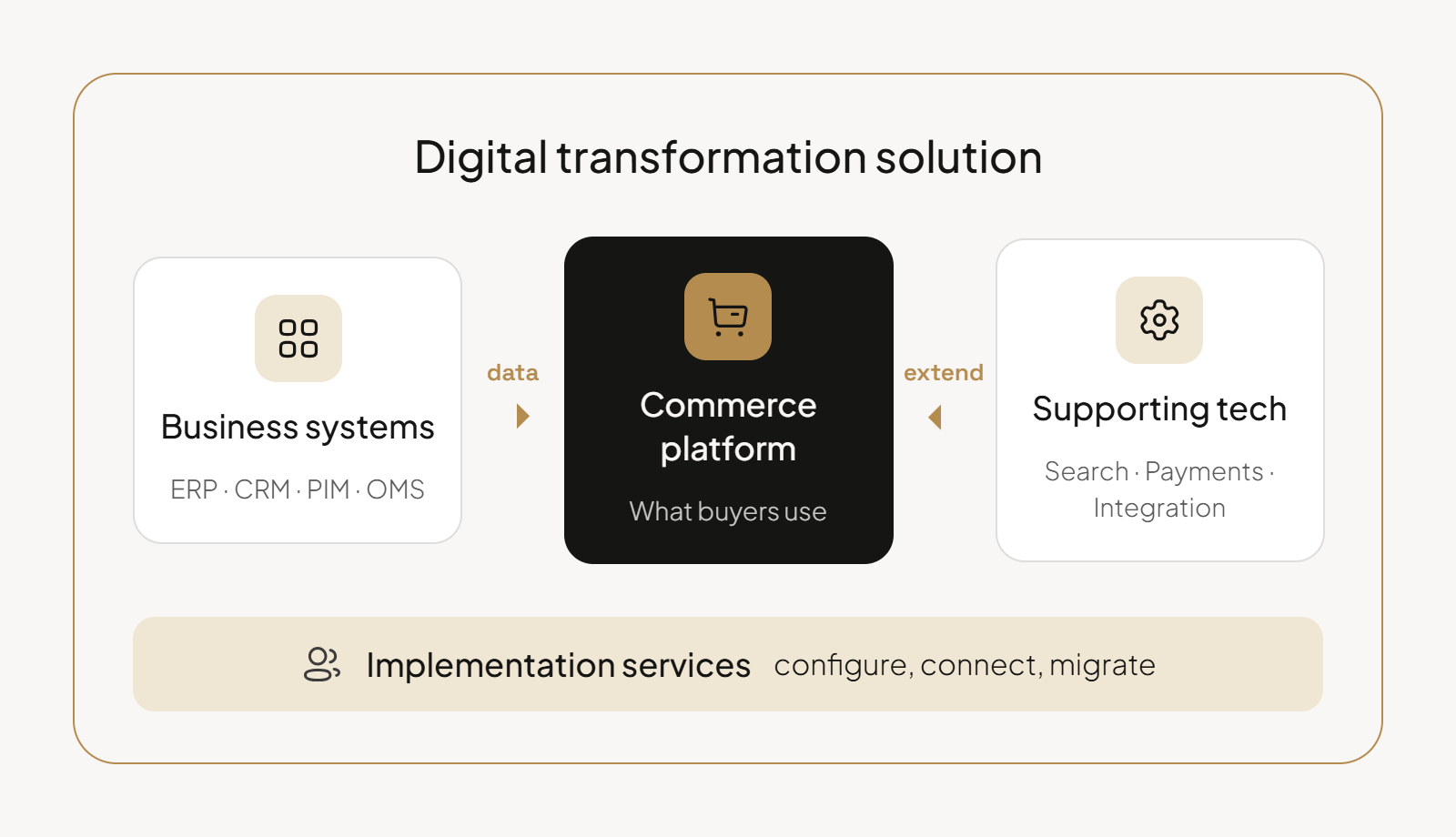
In eCommerce, the core digital transformation solution is the commerce platform. It becomes the customer-facing layer where buyers access products, account-specific pricing, quotes, orders, invoices, and other self-service processes.
That platform rarely operates alone. A broader eCommerce transformation can also include:
- Connected business systems: ERP, CRM, PIM, OMS, and other systems provide the customer, product, pricing, inventory, and order data the commerce platform uses.
- Supporting technologies: Search, payments, data analytics, integration software, and automation tools extend what the commerce platform can do or help information move between systems.
- Implementation services: Internal teams and implementation partners configure the platform, connect existing systems, migrate data, and adapt workflows to the business.
Why Most Digital Transformation Projects Fail
Most digital initiatives fail because of how companies run them, not the software they buy.
For example, a 2025 report from Boston Consulting Group (BCG), the management consulting firm, shows the pattern: 60% of companies get hardly any material value from AI, and the main roadblocks are organizational.
Struggling companies hand strategy to middle managers and spread budgets across disconnected projects. That’s why BCG recommends putting 70% of the effort into people and processes, and only 30% into technology and algorithms.
A digital transformation strategy without an owner, an integration budget, and an adoption plan rarely survives live ERP data. Acquisitions often make it worse. Acquired companies can bring their own ERPs and storefronts, and the sprawl blocks a consistent B2B customer experience after a merger or acquisition.
The most common reasons projects stall
- The scope is bigger than expected: More processes get pulled into the project than planned.
- Requirements surface too late: Key B2B needs appear after development has started.
- Siloed systems: ERP, CRM, and storefront data live apart, so prices and stock never match.
- Unclear ownership: IT, sales, and eCommerce each own part of the digital strategy, but nobody owns the outcome.
- Underestimated integration effort: connecting existing systems takes longer than building the storefront.
- Weak adoption: reps and buyers stick with email because new digital platforms add friction.
How the right platform reduces the risk
Each failure maps to a selection criterion below. Native B2B features replace add-ons, and proven ERP connectors cut integration effort. Open architecture limits lock-in, while fast time to value builds adoption.
Even modern technologies stall without these safeguards. No platform fixes weak ownership on its own, though.
A successful digital transformation starts with a platform that removes problems instead of adding them.
How We Evaluated the Best Solutions
We ignored vendor claims about innovative solutions and evaluated each platform on six criteria. Platforms needing tailored solutions for basic B2B tasks, like contract pricing, scored lower. Your weighting may differ.
Our evaluation criteria
- Out-of-the-box B2B functionality: native quotes, contract pricing, buyer roles, and approval workflows.
- Integration and ERP fit: connectors and APIs for SAP, Microsoft Dynamics 365, Oracle, and NetSuite.
- Flexibility and architecture: support for headless builds and cloud technologies without forking the core code.
- Total cost of ownership: license, hosting, add-on, and partner fees over five years.
- Scalability across regions and brands: multi-currency, multi-language, and multi-site support for global businesses engaged in global trade.
Quick Comparison of the Top eCommerce Digital Transformation Solutions
Want the short version? Here’s how the five platforms differ in architecture, pricing, and native B2B depth.
| Solution | G2 Rating | Best for | Architecture | Pricing model | B2B approach |
| OroCommerce | 4.3/5 | Manufacturers, distributors, wholesalers with complex B2B operations | Modular, headless; SaaS or on-premises | Custom quote; all-in-one | B2B-first platform with workflows and account structures built in |
| Adobe Commerce (Magento) | 4.0/5 | Enterprises that need highly customizable B2B and B2C commerce | PHP; cloud, self-hosted, or SaaS | Custom quote tied to GMV | General commerce with B2B capabilities and extensions |
| Salesforce Commerce Cloud | 4.3/5 | Enterprises that want commerce closely connected with CRM, sales, and service workflows | Multi-tenant SaaS | Custom quote | B2B commerce built as part of a broader sales, service, and data suite |
| Kibo Commerce | 4.1/5 | Order-heavy distributors and retailers | Composable microservices | Custom quote by module | Modular commerce platform with strong order management and fulfillment |
| commercetools | 4.6/5 | Enterprises that want a composable, API-first commerce architecture | API-first MACH | Custom quote; 60-day trial | composable commerce services that companies assemble into their own stack |
Table 1: Platform snapshot from vendor websites, October 2026
Need more options for complex catalogs? See this roundup of platforms for industrial B2B eCommerce.
Top Ecommerce Digital Transformation Solutions Compared
The five platforms take noticeably different approaches to B2B commerce, from packaged B2B applications to composable services. Here’s where each fits, what comes built in, and where additional products or development may be required.
OroCommerce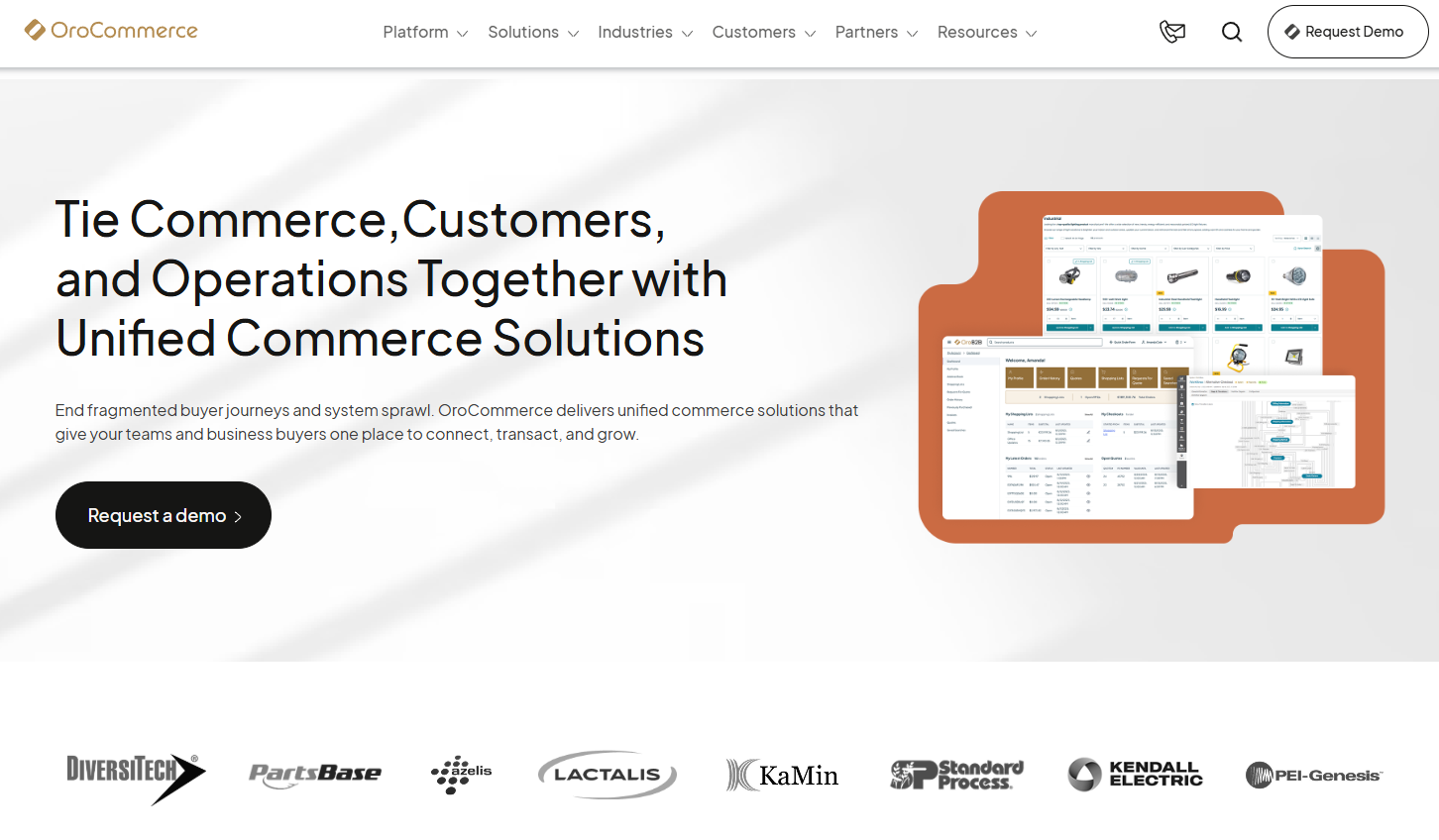
OroCommerce is a B2B-first commerce platform built for manufacturers, distributors, and wholesalers with complex selling processes. It combines commerce, CRM, quoting, workflow automation, and multi-organization management in one application, with APIs for connecting ERP and other business systems.
Best for
B2B sellers with complex pricing, large catalogs, several ERPs, or multiple brands and regions.
Key features
- Built-in CRM: Sales teams track accounts, opportunities, and contracts in the same system buyers order from.
- CPQ and RFQ: Buyers request quotes and configure bundles or kits, and reps negotiate them in one workflow.
- B2B workflows are built into the platform: RFQ and quoting, order approvals, price lists, and configurable workflows don’t depend on separate B2B extensions.
- Multi-org and multi-site management: One instance runs multiple websites, business units, price lists, and warehouses.
- SmartOrder and SmartAgent: AI converts emailed PDF purchase orders into draft orders and answers buyer questions without a rep.
- OroIQ: AI lets teams query commerce data, create quotes and segments, retrieve customer information, and carry out day-to-day commerce tasks through natural language.
Pricing
Oro quotes by deployment type, GMV, and admin users, with the first 25 admin users included. You pay no fees for API calls, sales channels, or transactions. Learn more on the pricing page.
Adobe Commerce (Magento)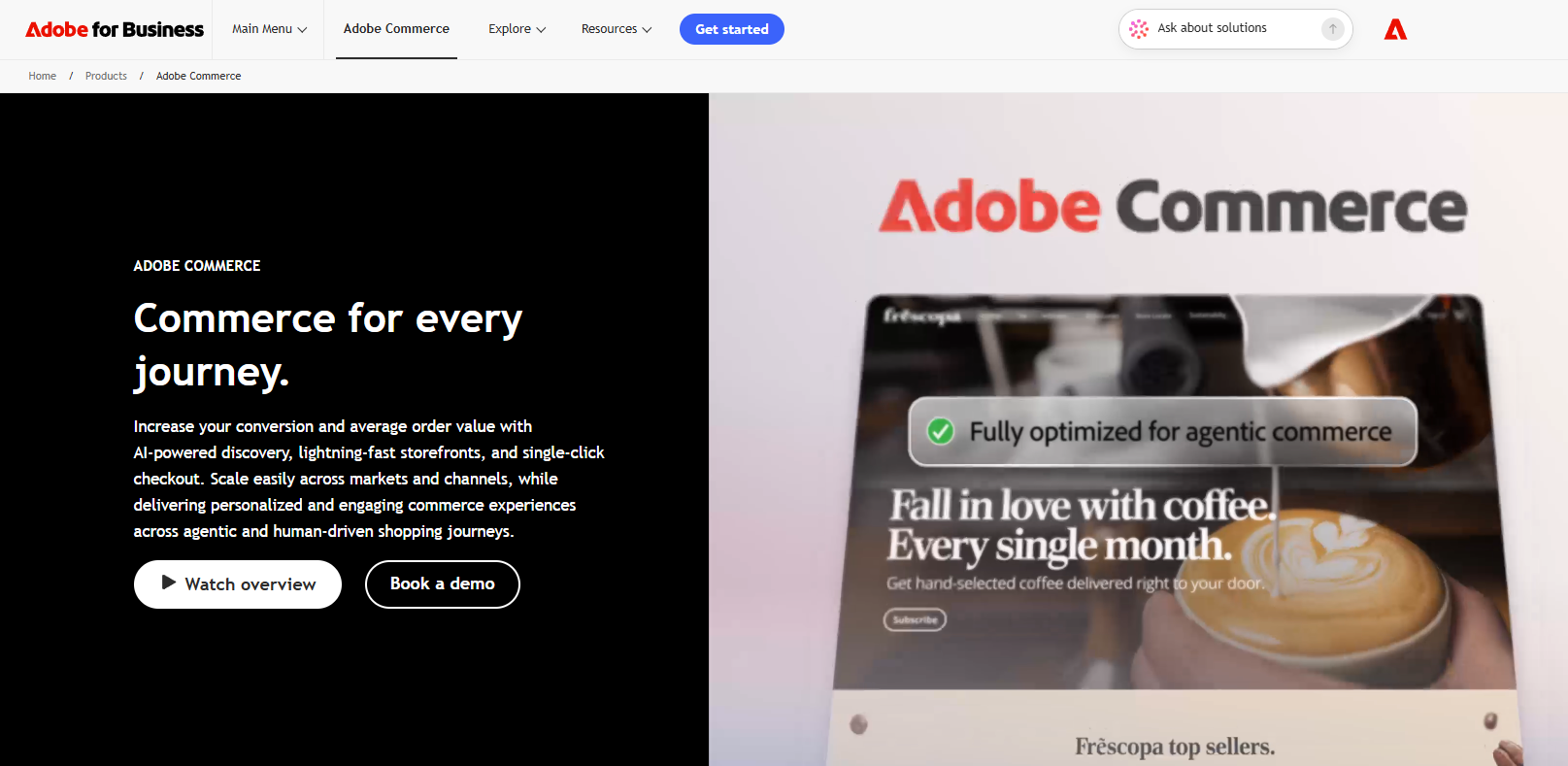
Adobe Commerce grew out of Magento, the open-source PHP platform, and now sits inside Adobe Experience Cloud. You can run it as a managed cloud service, self-hosted, or SaaS. A large agency network builds customized solutions on it, but upgrades take ongoing developer time.
Learn more:
- Adobe Commerce Competitors
- OroCommerce vs Adobe Commerce
- Adobe Commerce vs Shopify
- commercetools vs Adobe Commerce
- Adobe Magento vs Salesforce Commerce Cloud
Best for
Brands with in-house or agency PHP developers that sell B2C and B2B from one codebase.
Key features
- B2B module: Company accounts, buyer roles, shared catalogs, and purchase approvals ship as a native module.
- Negotiable quotes: Buyers and sellers negotiate prices and terms on a quote before checkout.
- Live Search and Product Recommendations: Adobe Sensei AI ranks results and suggests products from shopper behavior.
- Adobe Experience Cloud integration: Adobe Experience Manager, Adobe Analytics for digital analytics, and Real-Time CDP support a personalized customer experience.
- Commerce Marketplace: Thousands of extensions add payments, shipping, tax, and ERP connectors.
Pricing
Adobe sells a custom annual license based on GMV and average order value, with no published starting price. Magento Open Source is free, but you host and develop it yourself.
Salesforce Commerce Cloud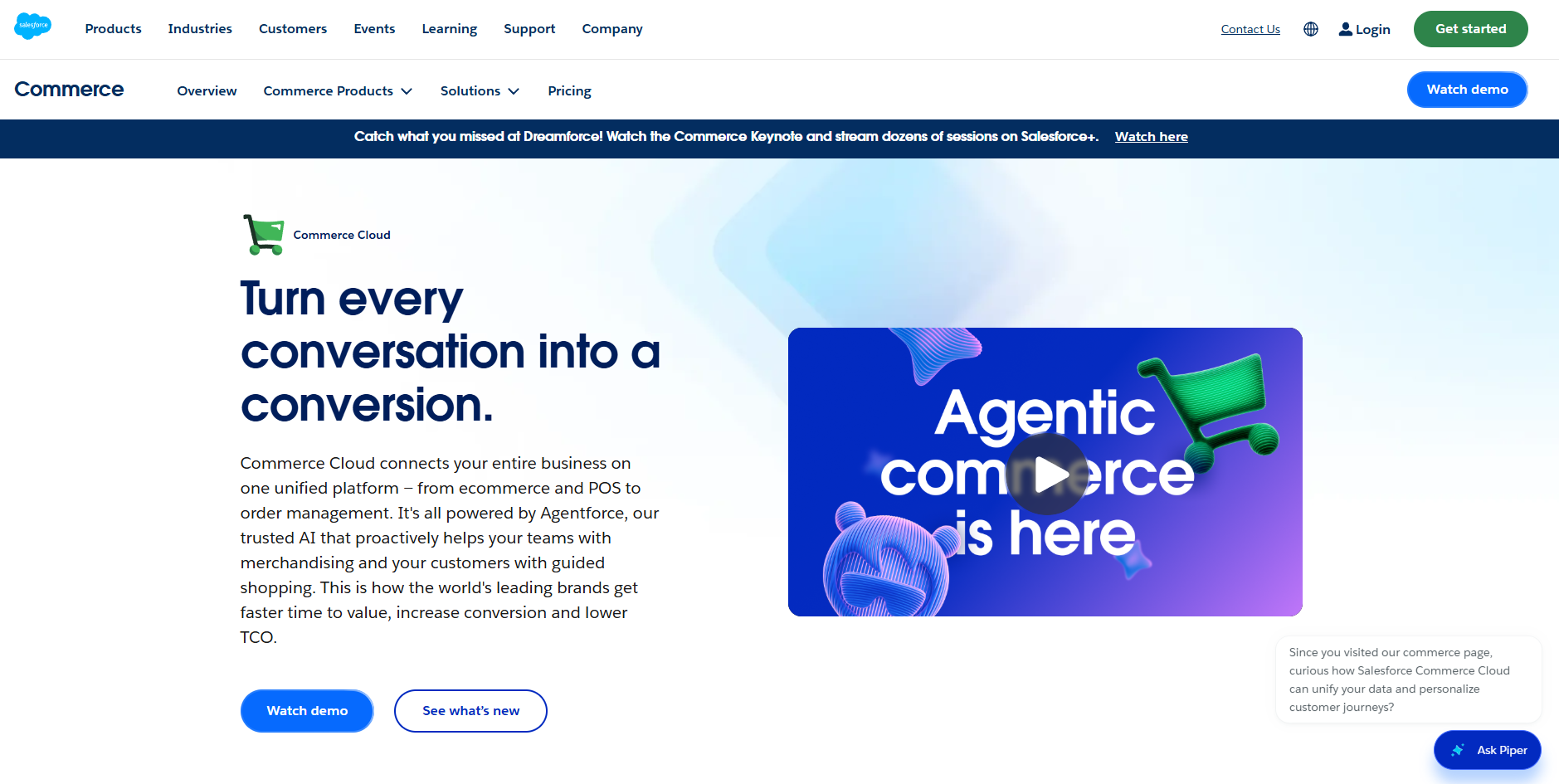
Salesforce offers commerce as part of a much larger sales, service, data, digital marketing, and order-management product ecosystem.
That can be a benefit for companies that want those functions closely connected, but it also means some capabilities sit in adjacent Salesforce products rather than in B2B Commerce itself.
Learn more:
- Salesforce Commerce Cloud Alternatives
- OroCommerce vs. Salesforce Commerce Cloud
- BigCommerce vs Salesforce Commerce Cloud
- Salesforce Commerce Cloud vs Shopify
Best for
Enterprises standardized on Salesforce cloud solutions that want commerce and sales on shared account data.
Key features
- Agentforce and Einstein AI: AI agents and predictive models apply advanced analytics to recommend products and automate merchant tasks.
- Native CRM data model: Buyer accounts, contacts, and contract pricing come straight from Sales Cloud.
- Experience Builder: Merchandisers edit pages and components with a low-code, drag-and-drop editor.
- Salesforce Order Management: A companion product orchestrates fulfillment, returns, and service across channels.
- AppExchange marketplace: Prebuilt integrations cover ERP, payments, tax, and search.
Pricing
Salesforce lists every Commerce Cloud edition, including B2B Commerce Growth Edition, as “contact for pricing.”
Kibo Commerce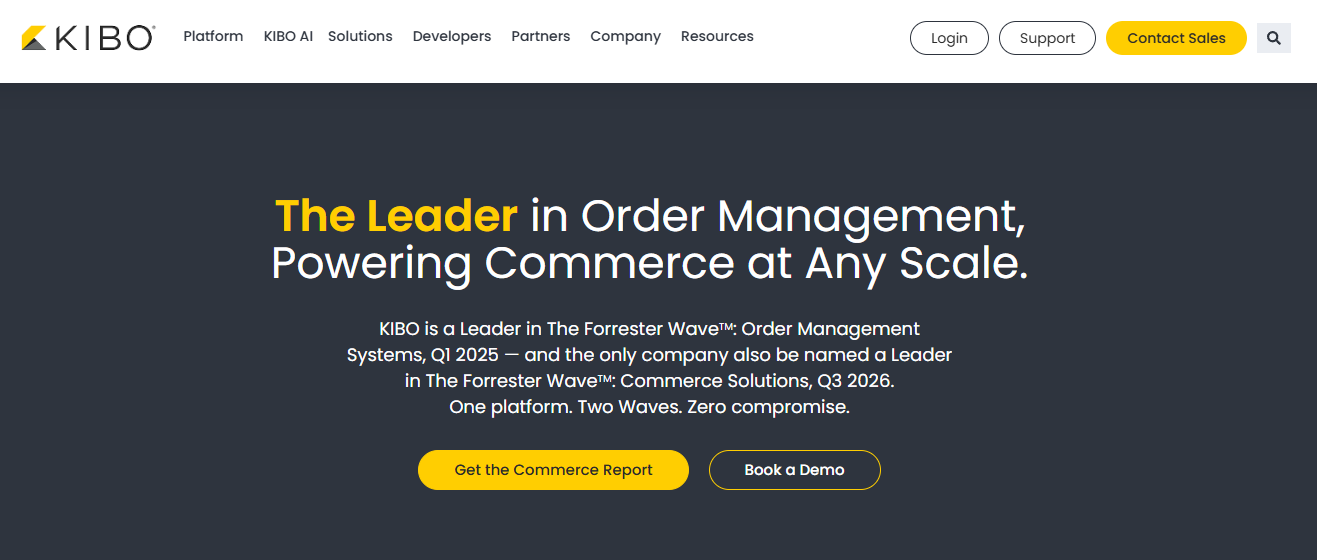
Kibo Commerce is a composable platform centered on order management. The company focuses on routing and fulfilling orders across stores and warehouses, then layers storefronts on top. You can deploy individual services, which suits phased rollouts alongside existing infrastructure.
Best for
Distributors and omnichannel retailers struggling with fulfillment across many locations. Comparing a B2B ecommerce platform for suppliers? Weigh this order depth against lighter CRM tooling.
Key features
- Distributed order management: Rules route each order to the cheapest or fastest fulfillment node.
- Real-time inventory and promising: Buyers see estimated delivery dates before they purchase.
- B2B account buying: Accounts get contract pricing, quotes, purchase orders, and net terms.
- Packaged microservices: Cart, catalog, pricing, and inventory services deploy individually through APIs.
- KIBO AI: Agentic AI explains exceptions and shows data-driven insights across the order network.
Pricing
Kibo quotes based on the modules and volume you license and publishes no starting price.
commercetools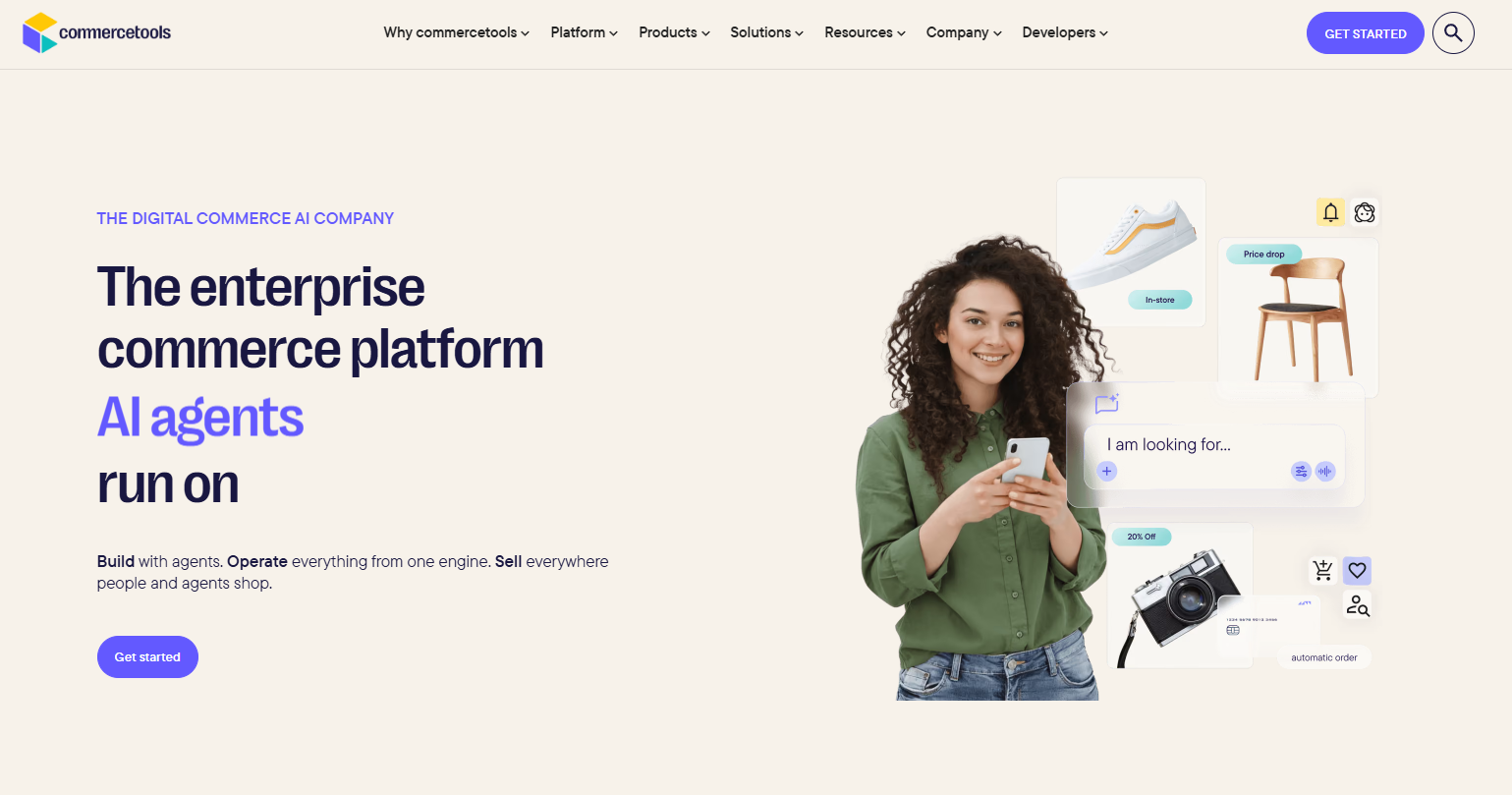
commercetools pioneered the MACH approach (microservices, API-first, cloud-native, headless). It sells commerce as composable APIs rather than a packaged application.
You assemble your own front end, search, and CMS, trading build work for control. The model rewards strong digital engineering teams and penalizes thin ones.
Learn more:
Best for
Enterprises with large engineering teams that want a fully composable stack and plan to run multi-site B2B ecommerce solutions across brands and regions.
Key features
- Composable Commerce APIs: Separate APIs for catalog, cart, orders, pricing, and promotions scale independently.
- Business units and associate roles: B2B accounts mirror company hierarchies with role-based permissions.
- Quotes and approval rules: Buyers request quotes, and approval flows route orders by amount or role.
- Stores and product selections: One project serves multiple brands and regions with distinct assortments and prices.
- commercetools Connect: Prebuilt connectors deploy integrations inside the commercetools environment.
Pricing
commercetools sells custom annual subscriptions and publishes no starting price. A 60-day free trial with full API access lets you test it first.
Which Option Should Different Businesses Choose?
Platform fit depends less on company size than on your business strategy, operating model, and available technical expertise. The best digital transformation provider is the one that matches where your commerce complexity sits and how much you want the platform itself to handle.
Match the platform to your scenario
Match your main constraint to the right platform for the fastest business value.
| Scenario | Best fit | Why |
| Complex B2B with ERP and contract pricing | OroCommerce | Native CPQ, CRM, and PIM reduce integrations |
| Heavy custom development | Adobe Commerce | Open PHP codebase and extension marketplace |
| Salesforce-centric enterprise | Salesforce Commerce Cloud | Shares account data with Sales Cloud |
| Fast launch with a small team | OroCommerce | B2B workflows ship out of the box |
| Fully composable build | commercetools | API-first services for in-house engineers |
Table 2: Platform fit by business scenario.
Don’t choose based on who promises the most cutting edge solutions. Compare what must be configured, integrated, or custom-built to deliver the business value you expect.
Running Microsoft Dynamics, SAP, or Epicor? Review these ERP-integrated alternatives before you commit.
Questions to ask before you shortlist
Ask every vendor and digital transformation provider:
- Integration effort: Which ERP and CRM connectors are prebuilt, and which need custom code?
- Total cost: What will licenses, hosting, add-ons, and partners cost over five years?
- Upgrade path: How do upgrades work, and do customizations survive them?
- Vendor support: Who supports the platform after launch, and which SLAs apply?
- AI-assisted delivery: How do you use AI to speed up implementation, development, testing, and upgrades?
For complex B2B, the case for OroCommerce follows.
Why OroCommerce Is the Best Choice for B2B Digital Transformation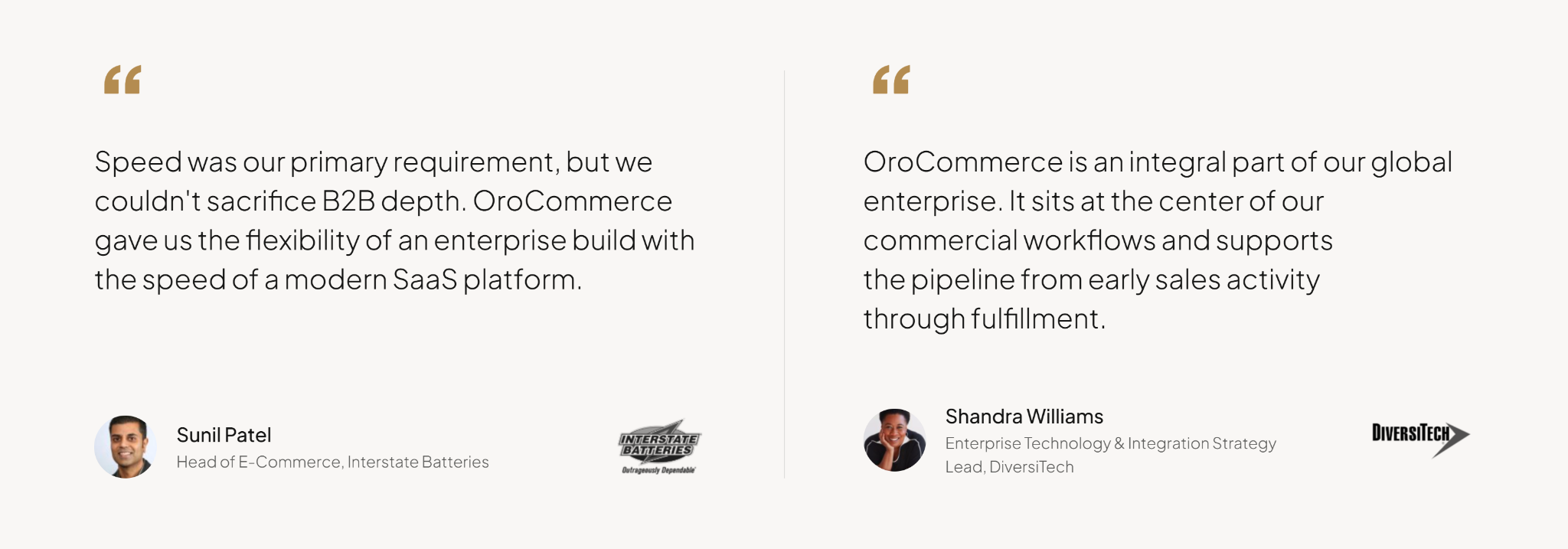
OroCommerce, the B2B-first eCommerce platform for manufacturers, distributors, and wholesalers, ships eCommerce, CRM, CPQ, RFQ, PIM, CMS, and payments in one platform. Most competing platforms need several add-ons to match that B2B scope. Each add-on means another integration.
Oro designed the platform for multi-entity businesses. New channels, markets, or business units need no duplicated catalogs, codebases, or price lists, and no extra fees. That protects operational efficiency as you grow.
In 2026, OroCommerce ranked #2 in Gartner Critical Capabilities for the B2B Digital Commerce Use Case. The recognition comes alongside six consecutive years in the Gartner Magic Quadrant™ for Digital Commerce.
One platform instead of a patchwork of tools
- Unified commerce: Storefront, CRM, quoting, PIM, CMS, and OroPay payments share one data model.
- ERP integration: Open APIs sync orders, pricing, and inventory with ERPs such as Microsoft Dynamics 365, SAP, and NetSuite.
- Modular and headless architecture: Teams use the built-in storefront or connect any front end through APIs.
- AI SmartOrder and SmartAgent: AI turns emailed purchase orders into draft orders and gives buyers instant answers.
- SOC 2 security: OroCommerce meets SOC 2 Type I and Type II and PCI DSS standards.
Proof from real B2B rollouts
Each rollout used process automation to streamline operations as part of a customer experience transformation.
- DiversiTech: the HVAC components manufacturer unified 12 ERPs under one order flow and gained 20% productivity from AI order intake.
- Azelis: the specialty chemicals distributor runs more than 150 localized portals across languages and currencies from a single instance.
- Lactalis: the dairy group increased digital orders by 230% and cut manual processes by 44%.
Bring your requirements, systems, and sales processes. We’ll show you how OroCommerce would fit.
Implementation Checklist for Digital Transformation Services Companies
Your partner affects the timeline and cost as much as the platform does. Before you sign with any of the digital transformation services companies on your list, confirm they’ve shipped B2B projects with similar ERP complexity.
Whether you hire a global integrator or a specialist digital transformation company, a strong technology implementation needs certified skills. Finding the right digital transformation partner gets easier through the Oro solution partners program.
Step-by-step implementation checklist
A reliable rollout follows seven steps.
- Define business objectives and KPIs such as digital order share, quote turnaround, customer engagement, and customer satisfaction.
- Audit current systems, data quality, and IT infrastructure.
- Map ERP, CRM, and PIM integrations and assign an owner to each.
- Plan data migration and cloud migration in phases, starting with product and pricing data.
- Phase the rollout by region, brand, or customer segment.
- Train sales and buyer-facing teams before launch.
- Set up post-launch support, performance optimization, and an analytics framework.
Then build business intelligence dashboards on it for data-driven decision-making.
Questions to ask a services company before signing
- Platform certification: Is your team certified on our chosen platform?
- B2B project experience: Which similar B2B projects have you delivered?
- Timeline and cost transparency: How do you estimate cost, and what triggers change orders?
- Post-launch support: What SLAs apply after go-live?
Ecommerce Digital Transformation Trends to Plan For
Four emerging technologies will shape B2B commerce budgets through 2027. Start with the one closest to your biggest bottleneck.
- AI-assisted ordering and search: Smarter search and reorder suggestions drive customer engagement.
- AI-assisted development: Coding assistants accelerate innovation on open codebases such as OroCommerce and Adobe Commerce.
- Embedded payments: OroPay and Salesforce Payments bring invoicing into checkout, speeding cash collection from online sales.
- Self-service portals: Round-the-clock access to pricing, orders, and invoices helps improve customer engagement.
AI in B2B commerce
Artificial intelligence now handles order intake, search, and buyer support in live B2B deployments. Thanks to OroCommerce, DiversiTech’s order intake is now AI-powered and converts purchase orders with 700+ lines in seconds.
AI assistants enhance customer experiences by answering order questions instantly, which helps increase customer satisfaction. Digital innovation moves fast, so keep this guide to AI-powered ecommerce and these practical AI use cases in B2B commerce close.
Conclusion About Top Ecommerce Digital Transformation Solutions
The right platform depends on where your commerce complexity sits and how much you want the platform itself to handle.
For complex B2B, compare how each option supports pricing, account structures, workflows, integrations, and long-term ownership costs. OroCommerce is strongest where those requirements need to live together in one B2B-first platform.
See how OroCommerce could work across your customers, systems, and markets.
FAQs About Top Ecommerce Digital Transformation Solutions
What are the top 10 digital transformation companies?
Lists of leading digital transformation companies usually include Accenture, Deloitte Digital, IBM Consulting, Capgemini, Cognizant, Infosys, Tata Consultancy Services, Wipro, EPAM Systems, and McKinsey Digital. These firms deliver tailored solutions that combine consulting services, cloud services, and systems integration for industries worldwide.
Why do 84% of companies fail at digital transformation?
Companies fail when they buy advanced technologies before fixing ownership, data, and processes. According to Boston Consulting Group’s 2025 research, 60% of companies get hardly any material value from AI investments.
Common causes are siloed systems, platform lock-in, underestimated integration work, and weak adoption. The 84% figure circulates widely but lacks a clear primary source.
What are the best ecommerce solutions?
The best ecommerce solution depends on your business model. OroCommerce, the unified B2B ecommerce platform for manufacturers, distributors, and wholesalers, suits complex B2B selling. Adobe Commerce works for teams that customize heavily.
Salesforce Commerce Cloud fits Salesforce-centric enterprises. Kibo Commerce specializes in order management, and commercetools serves API-first, composable builds.
Who are the top digital transformation service providers in the USA?
Major providers of digital transformation services to US enterprises include Accenture, Deloitte Digital, IBM Consulting, Cognizant, and EPAM Systems. IBM’s deep expertise in hybrid cloud and AI suits regulated industries.
Accenture, a global leader in professional services, runs a global delivery model. Deloitte pairs strategic consulting with implementation.